


Solar Panels with Micro Inverters Built In: The Smart, Simplified Future of Home Energy
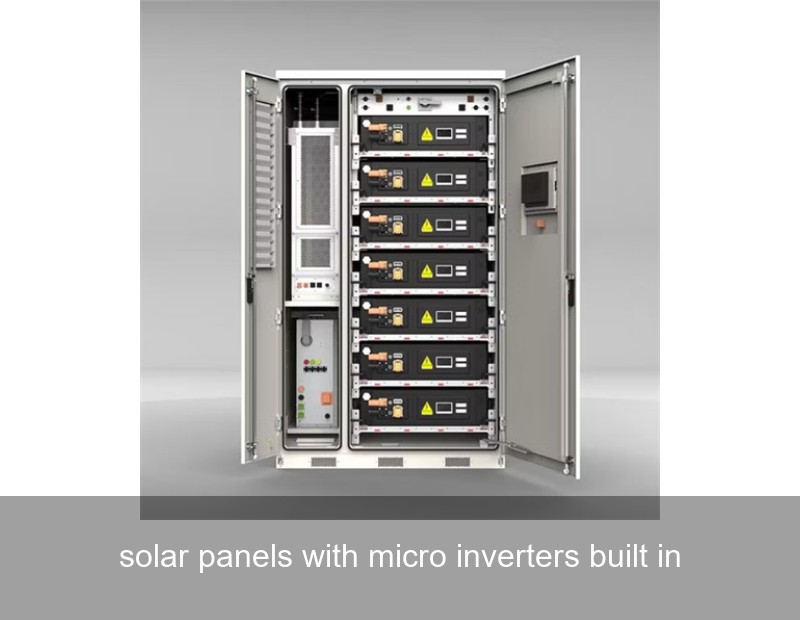
Imagine your rooftop solar array not just generating power, but making intelligent, panel-by-panel decisions to maximize every ray of sunlight. This isn't a distant future concept—it's the reality offered by integrated solar panels with micro inverters built in. For homeowners in Europe and the US, this technology is revolutionizing how we think about solar energy, shifting from a simple, centralized system to a resilient, optimized, and remarkably intelligent power plant on your roof. As a product technology expert at Highjoule, a global leader in advanced energy storage since 2005, I've seen how this innovation pairs perfectly with modern battery storage to create truly autonomous home energy systems. Let's delve into why this integrated approach is becoming the gold standard.
Table of Contents
- What Are Solar Panels with Built-In Micro Inverters?
- The Centralized Problem: A Single Point of Failure
- The Data Advantage: Quantifying the Performance Gap
- A Real-World Case: The Munich Suburb Retrofit
- The Critical Synergy with Home Battery Storage
- Highjoule's Role: Integrating Intelligence from Roof to Outlet
- Is an Integrated System Right for Your Home?
Image Source: Unsplash - Professional photography of residential solar panels.
What Are Solar Panels with Built-In Micro Inverters?
Traditionally, solar installations use a string inverter—a single box that converts the direct current (DC) from a whole series of panels into usable alternating current (AC). Solar panels with micro inverters built in flip this design. Each panel has its own dedicated, small inverter attached directly to the back or integrated into the frame. This means DC-to-AC conversion happens right at the source, turning every solar panel into an independent, smart power producer.
Think of it like a team: a string inverter is like a single speaker for the entire choir; if one voice falters, the whole output is affected. Microinverters give each singer their own microphone, ensuring every individual performance is optimized and heard clearly, regardless of what's happening next door.
The Centralized Problem: A Single Point of Failure
The phenomenon is familiar to many solar owners: your system's output dips on a seemingly perfect day. The cause? Often, it's partial shading from a growing tree, seasonal chimney shadows, bird droppings, or even a single faulty panel. In a traditional string system, the entire string's performance is dragged down to the level of its weakest panel. This "catering to the lowest common denominator" effect can lead to significant, unexpected energy losses. Furthermore, diagnosing a problem often requires professional troubleshooting, as the system only provides data for the whole string.
The Data Advantage: Quantifying the Performance Gap
The theoretical benefits are compelling, but the data solidifies the case. According to field studies by the National Renewable Energy Laboratory (NREL), systems using module-level power electronics (like microinverters) can outperform traditional string inverter systems by 5% to 25% annually, depending on shading and roof complexity. This isn't marginal; for a typical 6kW home system, that can translate to hundreds of kilowatt-hours of additional, free electricity each year.
Consider this comparison table:
| Feature | Traditional String Inverter System | Integrated Microinverter System |
|---|---|---|
| Shading Impact | High - affects entire string | Low - only affects the shaded panel |
| Panel-Level Monitoring | No | Yes |
| System Uptime | Lower (single point of failure) | Higher (distributed architecture) |
| Expansion Flexibility | Difficult, must match existing string | Easy, panels operate independently |
| Long-Term ROI | Can be degraded by shading/mismatch | Maximized through individual optimization |
A Real-World Case: The Munich Suburb Retrofit
Let's look at a concrete example from our operations in Germany. A client in a leafy Munich suburb had a 7-year-old 8kW string inverter system. Their energy production had gradually declined by nearly 18%. They suspected the aging central inverter but were also dealing with increased shading from now-mature trees on their property's south side.
Instead of a simple inverter swap, Highjoule proposed a retrofit with new, high-efficiency solar panels with micro inverters built in. The results, monitored over one year, were striking:
- Year-over-Year Energy Harvest Increase: 22% (accounting for the new panels' higher base efficiency).
- Performance Visibility: The homeowner can now see the output of each of their 24 panels via a smartphone app, instantly identifying a 3% dip on one panel caused by a persistent nest—easily resolved.
- System Reliability: The distributed nature eliminated the risk of a total system shutdown from a single component failure.
This case highlights how integrated technology solves both the visible problem (aging hardware) and the invisible one (complex, dynamic shading).

Image Source: Unsplash - Visualization of detailed energy performance analytics.
The Critical Synergy with Home Battery Storage
This is where the story gets even more powerful. Solar panels with micro inverters built in are the ideal generating partner for a modern home battery system like those from Highjoule. Here’s why:
- Granular DC/AC Management: Since the power from each panel is already optimized and converted to AC, it can be seamlessly and efficiently channeled to charge your battery or power your home, with minimal conversion losses.
- Enhanced Resilience: In the event of a grid outage, many microinverter systems can more safely and intelligently form a "microgrid" with a compatible battery. This allows critical circuits to remain powered by your solar panels even when the main grid is down—a feature traditional string inverters often cannot support safely.
- Predictable Charging: The consistent, panel-level optimized output provides a more predictable energy stream for your battery's charging algorithms, promoting battery health and longevity.
Highjoule's Role: Integrating Intelligence from Roof to Outlet
At Highjoule, our expertise isn't just in storage; it's in creating holistic, intelligent energy ecosystems. While we specialize in advanced, modular battery storage solutions for homes and businesses, we understand that the generation source is paramount. We frequently design and commission systems that incorporate the latest in integrated solar panel technology.
Our HES (Home Energy System) platform acts as the brain. It doesn't just manage battery charge and discharge; it communicates with your solar array (whether with built-in microinverters or optimized string solutions), your home's energy consumption patterns, and the grid. Using real-time data and weather forecasts from sources like the European Centre for Medium-Range Weather Forecasts (ECMWF), it makes millisecond decisions: store energy, power the house, sell back to the grid, or prepare for an incoming storm. This level of integration ensures that every watt produced by your high-tech solar panels is used in the most economical and sustainable way possible.
Is an Integrated System Right for Your Home?
The move towards solar panels with micro inverters built in represents a clear trend in democratizing energy resilience and efficiency. They are particularly advantageous for homes with:
- Complex roof layouts with multiple angles or orientations.
- Potential for partial shading (trees, vents, dormers).
- Plans for future roof expansion.
- A strong desire for detailed, panel-level system performance data.
- Plans to pair solar with a home battery for backup power.
While the initial investment per panel can be higher, the long-term energy harvest gains, increased reliability, and seamless integration with storage often deliver a superior lifetime value. It's a move from seeing solar as a static installation to treating it as a dynamic, interactive asset.

Image Source: Unsplash - Technician installing clean energy storage technology.
As energy prices remain volatile and climate consciousness grows, the question is no longer just "should I get solar?" The more nuanced question is becoming: "How do I architect my energy system for maximum intelligence, independence, and return?" With technologies like integrated microinverters and intelligent storage from providers like Highjoule, that architecture is now within reach for homeowners on both sides of the Atlantic. What's the first step you'll take to understand your home's true energy potential?
 Inquiry
 Online Chat