


Solar Recharger: How Much Does It Really Cost to Power Your Life with the Sun?
You've seen the sleek panels on rooftops and the portable chargers in camping stores. The idea of harnessing free energy from the sun is undeniably appealing. But when you start searching for a "solar recharger," one question quickly rises to the top: how much? The answer isn't a single number. It's a spectrum, ranging from a $50 gadget for your phone to a $50,000 investment that can transform your home's energy independence. As a product technology expert at Highjoule, a global leader in advanced energy storage systems since 2005, I'm here to demystify the true cost of solar recharging. We'll move beyond the price tag to understand the value, the long-term savings, and the smart technology that makes it all work.
Table of Contents
The Solar Recharger Spectrum: From Pocket-Sized to Whole-House
Let's clarify the term "solar recharger." It can mean three fundamentally different things, each with a vastly different scope and cost.
1. Portable Solar Chargers
These are small, foldable panels designed to charge USB devices like phones, power banks, and tablets. Perfect for hiking, emergencies, or remote work.
- Cost Range: $30 - $300.
- What you get: 10W to 100W of solar power, a built-in battery pack, and various ports.
- The "How Much": This is a straightforward purchase. You pay once, and it works. The "recharging" cost is zero, aside from the initial investment.

Image Source: Unsplash (Representative image of portable solar tech)
2. Off-Grid Solar Kits
These are larger systems for cabins, RVs, or boats. They power lights, small refrigerators, and tools, but aren't designed for a full home's constant load.
- Cost Range: $500 - $5,000+.
- What you get: 100W to 2000W of solar panels, a charge controller, an inverter, and a battery bank (often lead-acid).
- The "How Much": Cost depends on your power needs. A 500W system for a cabin might cost $1,500. This is where "how much" starts involving system sizing.
3. Residential & Commercial Solar + Storage Systems
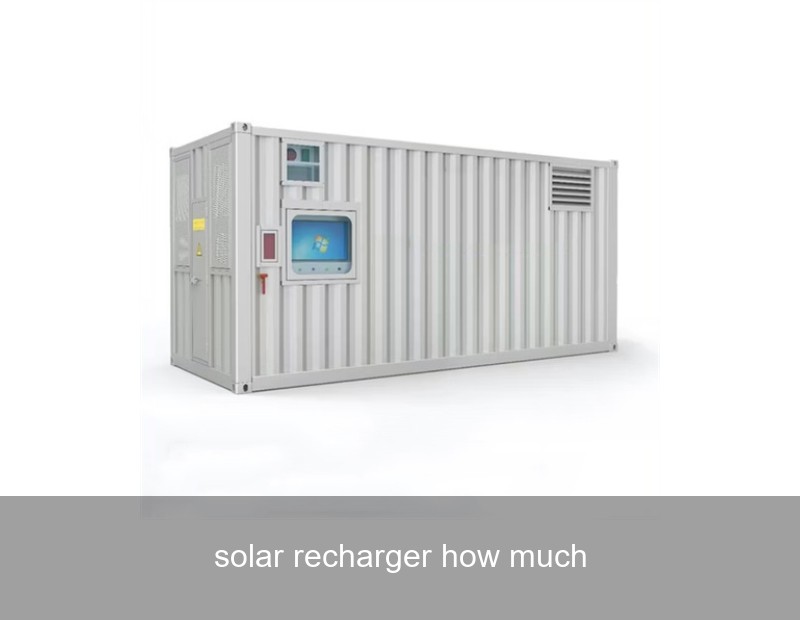
This is the full-scale solution. It integrates rooftop solar panels with a sophisticated battery energy storage system (BESS) and grid connection. It doesn't just recharge devices; it recharges your entire home or business, stores excess energy, and provides backup power.
- Cost Range: $15,000 - $50,000+ (before incentives).
- The "How Much": This is the complex, high-value question most homeowners and businesses are asking. The price is influenced by panel count, battery capacity, inverter technology, and installation complexity. This is Highjoule's core expertise.
The Real Cost Breakdown: More Than Just Panels
For a whole-home system, the "solar recharger" concept evolves into a "solar power ecosystem." The cost has several key components:
| Component | Purpose | Cost Factor & Notes |
|---|---|---|
| Solar Panels (PV Modules) | Convert sunlight into DC electricity. | Typically 20-30% of system cost. Efficiency ratings impact how many you need. |
| Inverter(s) | Convert DC electricity from panels/battery to usable AC for your home. | 10-15% of cost. Modern hybrid inverters can manage solar, battery, and grid seamlessly. |
| Battery Storage System (BESS) | Stores excess solar energy for use at night or during outages. | 25-40% of cost. This is the critical "recharger" component. Lithium-ion (like LiFePO4) is the standard for safety and longevity. Highjoule's systems use intelligent management to optimize battery life and performance. |
| Balance of System (BOS) | Mounting, wiring, electrical panels, monitoring systems. | 15-25% of cost. Quality here ensures safety and reliability. |
| Installation & Permits | Professional design, labor, and grid connection fees. | 15-25% of cost. Varies greatly by region and roof type. |
So, when you ask "solar recharger how much?" for your home, you're really asking about the cost of this entire integrated system. The game-changer, however, isn't just the hardware—it's the intelligence behind it. A smart system like those from Highjoule doesn't just store energy; it learns your usage patterns, decides when to draw from the grid, when to store, and when to send energy back, maximizing your financial return.
A Real-World Case Study: The German Household
Let's look at real data from a key market. Germany has high electricity prices (around €0.40/kWh for households in 2023) and strong solar adoption. Consider a family home in Bavaria with a 10 kW solar array and a battery storage system.
- System Cost (2023): Approximately €25,000 (before subsidies).
- German Subsidy (BAFA): Up to €3,300 for the battery storage portion, reducing net cost.
- Annual Solar Production: ~9,500 kWh.
- Self-Consumption Rate (without battery): ~30%. 70% of solar power is exported to the grid for a lower feed-in tariff.
- Self-Consumption Rate (with Highjoule-type battery): ~80%. The battery stores daytime excess for evening use.
- Annual Savings + Grid Revenue: With intelligent storage, this household can reduce its grid electricity purchases by over 75% and optimize feed-in. The annual financial benefit can exceed €2,500.
- Payback Period: With incentives, the system can pay for itself in 8-10 years. Given a system life of 20+ years for panels and 10-15 years for a quality battery, this represents significant long-term savings and price stability.
This case shows that "how much" transforms from an upfront cost to a long-term investment with a measurable return. You can explore more on Germany's energy trends via the Fraunhofer ISE Energy Charts, a leading authority.
The Highjoule Advantage: Intelligent Storage is Key
At Highjoule, we've focused on the heart of the modern solar recharging ecosystem since 2005: the advanced battery storage system. For residential, commercial, and microgrid applications, our answer to "how much value can I get?" is defined by our technology.
Our integrated systems, like the Highjoule H-Series Home Battery, are built with lithium iron phosphate (LiFePO4) chemistry, renowned for its safety and exceptional cycle life. But the hardware is just the start. Our proprietary energy management software is the brain. It continuously analyzes:
- Your real-time energy consumption
- Solar production forecasts
- Dynamic electricity tariffs (increasingly common in Europe and the US)
- Grid status
This intelligence allows the system to automatically decide the most economical and efficient way to recharge itself—from your solar panels or the grid during off-peak hours—and power your home. For a business with time-of-use rates, this can mean massive savings. For a community microgrid, it means resilience.

Image Source: Unsplash (Representative image of a wall-mounted home battery system)
When you partner with Highjoule, you're not just buying a battery; you're investing in a platform for energy independence that becomes more valuable as energy markets evolve. Learn about the fundamentals of grid storage from the U.S. Department of Energy.
Making Your Decision: Key Questions to Ask
So, how do you navigate from "solar recharger how much" to the right solution? Ask these questions:
- What is my primary goal? Emergency backup, reducing bills, environmental impact, or going fully off-grid?
- What is my current energy consumption? (Look at your utility bill in kWh).
- What is my roof's solar potential? (Orientation, shading).
- What financial incentives are available in my area? (e.g., U.S. Federal Tax Credit, European subsidies).
- Does the system use intelligent, software-driven management? Or is it just a simple battery bank?
Ultimately, the most relevant question shifts from "How much does it cost?" to "How much will it save and secure for me over the next 20 years?" With the right technology partner, the sun provides more than just power; it provides predictability and control in an uncertain energy landscape.
 Inquiry
 Online Chat