


Your Solar System Home Electricity Guide: Powering Independence and Savings
Imagine a quiet hum from your rooftop, not from an appliance, but from your very own power plant. This is the new reality for millions of homeowners across the US and Europe who are turning to solar system home electricity. It's more than just an eco-friendly choice; it's a profound shift towards energy self-reliance, financial predictability, and taking direct control over where your power comes from. But if you're considering this move, you likely have questions. How does it all fit together? Is it truly reliable when the sun goes down? Let's demystify the journey from sunlight to socket, and explore how modern technology makes energy independence not just possible, but practical and powerful.
Solar System Home Electricity 101: How Does It Actually Work?
At its heart, a solar system for home electricity is an elegant dance of physics and engineering. It starts with photovoltaic (PV) panels on your roof. When sunlight hits these panels, it knocks electrons loose from atoms within the silicon cells, creating a flow of direct current (DC) electricity. This is where many people's understanding stops, but the magic is in the conversion and management.
The DC electricity travels to an inverter, the true brain of the solar operation. This device converts that DC power into the alternating current (AC) that powers everything in your home—from your fridge to your TV. Now, here's the critical part: your home uses this clean solar electricity in real-time. Any excess power you don't use immediately doesn't go to waste. In most setups, it's fed back into the public grid, often earning you credits through a process called net metering. However, this traditional model has a key limitation: it leaves you dependent on the grid at night or during outages. This brings us to the most significant advancement in home energy—the integration of storage.
Image: A modern home solar and storage installation. Source: Unsplash
The Storage Imperative: Why Solar Alone Isn't the Full Answer
Think of a solar-only system like a water faucet that only runs during the day. You can use the water immediately or send it back to the town reservoir (the grid), but you can't save it for a shower at night. This is the inherent challenge of solar: its generation profile rarely matches a home's consumption profile. We're often out at work when the sun is brightest, and need power most in the evenings.
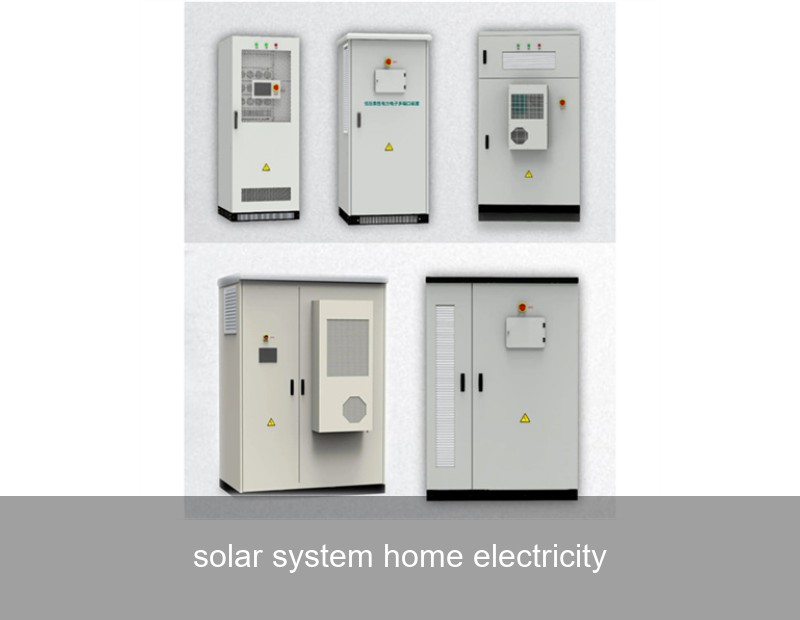
This mismatch is why the conversation around solar system home electricity has decisively shifted to include battery storage. A battery energy storage system (BESS) acts as your personal energy reservoir. It stores the surplus solar energy produced during the day for use whenever you need it—at night, on cloudy days, or, most importantly, during a grid outage. With a storage system, your home can become a true energy island, maintaining critical power even when the neighborhood goes dark. According to the U.S. Department of Energy, pairing storage with solar is key to unlocking resilience and maximizing the value of every kilowatt-hour generated on your roof.
The Core Components of a Complete Solar + Storage System:
- Solar PV Panels: Capture sunlight and convert it to DC electricity.
- Inverter(s): Convert DC electricity to usable AC electricity. In advanced systems, a hybrid inverter manages both solar and battery charging/discharging.
- Battery Storage Unit: Stores excess solar energy chemically for later use.
- Energy Management System (EMS): The intelligent software that decides when to charge the battery, power the home, or export to the grid, optimizing for cost or resilience.
- Critical Loads Panel (Optional): A sub-panel that ensures essential circuits (lights, refrigeration, internet) are powered during an outage.
Real Numbers, Real Savings: A Case Study from California
Let's move from theory to tangible impact. Consider the Johnson family in Sacramento, California—a region with high electricity rates and a growing number of grid reliability events (like Public Safety Power Shutoffs). In 2021, they installed a 9.6 kW solar array paired with a 13.5 kWh battery storage system.
The Phenomenon: High utility bills ($250-$400/month) and anxiety over multi-day power outages.
The Data & The Solution: Their system was designed to cover over 95% of their annual energy consumption. In its first full year of operation:
| Metric | Result |
|---|---|
| Annual Solar Production | 14,200 kWh |
| Energy Self-Consumption (using their own solar) | 78% |
| Grid Electricity Purchased | ~900 kWh (down from 11,000 kWh) |
| Estimated Annual Bill Savings | $3,200 |
| Outages Experienced | 3 (totaling 42 hours) |
| Outage Hours Powered by Battery | 42 hours (100% coverage) |
The Insight: For the Johnsons, the value wasn't just in savings. It was in uninterrupted life. During a 24-hour PSPS event, their home maintained power for lights, refrigeration, internet, and medical equipment, while neighbors scrambled for generators. Their system paid for itself in under 8 years, and they now have a predictable, low energy cost for the next 15+ years. This holistic value—financial + resilience—is what defines modern solar system home electricity.
Choosing Your System: Key Considerations for Homeowners
If the Johnson family's story resonates, your next step is understanding what to look for. Not all systems are created equal. Here’s a quick checklist:
- Energy Audit: Start with your last 12 months of utility bills. How many kWh do you use, and what's your peak demand?
- Roof Suitability: Direction, shading, and structural integrity matter. South-facing (in the Northern Hemisphere) with minimal shade is ideal.
- Storage Capacity: Size your battery based on your "critical load" needs during an outage, not your whole home's peak consumption. A quality provider will help you model this.
- System Intelligence: Can the system learn your habits and weather forecasts to optimize energy flow? Can it be updated remotely as energy markets evolve?
- Quality & Warranty: Look for tier-1 solar panels, proven battery chemistry (like LiFePO4 for safety and longevity), and strong warranties (often 10+ years on batteries, 25 on panels).
Highjoule's Smart Energy Ecosystem: Designed for Modern Living
This is where Highjoule's nearly two decades of expertise comes into play. We don't just sell components; we engineer integrated energy ecosystems. For the residential market, our Highjoule Home Energy Vault is the cornerstone. It's a seamlessly integrated system featuring high-efficiency bifacial solar panels, a powerful hybrid inverter, and our proprietary lithium iron phosphate (LiFePO4) battery modules.
What sets it apart is the Highjoule Smart Hub—our AI-driven energy management platform. Think of it as the conductor of your personal energy orchestra. It doesn't just react; it predicts. By analyzing your usage patterns, local weather forecasts, and even real-time grid pricing signals (where available), it automatically decides the most economical and resilient way to power your home. Do you charge the battery from solar to prepare for a storm forecasted tomorrow? Do you use a bit of grid power now if rates are negative and save your solar for peak evening hours? The Smart Hub handles these complex decisions so you don't have to.
Our systems are designed with scalability in mind. You can start with a configuration that meets your current needs and budget, and easily add more battery capacity later as your family grows or you add an electric vehicle. This focus on future-proof, intelligent, and safe solar system home electricity solutions is what has made Highjoule a trusted partner for homeowners from Germany to Texas.
Image: Monitoring and controlling home energy flow. Source: Unsplash
The Interactive Future of Home Energy: What's Your Role?
The evolution of solar system home electricity is moving towards interactive grids. In places like the UK and parts of the US, programs exist where you can sell small amounts of stored power back to the grid during times of peak demand to stabilize the network and earn extra income—a concept known as virtual power plants (VPPs). With a smart system like Highjoule's, your home could potentially participate in this energy democracy, transforming from a passive consumer into an active prosumer.
So, as you contemplate your home's energy future, ask yourself this: Is your goal simply to lower your bill, or is it to build a foundation of resilience and independence for your family? What would it mean to you to never worry about a blackout disrupting your work, your safety, or your comfort again?
We invite you to explore what a truly intelligent energy partnership looks like. What's the first question you'd need answered to feel confident taking the next step toward energy independence?
 Inquiry
 Online Chat