


The Solid State Battery Quantumscape Breakthrough: What It Means for the Future of Energy Storage
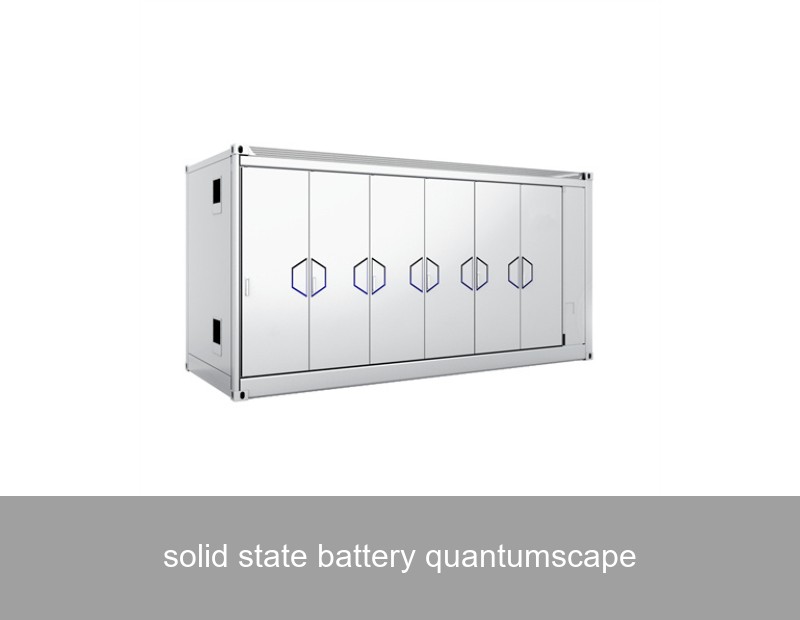
You've likely heard the buzz. Electric vehicles (EVs) with 500-mile ranges, phones that charge in minutes, and a renewable-powered grid that doesn't falter when the sun sets. For years, these promises have been tethered to one critical bottleneck: battery technology. Enter the solid state battery Quantumscape achievement. This isn't just an incremental upgrade; it represents a fundamental shift in the chemistry that powers our world. But what does this lab-scale marvel truly mean for industries, homeowners, and our global energy infrastructure? Let's peel back the layers.
What is a Solid-State Battery? The Quantum Leap Explained
To understand why the solid state battery Quantumscape development is so pivotal, we must first look at today's standard: the lithium-ion battery. Inside every common battery is a liquid electrolyte—a flammable chemical soup that facilitates the flow of lithium ions between the anode and cathode. This liquid component is the source of well-documented issues: fire risk, degradation over cycles, performance loss in cold weather, and a hard limit on energy density.
A solid-state battery, as the name implies, replaces that volatile liquid with a solid electrolyte. This can be a ceramic, polymer, or sulfide-based material. The implications are profound:
- Safety: Dramatically reduced fire hazard, eliminating a major concern for EVs and large-scale energy storage.
- Energy Density: Potential for 2-3 times the energy storage in the same space, enabling longer ranges and more compact systems.
- Longevity: Significantly more charge-discharge cycles, extending the useful life of the battery from years to decades.
- Charging Speed: Faster ion movement in solid electrolytes could enable ultra-rapid charging.
Quantumscape's specific innovation lies in its proprietary ceramic solid separator and anode-free design, which aims to overcome historical solid-state challenges like dendrite formation (tiny metallic growths that can short-circuit a battery).
Quantumscape's Solid-State Battery: A Closer Look at the Data
Pioneering claims require rigorous validation. In late 2023, Quantumscape's solid state battery cells underwent independent testing at PowerCo, the battery arm of the Volkswagen Group. The published results turned heads in the industry. The 24-layer prototype cells demonstrated:
- Over 1,000 full charge-discharge cycles while retaining 95% of initial capacity.
- Excellent performance at sub-zero temperatures.
- Remarkable stability, showing no dendrite-related short circuits.
To put this in perspective, a typical EV battery warranty today covers about 1,000 cycles or 8 years to 70% capacity. Retaining 95% after 1,000 cycles suggests a potential lifespan that could outlive the vehicle itself. This data, while still from advanced prototypes, points to a tangible future where battery anxiety—for both range and replacement cost—could become a relic of the past. For a deeper dive into the technical validation, you can review the analysis from Nature Energy.

Image Source: Unsplash - Representative image of advanced battery testing.
From Lab to Grid: A European Energy Storage Case Study
The promise of solid-state extends far beyond the road. Let's consider its impact on the backbone of the energy transition: grid-scale storage. Germany's "Energiewende" (energy transition) faces a classic intermittency challenge—managing peaks and troughs from wind and solar. A 2023 project by a leading utility in Bavaria piloted a hybrid storage system pairing lithium-ion with emerging technologies to stabilize a local microgrid for 10,000 residents.
The initial findings were telling. While lithium-ion handled daily load-shifting, its limitations in rapid, high-power response and long-duration storage created gaps. Projections based on the specifications of technologies like the solid state battery Quantumscape platform showed a potential game-changer. A solid-state system of the same footprint could:
| Metric | Current Li-ion System | Projected Solid-State System |
|---|---|---|
| Response Time | ~200 milliseconds | <50 milliseconds (estimated) |
| Cycle Life at 90% Depth of Discharge | ~4,000 cycles | >10,000 cycles (projected) |
| System Safety Footprint | Requires extensive fire suppression & spacing | Minimal safety spacing needed |
This translates to a more resilient grid, lower lifetime operational costs, and safer installations near population centers. It's a clear signal that the future of grid storage is multi-technology, with solid-state poised to play a starring role in high-performance, high-cycle applications.
Beyond Electric Vehicles: The Broader Impact on Renewable Energy
So, where does this leave businesses and homeowners investing in solar today? The integration of renewables is fundamentally an energy storage problem. At Highjoule, we view breakthroughs like solid state battery Quantumscape not as distant dreams, but as the coming evolution of the ecosystem we are building today. Our current Hyperion Commercial & Industrial (C&I)储能系统 and Helios Residential Energy Hub are designed with this future in mind.
Our systems utilize the most advanced, safe, and durable lithium-ion chemistry available today, coupled with intelligent energy management software. This software—the true "brain" of the system—is already being architected to seamlessly integrate future battery chemistries, including solid-state modules. Think of it as a future-proof platform: you invest in the intelligent infrastructure now, and the storage medium can evolve as technology matures, protecting your capital and maximizing your energy independence. For current global storage trends, the IEA's Grid-Scale Storage Report provides excellent context.

Image Source: Unsplash - Home solar and storage installation.
Highjoule's Role: Bridging Today's Needs with Tomorrow's Technology
Founded in 2005, Highjoule has navigated multiple waves of energy storage innovation. Our mission is to provide intelligent, efficient, and sustainable power solutions that are both cutting-edge and practical. While we monitor and test next-generation chemistries like solid-state, our focus remains on delivering reliable value today. Our Microgrid Controller and Atlas Utility-Scale Storage Platform are solving real-world problems for communities and industries across Europe and North America, from mitigating demand charges to providing black-start capability.
The key is a layered approach. We see solid-state batteries eventually revolutionizing specific applications where their superior energy density and safety are paramount. In the interim, our engineered solutions combine optimized lithium-ion batteries, predictive AI software, and robust power conversion systems to create the most resilient and economical storage available. When solid-state is ready for prime time, our platforms will be ready to harness its full potential for our clients.
The Road Ahead: Challenges and Open Questions
The path from a successful 24-layer prototype to mass-produced, cost-competitive battery packs is steep. Scaling the manufacturing of defect-free ceramic separators at high speed is a monumental engineering challenge that Quantumscape and others are racing to solve. Supply chains for new materials need to be established. The final cost per kilowatt-hour (kWh) remains the ultimate metric for widespread adoption in both automotive and energy sectors.
This leads us to a crucial, open question for every business leader, municipality, and homeowner planning their energy future: In a landscape of rapidly evolving battery technology, what is the optimal strategy for investing in energy storage today to ensure it remains an asset, not a stranded cost, tomorrow?
We believe the answer lies not in waiting, but in building adaptable, intelligent infrastructure. What specific energy resilience or cost-saving challenge could a modular, software-defined storage platform start solving for you right now?
 Inquiry
 Online Chat