


How a Storage Unit for Electricity Can Transform Your Energy Independence
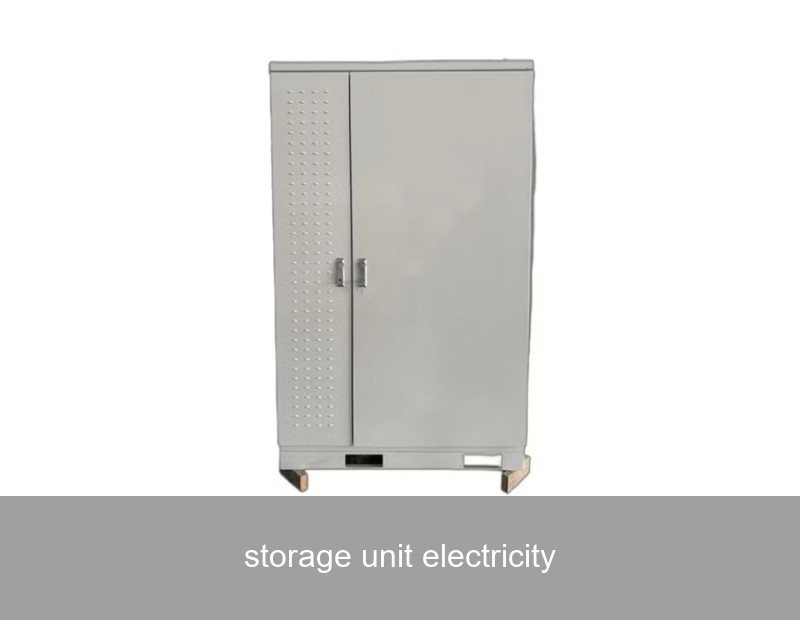
Imagine a world where your home or business isn't at the mercy of the grid. Where a power outage is a minor inconvenience, not a crisis. Where the sun shining on your roof can power your nights. This isn't a distant future; it's the reality enabled by a modern storage unit for electricity—the battery energy storage system (BESS). For homeowners and businesses across Europe and the US, this technology is shifting from a niche option to a mainstream pillar of energy resilience and financial prudence. Let's explore how these intelligent systems work and why they might be the most strategic upgrade you make this year.
Table of Contents
- The Phenomenon: From Passive Consumer to Proactive Prosumer
- The Data: Economics and Grid Stability in Numbers
- The Case Study: A German Bakery's Recipe for Resilience
- The Insight: It's More Than Just a Battery
- Highjoule's Role: Intelligent Storage for Real-World Demands
- Your Energy Future: A Question of Control
The Phenomenon: From Passive Consumer to Proactive Prosumer
For decades, electricity flow was a one-way street: from the power plant, through the grid, to your outlet. You consumed what was supplied, with little choice or control. The rise of solar PV changed that, allowing many to generate their own power. But this created a new challenge: intermittency. Solar panels don't produce at night, and production peaks often don't align with consumption peaks. This mismatch means sending cheap, self-generated power to the grid only to buy back expensive power later—a frustrating cycle.
This is where the storage unit for electricity becomes the game-changer. It's the essential link that transforms a solar setup from a partial solution into a comprehensive energy system. By storing excess solar generation, it effectively time-shifts energy, making your self-consumption soar. Suddenly, you're not just a consumer or even a producer—you're a "prosumer" with active control over your energy destiny.
The Data: Economics and Grid Stability in Numbers
The drivers for adoption are backed by compelling data. Let's break down two key angles: personal finance and grid health.
Financial Incentives: It's About Savings and Security
Across target markets, the economics are becoming irresistible.
- Rising Grid Prices: In Europe, household electricity prices in H1 2023 were, on average, over 40% higher than pre-energy crisis levels (2019-2021). In the US, average retail electricity prices have risen steadily over the past decade (U.S. Energy Information Administration).
- Falling Solar + Storage Costs: The levelized cost of solar PV and lithium-ion batteries has plummeted by over 80% in the last decade.
- Increased Self-Consumption: Adding a storage unit can increase direct solar self-consumption from 30-50% to 70-90%, dramatically reducing bills.
Grid Support: The Unseen Benefit
Your private storage unit also provides a public service. During peak demand (hot summer evenings when air conditioners strain the grid), utilities often activate expensive and polluting "peaker plants." Distributed storage systems can alleviate this stress. A study by the National Renewable Energy Laboratory (NREL) found that high penetration of behind-the-meter storage can significantly reduce peak load, defer costly grid upgrades, and enhance overall reliability.
| Benefit | Impact on Owner | Impact on Grid/Community |
|---|---|---|
| Energy Time-Shifting | Lower electricity bills, maximized solar ROI | Reduced strain during peak hours |
| Backup Power | Resilience during outages | Faster grid recovery (if configured for grid services) |
| Voltage/Frequency Support | Stable power quality for sensitive equipment | Enhanced local grid stability and efficiency |
The Case Study: A German Bakery's Recipe for Resilience
Let's look at a real-world example. Bäckerei Schmidt (name changed for privacy), a mid-sized artisan bakery in Bavaria, Germany, faced a critical problem. Their delicate fermentation processes and refrigeration units required a constant, high-quality power supply. Even brief voltage sags could ruin a day's production. Furthermore, their existing 50 kW rooftop solar system was exporting most of its midday output at low feed-in tariffs, while they bought power at high rates during their early morning and afternoon peaks.

Their solution was a turnkey storage unit for electricity system. Installed in 2022, the system includes:
- A 120 kWh lithium iron phosphate (LFP) battery bank.
- An advanced hybrid inverter managing AC/DC coupling.
- Intelligent energy management software (EMS) that prioritizes self-consumption and schedules charging/discharging based on production schedules and tariff forecasts.
- Energy Cost Reduction: Grid electricity purchases decreased by 68%.
- Self-Consumption Rate: Increased from 35% to 89%.
- Payback Period: Estimated at 5.2 years, factoring in German subsidy programs.
- Business Resilience: The system provides 8 hours of full backup for critical loads, ensuring production continues through grid outages. The owner reported zero production loss due to power quality issues in the last year.
This case exemplifies the dual value proposition: hard financial returns coupled with operational continuity that is priceless for a business.
The Insight: It's More Than Just a Battery
A common misconception is that a storage unit for electricity is simply a box of batteries. In reality, the hardware is just one component. The true intelligence lies in the software and system integration. An advanced Energy Management System (EMS) is the brain that makes decisions: Should I store solar energy now or sell it because grid prices are exceptionally high? Should I keep the battery at 50% reserve for a potential outage tonight? How can I participate in a utility's demand response program for additional revenue?
Choosing a system without this intelligence is like buying a smartphone without an operating system. The hardware potential remains locked. This is why partnering with a provider that masters both the electrochemical science and the digital intelligence is crucial.
Highjoule's Role: Intelligent Storage for Real-World Demands
At Highjoule, with nearly two decades of experience since 2005, we've moved beyond just providing hardware. We engineer integrated smart energy ecosystems. Our solutions are designed to meet the specific challenges highlighted in the case study and data above.
For our commercial and industrial clients in Europe and North America, like Bäckerei Schmidt, our H-Series C&I Systems offer modular, scalable storage from 100 kWh to multi-MWh. These systems feature our proprietary Adaptive EMS Platform, which uses AI-driven forecasting to optimize for the most complex objectives: maximizing self-consumption, navigating time-of-use tariffs, providing seamless backup, and even generating revenue through grid services where available.

For residential customers seeking independence, our HomePower+ suite integrates solar, storage, and smart home energy control into one intuitive interface. It’s more than a storage unit for electricity; it's the command center for your home's energy flow, giving you visibility and control over every kilowatt-hour.
Our core philosophy is that every installation is part of a larger energy network. We ensure our systems are not only robust and safe, using top-tier LFP battery cells, but also future-proof and communicative, ready to support the evolving smart grid. Learn more about our approach to sustainable power solutions.
Why Highjoule's Technology Makes the Difference
- Adaptive EMS: The software that learns your patterns and adapts to market signals for optimal savings.
- Modular & Scalable Design: Start with what you need and expand capacity as your needs grow, protecting your investment.
- Grid-Interactive Functionality: Systems are designed to be good grid citizens, supporting stability when configured to do so.
- Comprehensive Service: From initial site assessment and financial modeling to installation, commissioning, and remote monitoring, we provide a single point of accountability.
Your Energy Future: A Question of Control
The transition to decentralized, resilient energy is underway. The data shows it's economically sensible, and real cases like our German bakery prove it's operationally transformative. The technology, as exemplified by Highjoule's intelligent systems, is mature, reliable, and smart. So, the question isn't really if a storage unit for electricity will become a standard feature of an efficient home or business, but when.
What would uninterrupted power protect for you? What could you build with the savings and predictability a smart energy system unlocks? The control is, increasingly, in your hands.
 Inquiry
 Online Chat