


Streich Solar Industries and the Critical Role of Advanced Energy Storage
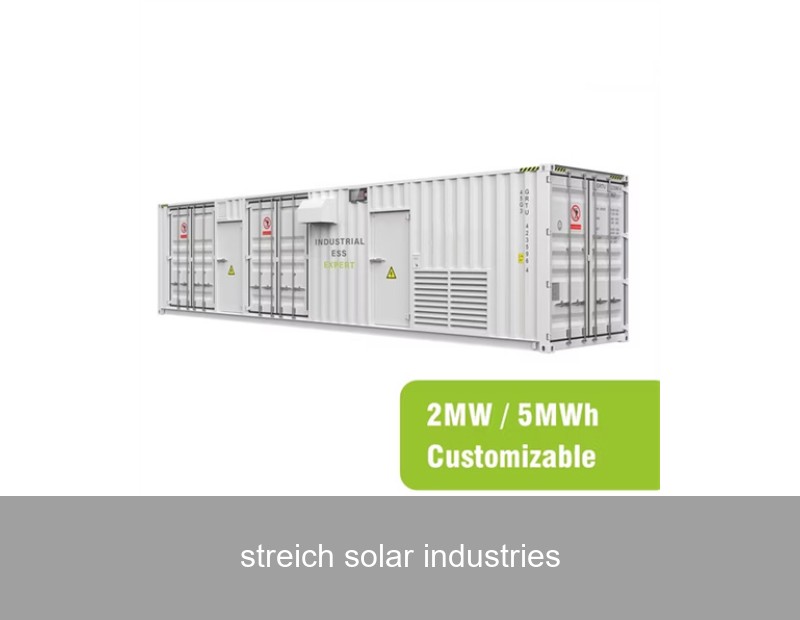
If you're involved in the solar sector in Europe or the United States, the name Streich Solar Industries likely resonates. As a major player in photovoltaic system distribution and installation, they represent a key segment of the renewable energy value chain. Their success, and the success of the entire solar industry, hinges on a crucial, often under-discussed factor: effectively managing the very power we generate. The conversation is rapidly shifting from just installing panels to creating resilient, intelligent energy systems. This is where the synergy between solar pioneers and advanced energy storage providers becomes not just beneficial, but essential for future growth and grid stability.
Table of Contents
- The Phenomenon: Solar's Intermittency Challenge
- The Data: Quantifying the Need for Storage
- The Case Study: A German Industrial Park's Solution
- The Insight: Intelligent Storage as a Business Enabler
- Highjoule's Role: Partnering for a Sustainable Future
- What's Your Energy Resilience Threshold?

Image: Modern solar installations are increasingly designed with integrated storage from the outset. Source: Unsplash
The Phenomenon: Solar's Success Creates a New Grid Dynamic
For distributors and installers like Streich Solar Industries, the past decade has been transformative. Solar adoption has skyrocketed, driven by falling costs and strong policy support. However, this very success introduces a complex challenge: the duck curve. This term, popularized by the California Independent System Operator (CAISO), describes the deepening dip in net grid load during sunny afternoons when solar floods the market, followed by a steep ramp-up as the sun sets and demand peaks. This curve strains traditional power plants, can lead to curtailment (wasting perfectly good solar energy), and ultimately threatens grid reliability.
For commercial and industrial (C&I) clients, this isn't just a grid operator's problem. It directly impacts their bottom line through time-of-use charges, demand charges based on peak consumption, and vulnerability to outages. A solar array alone cannot solve these issues; it can sometimes exacerbate the demand charge problem if not managed correctly.
The Data: The Compelling Economics of Storage Integration
The argument for pairing solar with storage is backed by hard numbers. Let's break down the key value streams:
| Value Stream | Impact for C&I Customers | Typical Savings/Revenue Potential |
|---|---|---|
| Demand Charge Reduction | Storage discharges during short periods of peak demand, flattening the load profile. | Can reduce demand charges by 20-40%. |
| Energy Arbitrage | Store cheap solar/off-peak grid energy, use it during expensive peak periods. | Leverages differential between high and low electricity rates. |
| Backup Power & Resilience | Provides seamless power during grid outages, avoiding operational downtime. | Value of avoided downtime can be enormous (thousands per hour). |
| Grid Services (where available) | Aggregated storage can provide frequency regulation to the grid for revenue. | Additional annual revenue stream per system. |
According to the National Renewable Energy Laboratory (NREL), the levelized cost of solar-plus-storage for commercial applications has fallen by over 70% since 2015. The financial payback period is now well within the investment horizon for most businesses, making it a strategic asset, not just a sustainability play.
The Case Study: A German *Mittelstand* Company Takes Control
Let's look at a real-world example in Bavaria, Germany—a key market for Streich Solar Industries. A mid-sized automotive component manufacturer (a classic *Mittelstand* firm) with a 500 kW rooftop solar system faced two issues: significant demand charges due to simultaneous operation of heavy machinery, and concerns about power quality affecting precision equipment.
In 2022, they partnered with a system integrator to deploy a 250 kW / 550 kWh lithium-ion battery energy storage system (BESS). The system was specifically programmed for:
- Peak Shaving: The BESS automatically discharges when the plant's total power draw approaches a predefined threshold, capping the peak demand.
- Solar Self-Consumption Optimization: Excess midday solar production is stored for use later in the afternoon/evening, increasing self-consumption from 35% to over 80%.
- Frequency Regulation: The system participates in Germany's primary control reserve market, generating revenue.
The results after one year were compelling:
- A 28% reduction in monthly demand charges.
- An overall 18% decrease in energy costs from the grid.
- Approximately €15,000 in annual revenue from grid services.
- A project payback period of under 7 years, with a system lifespan of 15+ years.
This case exemplifies how solar distributors who offer integrated storage solutions provide transformative value, moving from equipment suppliers to strategic energy partners.

Image: Modern BESS units like Highjoule's Nexus series allow for precise monitoring and control. Source: Unsplash
The Insight: Intelligent Software is the True Differentiator
While battery chemistry is important, the real brain of a modern storage system is its energy management system (EMS). A "dumb" battery provides limited value. An intelligent, AI-driven EMS like the one embedded in Highjoule's Nexus Series platforms is what unlocks the full spectrum of value streams. It must:
- Predict energy generation and load patterns using machine learning.
- Optimize dispatch across multiple, sometimes competing, objectives (saving money, providing backup, earning revenue).
- Seamlessly integrate with existing solar inverters and building management systems.
- Ensure safety and prolong battery life through advanced thermal and state-of-charge management.
For solar companies, offering a solution with superior software means happier clients, better system performance, and fewer operational headaches. It transforms a battery from a cost center into a smart, grid-interactive asset.
How Highjoule Empowers Solar Industry Leaders
At Highjoule, we've spent nearly two decades refining storage technology specifically for the demands of C&I, residential, and microgrid applications. We understand that for partners like Streich Solar Industries, reliability, scalability, and ease of integration are paramount. Our product suite is designed to be the perfect complement to any solar installation:
- Nexus Commercial & Industrial (C&I) Series: Our flagship modular, containerized solution. Its scalable design from 100 kW to multi-MW allows distributors to tailor solutions precisely to client load profiles. Its advanced EMS is pre-programmed with strategies for demand charge management, arbitrage, and grid services, making commissioning and optimization straightforward.
- Highjoule Home Energy Hub: For the residential segment, this all-in-one unit provides backup power, maximizes solar self-consumption, and gives homeowners full control over their energy destiny through an intuitive app.
- Microgrid Controller: For larger or off-grid projects, our controller can seamlessly orchestrate solar, storage, and backup generators, creating truly independent and resilient energy islands.
Our global service network provides the peace of mind that partners and end-users require, ensuring long-term performance and support.
What's Your Energy Resilience Threshold?
The trajectory is clear. The future belongs not to standalone solar, but to integrated, intelligent energy systems. For solar distributors, this is a moment of immense opportunity. The question is no longer *if* storage should be added, but *how* and *with whom*.
As you consult with your clients—whether they are a factory concerned about production costs, a hospital that cannot afford a second of downtime, or a community seeking energy independence—what will be the catalyst that moves them from interest to action? Is it the next spike in energy prices, a nearby outage, or the competitive advantage of a greener, more resilient operation?
We invite you to explore how integrating a smart storage strategy can future-proof your offerings and deepen your client relationships. What is the one energy challenge your most important client faces today that a solar-plus-storage solution could solve?
 Inquiry
 Online Chat