


Finding the Right Solar Ground Supplier: Your Guide to Quality and Performance
So, you've decided to harness the sun's power. You have the land, the vision, and the drive to build a solar farm. But a critical piece of the puzzle remains: choosing a reliable suelo solar supplier. This isn't just about buying panels; it's about securing the very foundation—both literally and figuratively—of your project's long-term success. The ground beneath your solar array, and the structures that hold it, are what turn sunlight into a stable, decades-long revenue stream. Let's explore why this choice is so pivotal and how to navigate it.
Table of Contents
The Hidden Phenomenon: When the Ground Fails the Sun
Imagine this: a 5MW solar farm in Southern Europe, operational for just three years. During a routine inspection, engineers discover uneven settling, misaligned rows, and increased stress on panel connections. The culprit? Incompatible ground screws and mounting structures that couldn't handle the site's specific soil composition after particularly wet winters. The result isn't immediate collapse, but a creeping loss of efficiency and soaring, unplanned O&M costs. This scenario, while unfortunate, highlights a key truth: your solar ground supplier provides the skeleton of your project. A weak skeleton compromises the entire body, no matter how healthy the heart (the panels) might be.
The Data Reality: More Than Just a Price Tag
The financial case for prioritizing quality groundwork is compelling. According to the National Renewable Energy Laboratory (NREL), balance-of-system (BoS) costs, which include mounting and installation, can represent up to 30% of total utility-scale solar capital expenditure. Furthermore, a study by the IEA PVPS Task 13 notes that robust mechanical design can reduce operational risks and extend system lifespan directly impacting the levelized cost of energy (LCOE). Choosing a supplier based on the lowest upfront cost can be a false economy if it leads to:
- Increased Installation Time: Poorly designed or incompatible components slow down assembly.
- Geotechnical Risks: Inadequate load calculations or corrosion protection can lead to failures.
- O&M Headaches: Difficult access for cleaning or repairs due to poor layout.

Image source: Unsplash. A professional ground screw installation is critical for long-term stability.
A Case Study from Bavaria: Precision in Practice
Consider a recent 12MW agrivoltaic project in Bavaria, Germany. The challenge was dual-use land: maximizing solar yield while allowing for agricultural machinery to operate beneath. The project developer needed a suelo solar supplier that could provide elevated, high-clearance mounting structures with exceptional load-bearing capacity and precise, repeatable installation to avoid damaging fertile soil.
The chosen supplier delivered a proprietary ground screw system with integrated geotechnical data logging during installation. This ensured each screw met the precise torque and depth specification for the variable soil conditions across the site. The result?
- Installation was completed 15% faster than the regional average for similar projects due to the optimized design.
- The structure provided a consistent 3.5-meter clearance, enabling seamless farming activity.
- Post-installation laser scanning showed a near-perfect plane alignment, optimizing panel performance.
This case underscores that the right supplier delivers not just metal, but a precision-engineered solution tailored to the project's unique constraints.
Beyond the Structure: The Intelligent Foundation
The modern solar farm's foundation is becoming intelligent. Leading solar ground suppliers now integrate considerations for the entire energy ecosystem. This is where the conversation evolves from mere structural support to comprehensive energy management.
Think about it: that vast array of panels generates power intermittently. To maximize its value—whether for self-consumption, grid services, or off-grid reliability—it needs to be paired with advanced energy storage. This creates a seamless, dispatchable power plant. This holistic view is exactly where a company like Highjoule excels. While we are globally recognized for our advanced battery energy storage systems (BESS), our expertise is deeply interwoven with the solar development process.
We partner with developers and EPCs from the early design phase. By understanding the site layout, interconnection capacity, and energy profile, we can advise on how the solar infrastructure can be optimized for future storage integration. For instance, our Highjoule GridStackTM commercial BESS can be seamlessly coupled with a new solar farm, transforming it into a 24/7 power resource. This means the choice of your structural supplier should be made with an eye on the complete system, including storage readiness.
Highjoule's Role: From Groundwork to Grid Integration
Founded in 2005, Highjoule has grown into a global leader by solving the core challenge of modern energy: making it intelligent, reliable, and sustainable. While we don't manufacture ground screws or racking, our role is to ensure the electricity generated by your solar foundation is used with maximum efficiency and value.
For large-scale commercial and industrial (C&I) or microgrid applications, our solutions act as the brain and battery for solar assets. Picture a solar farm built with quality components from a top-tier suelo solar supplier. Now, integrate a Highjoule storage system:
- Energy Time-Shifting: Store excess midday solar energy and discharge it during evening peak demand, dramatically improving economics.
- Grid Stability: Provide frequency regulation services, turning your solar asset into a grid-supportive tool.
- 100% Renewable Microgrids: For remote or critical operations, combine solar, our storage, and advanced controls to achieve true energy independence.
Our Highjoule HomePowerTM series does the same for residential communities, allowing homeowners to maximize self-consumption of rooftop solar. By considering storage early, you future-proof your solar investment, and that journey starts with a conversation about your overall system goals.

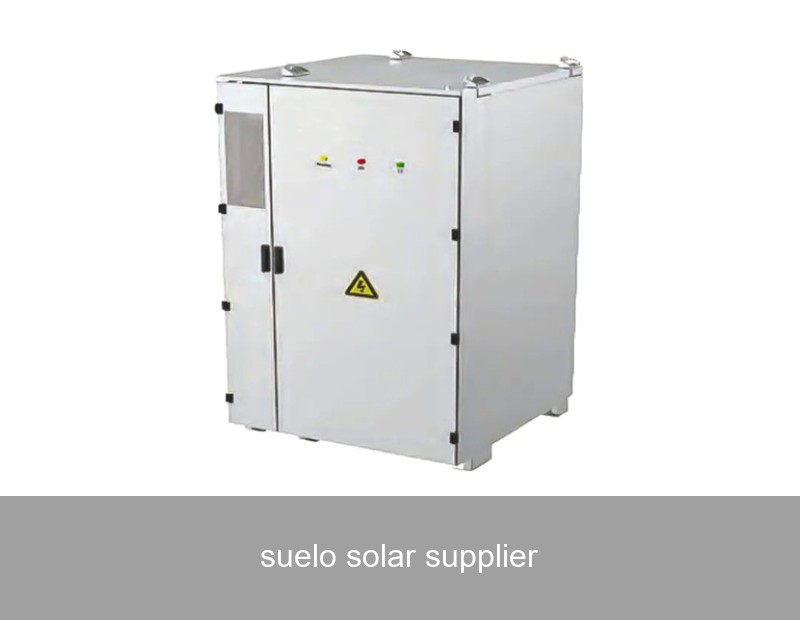
Image source: Unsplash. A containerized BESS unit, like Highjoule's GridStack, seamlessly integrates with solar farms.
Choosing Your Solar Ground Supplier: A Checklist
To make an informed decision, use this framework when evaluating potential solar ground suppliers:
| Criteria | Key Questions to Ask | Why It Matters |
|---|---|---|
| Engineering & Certification | Are your systems certified for local wind/snow loads (e.g., EU, IEC, ASCE 7)? Do you provide site-specific geotechnical analysis? | Ensures structural integrity and compliance with regional regulations, reducing liability. |
| Material Quality & Logistics | What is your corrosion protection standard (e.g., hot-dip galvanizing)? How do you manage regional warehousing and delivery timelines? | Guarantees longevity (25+ years) and prevents costly delays or on-site damage. |
| System Integration & Future-Proofing | How does your design accommodate potential future expansion or pairing with energy storage systems? | Protects your long-term asset value and allows for easy upgrades as technology evolves. |
| Local Track Record | Can you provide references from completed projects in my region (e.g., Texas, California, Spain, Italy)? | Proven experience with local authorities, labor, and climate conditions is invaluable. |
The ideal partner is one who sees themselves as part of your project's long-term ecosystem, not just a component vendor. They should be willing to discuss how their physical infrastructure aligns with your financial and operational software—the energy management system that will ultimately control the flow of power.
As you finalize plans with your suelo solar supplier, what is the one key performance indicator—be it peak shaving capability, grid independence, or ancillary service revenue—that will define the success of your energy asset in five years?
 Inquiry
 Online Chat