


The Renewable Revolution: A New Era for Empresas de Energías Renovables
If you're leading or working within empresas de energías renovables (renewable energy companies), you're not just in the business of power generation anymore. You're at the forefront of a fundamental shift in how our societies produce, consume, and think about energy. From sprawling solar farms in Andalusia to wind projects in the North Sea and commercial rooftop installations across California, the growth is undeniable. But as the sector matures, a new, critical question emerges: how do we ensure the clean power we generate is available precisely when it's needed most? The answer, increasingly, lies not just in capturing energy, but in mastering its storage and dispatch.
The Intermittency Challenge: Sun Doesn't Always Shine, Wind Doesn't Always Blow
Let's talk about the elephant in the room. The very nature of solar and wind power—their variability—presents the biggest hurdle to a 100% renewable grid. This isn't a flaw; it's a physics-based reality. A cloud passes over a solar farm, and output dips. The wind calms, and turbine rotations slow. For grid operators, this variability can cause instability. For empresas de energías renovables, it can mean lost revenue during peak price hours when your asset isn't producing, or even curtailment (being told to shut off) because the grid cannot absorb the excess power.
Consider this data: In 2023, California's grid operator, CAISO, had to curtail over 2.4 million MWh of solar and wind energy—enough to power nearly 250,000 homes for a year [Source: CAISO]. This is a stark reminder that generation alone is not enough. The next logical step in the evolution of a renewable energy company is to become a reliable energy supplier, decoupling production from consumption.

Credit: Photo by American Public Power Association on Unsplash. Solar farms are a cornerstone of renewable energy, but their output is subject to natural variability.
Storage: The Game-Changer for Modern Renewable Energy Companies
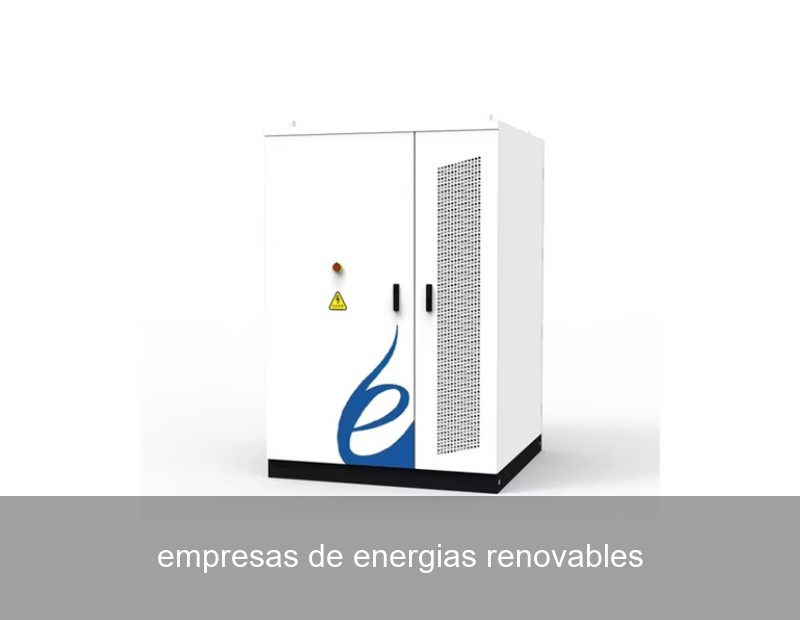
This is where Battery Energy Storage Systems (BESS) enter the stage, transforming the business model for forward-thinking empresas de energías renovables. Think of storage as a time-machine for electrons. It allows you to:
- Capture Excess Energy: Store surplus power generated during midday sun or windy nights.
- Provide Firm Capacity: Dispatch that stored energy during evening peak demand (the "duck curve" neck) or during periods of low natural generation.
- Stabilize the Grid: Offer fast-frequency response services, helping to maintain grid stability in the face of sudden changes.
- Maximize Financial Returns: Participate in energy arbitrage—buying low, storing, and selling high—and secure additional revenue streams from grid services.
Integrating storage is no longer a luxury; it's a strategic imperative for enhancing project economics, ensuring grid compatibility, and fulfilling the promise of reliable clean energy.
Case Study: A Spanish Solar Plant's Transformation with Highjoule
Let's look at a real-world example from southern Spain. A 50 MW solar PV plant, operated by a prominent local empresa de energías renovables, was experiencing significant curtailment during hours of high solar irradiance and facing challenges in meeting its guaranteed power supply contracts during early evening peaks.
Their solution was to integrate a 20 MW / 40 MWh Highjoule GridMaster BESS alongside their existing infrastructure. Here’s what happened:
| Metric | Before Highjoule BESS | After Highjoule BESS Integration (12-month period) |
|---|---|---|
| Curtailed Energy | ~15% of potential generation | Reduced to less than 2% |
| Revenue from Capacity Markets | None | €1.2 million annually |
| Evening Peak Power Delivery | Unreliable, dependent on sunset | Guaranteed 18 MW for 2 hours daily |
| Project ROI Enhancement | Base case | Improved by an estimated 22% |
The Highjoule system, with its advanced lithium-iron-phosphate (LFP) battery technology and integrated cooling, was chosen for its durability, safety, and superior cycle life—critical for daily charge/discharge cycles. This case perfectly illustrates how storage turns a variable generation asset into a predictable, dispatchable, and more profitable power plant.
Beyond the Battery: The Intelligent Energy Management System (EMS)
A battery is a powerful component, but its true potential is unlocked by intelligence. The brain of a modern storage solution is the Energy Management System (EMS). For empresas de energías renovables, a sophisticated EMS like Highjoule's NeuroGrid AI platform is what differentiates a simple battery pack from a smart grid asset.
Our NeuroGrid EMS doesn't just react; it predicts and optimizes. By analyzing historical generation data, real-time weather forecasts, and dynamic electricity market prices, it autonomously makes millisecond decisions:
- Should we store energy now for a predicted price spike in three hours?
- Should we provide frequency regulation at this moment or hold capacity for the plant's scheduled discharge?
- How can we optimally cycle the battery to maximize its lifespan while meeting financial targets?
This level of automated, AI-driven optimization is what allows renewable energy companies to extract maximum value from every kilowatt-hour, both for their own operations and for the broader grid.

Credit: Photo by Chris Liverani on Unsplash. Intelligent Energy Management Systems are the command centers for modern renewable energy assets.
Highjoule's Tailored Solutions for Renewable Energy Pioneers
At Highjoule, we've spent nearly two decades partnering with empresas de energías renovables globally. We understand that a one-size-fits-all approach doesn't work. A 10 MW community solar+storage project in Germany has different needs than a 500 MW hybrid plant in Texas. That's why our product suite is designed to scale and adapt.
For large-scale utility and commercial projects, our GridMaster containerized BESS offers utility-grade performance, scalability from tens to hundreds of MWh, and seamless integration with solar PV and wind inverters. Its modular design allows for easy expansion as your portfolio grows.
For commercial & industrial (C&I) applications and microgrids, the PowerHub series provides a robust, all-in-one solution. It enables businesses with on-site solar to drastically increase self-consumption, provide backup power, and participate in demand response programs, all while reducing their energy bills and carbon footprint.
Beyond hardware, our Highjoule 360 Services provide end-to-end support: from initial feasibility studies and financial modeling to system design, installation, long-term maintenance, and performance monitoring. We become an extension of your team, ensuring your storage investment delivers on its promise for decades.
The Future Outlook: Smarter, More Integrated Grids
The trajectory is clear. The future grid will be decentralized, digital, and resilient. Empresas de energías renovables will evolve into integrated clean energy platforms, managing fleets of generation and storage assets across regions, optimizing their collective output for both market and environmental benefits. Technologies like virtual power plants (VPPs), which aggregate distributed resources, will become commonplace, and storage will be the enabling glue.
As battery chemistries continue to advance—with research into solid-state, sodium-ion, and other technologies—we can expect even lower costs, higher densities, and longer durations. This will further accelerate the transition, making 24/7 clean energy not just a goal, but an operational reality. The International Energy Agency (IEA) continues to highlight the critical role of storage in net-zero pathways, noting its need for exponential growth [Source: IEA].

Credit: Photo by Andreas Gücklhorn on Unsplash. The future lies in hybrid renewable plants seamlessly integrated with storage.
So, as you plan your next solar park, wind farm, or commercial rooftop installation, what strategy are you developing to not only generate clean energy, but to truly control and monetize its full potential? The market is moving beyond megawatts generated; it's valuing megawatts delivered, on demand.
 Inquiry
 Online Chat