


Sun Link Energy: How Much Can You Really Save and Generate?
Have you ever looked at your electricity bill and wondered, "What if my roof could pay for this?" You're not alone. Across homes in Europe and the U.S., the term "sun link energy" is becoming a household conversation starter. It's more than just a buzzword; it represents the powerful connection between your property and the sun's boundless energy. But the million-dollar question remains: Sun link energy, how much can it actually deliver for your wallet and the planet? Let's break down the numbers, share real-world results, and explore how modern technology is maximizing this solar partnership.
Understanding Your Sun Link Energy Potential
Think of "sun link energy" as your personal energy pipeline from the sky. It's the total amount of solar power your system can harvest, convert into electricity, and deliver to your home or business. This isn't a fixed number. It's a dynamic value influenced by a fascinating interplay of geography, technology, and economics. According to the National Renewable Energy Laboratory (NREL), solar resource availability varies significantly even within the same country, impacting your base potential.

Image Source: Unsplash - Photograph of a residential solar installation.
So, before asking "how much," we need to ask "what determines how much?"
Calculating the "How Much": Key Factors
To estimate your sun link energy yield, consider this formula:
Total Energy (kWh) = Solar Irradiance x Panel Efficiency x System Size x Derate Factors
Let's translate this into practical elements:
- Location & Sunlight Hours: A rooftop in Southern California naturally has a stronger "sun link" than one in Northern Germany. Tools like the European Commission's PVGIS provide precise solar data for any address in Europe and beyond.
- Roof Orientation & Shading: South-facing (in the Northern Hemisphere), unshaded roofs are ideal. Even partial shading can disproportionately reduce output.
- Solar Panel Efficiency: High-quality monocrystalline panels, commonly used today, convert 20-22% of sunlight into electricity, a significant improvement from a decade ago.
- System Size (kWp): Measured in kilowatt-peak, this is the capacity of your installation. A typical residential system in the U.S. ranges from 6 kWp to 12 kWp.
Sample Output Table for Different Regions
| Location | Avg. Annual Sunlight (kWh/m²) | 6 kWp System Estimated Annual Yield | Potential Annual Savings (Est.) |
|---|---|---|---|
| Phoenix, USA | ~2,400 | 10,500 - 11,000 kWh | $1,500 - $1,800 |
| Munich, Germany | ~1,200 | 5,800 - 6,300 kWh | €1,200 - €1,500 |
| Madrid, Spain | ~1,800 | 8,700 - 9,200 kWh | €1,000 - €1,300 |
Note: Savings depend heavily on local electricity rates and net metering policies. Figures are illustrative.
Real-World Case Study: A German Bakery's Sustainable Recipe
Let's move from theory to practice. Consider "Bäckerei Schmidt," a family-run bakery in Bavaria, Germany. Facing rising energy costs and a commitment to sustainability, they installed a 50 kWp solar PV system in 2021.
- The Goal: Offset daytime energy consumption for ovens, refrigeration, and lighting.
- The Challenge: Production peaked in the early morning, before solar generation hit its stride. Excess midday solar energy was being fed back to the grid at a lower rate.
- The Data: The system generated approximately 48,000 kWh in its first year, covering about 60% of their direct electricity needs. However, self-consumption was only at 35%—meaning 65% of their precious solar power was exported, not maximizing their savings.
This is a classic "sun link energy" dilemma: How much you generate is important, but how much you use directly is what truly impacts your bottom line.
Maximizing Your Yield: The Role of Smart Energy Storage
The bakery's story highlights the missing link in many solar setups: storage. This is where the conversation evolves from simple generation to intelligent energy management. By adding a battery energy storage system (BESS), you can:
- Increase Self-Consumption: Store surplus midday sun for use in the evening or early morning, like baking those first loaves of bread.
- Provide Backup Power: Keep essential loads running during grid outages—a critical feature for businesses and homeowners alike.
- Optimize for Time-of-Use Rates: In markets like California, store solar when rates are low and use it when rates are high.
For Bäckerei Schmidt, integrating a 40 kWh battery system increased their self-consumption rate from 35% to over 80%. Their annual savings jumped by an additional 40%, and they gained invaluable operational resilience. This intelligent sun link transformed their solar array from a simple generator into a controlled, strategic asset.

Image Source: Unsplash - Interior of a commercial battery storage system.
Highjoule's Integrated Solutions: Beyond Generation
At Highjoule, we've been at the forefront of this energy evolution since 2005. We understand that the question "sun link energy, how much?" is ultimately about value, not just kilowatt-hours. That's why we provide end-to-end intelligent storage solutions that bridge the gap between solar generation and reliable, economical consumption.
Our product suite is designed to answer this complex question for our clients across Europe and North America:
- Highjoule HISE (Home Integrated Storage Engine): A sleek, powerful residential system that seamlessly couples with new or existing solar panels. Its AI-driven energy management software learns your household patterns, automatically deciding when to store, use, or export energy to maximize your financial return.
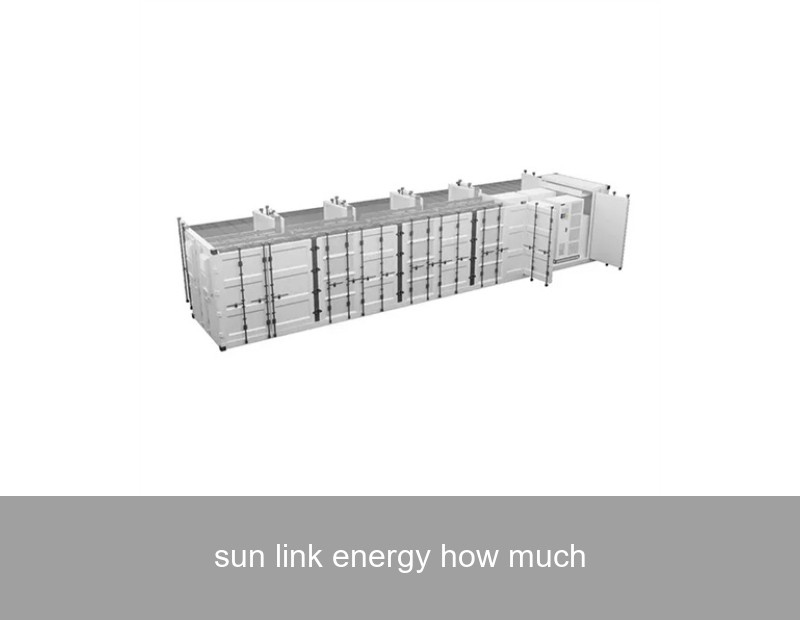
- Highjoule CIBES (Commercial & Industrial Battery Energy System): For businesses like Bäckerei Schmidt, our scalable CIBES units offer robust power and capacity. They integrate with building management systems, participate in demand-charge reduction programs, and provide a clean backup power source, ensuring operational continuity and significant cost savings.
- Highjoule Microgrid Controller: For campuses, remote communities, or industrial sites, this platform orchestrates solar PV, multiple storage units, and sometimes backup generators into a stable, independent microgrid, maximizing the use of local sun link energy.
Our approach isn't just about selling hardware; it's about delivering a guaranteed energy outcome. We analyze your consumption, local weather patterns, and utility tariffs to model the exact financial and operational benefit your unique "sun link" can provide.
Your Solar Journey: What's the Next Step?
The journey to answering "sun link energy, how much?" for your property is both exciting and data-driven. It starts with a detailed assessment. We encourage you to gather your last 12 months of electricity bills, note your average monthly consumption and costs, and explore solar mapping tools for your roof.
But the most critical step is to think bigger than panels. Ask yourself: What is my true goal—lower bills, energy independence, sustainability, or all three? The answer will define the optimal system for you.
Ready to move from curiosity to calculation? What specific energy challenge in your home or business could a stronger, smarter link to the sun solve?
 Inquiry
 Online Chat