


Sunshine Solar: How Much Can You *Really* Generate and Save?
So, you're thinking about solar. It's a brilliant idea. You look at your roof, you see the sun shining, and the question naturally pops into your head: "Sunshine solar—how much?" How much power can those panels actually produce? More importantly, how much will it save on my energy bills? If you're in sunny California or even in cloudier parts of Europe like Germany, the core question is the same. The answer, however, isn't a simple number. It's a fascinating equation involving geography, technology, and smart energy management. Let's demystify it together.
Image Source: Unsplash - A typical residential solar setup. The amount it generates depends on more than just a sunny day.
Calculating Your Solar Potential: The Key Factors
Think of your potential solar energy as a recipe. The sunshine is the main ingredient, but the outcome depends on your equipment, setup, and even local weather patterns.
Sunlight Hours & Solar Irradiance
This is the starting point. Not all sunshine is created equal. Solar irradiance—the power per unit area received from the sun—varies greatly. Southern Spain enjoys about 5.5 peak sun hours per day on average, while Seattle might see closer to 3.8. In the U.S., Arizona tops the charts, while parts of the Pacific Northwest receive less. Organizations like The World Bank Global Solar Atlas provide excellent, free tools to check your specific location's potential.
System Size and Efficiency
Size matters, and so does quality. A system's capacity is measured in kilowatts (kW). A typical home system in the U.S. ranges from 6kW to 12kW. Modern panels have efficiencies between 18% and 22%, meaning they convert that percentage of sunlight into electricity. Higher efficiency panels generate more power in the same roof space.
Roof Orientation, Tilt, and Shading
A south-facing roof (in the Northern Hemisphere) at an optimal tilt angle is ideal. East or west-facing roofs still perform well, typically at 80-90% of optimal. The real killer? Shading. A single chimney or tree casting a shadow can disproportionately reduce the output of an entire panel string. This is where a detailed site survey is crucial.
From kWh to $ Savings: The Financial Equation
Let's put some hypothetical numbers to it. Assume a 10kW system in Southern California:
- Daily Generation: 10kW * 5.5 sun hours = ~55 kWh per day.
- Annual Generation: 55 kWh * 365 days = ~20,075 kWh.
Now, if your current electricity rate is $0.25 per kWh, that's potential savings of over $5,000 per year. In Europe, with higher energy prices in many countries, the savings can be even more compelling. But here's the twist: you often don't consume all that power the instant it's produced. This leads us to the most critical part of the modern solar equation.
The Storage Game-Changer: Maximizing Your Sunshine
This is where the question "sunshine solar, how much?" evolves. Without storage, excess solar energy is often fed back to the grid for a feed-in tariff (which is usually lower than the retail price you pay). With a battery storage system, you capture that excess. You use your own solar power at night, during peak rate periods, or even during a grid outage.
Adding storage can increase your self-consumption of solar energy from 30-50% to 70-90% or more. That means more of those generated kilowatt-hours directly offset your highest-cost electricity.

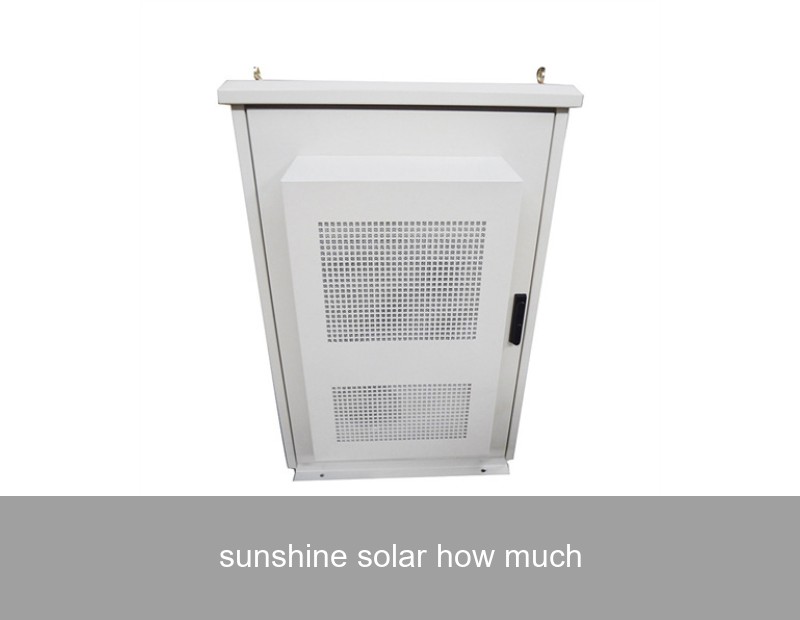
Image Source: Unsplash - A home battery storage system, key to unlocking full solar potential.
Case Study: A Berlin Bakery's Recipe for Energy Independence
Let's look at a real-world example from our operations in Europe. A family-owned bakery in Berlin, Germany, faced rising energy costs and wanted to stabilize its operational expenses. They had a 50kW solar array on their large roof, but most of their baking happened early in the morning, before peak solar production.
| Challenge | Solution | Result (First Year) |
|---|---|---|
| High grid consumption during morning peak hours (pre-solar peak). | Installation of a Highjoule HJ-Commercial 100 battery energy storage system (BESS) with intelligent energy management software. | Increased solar self-consumption from 35% to 88%. |
| Excess solar at noon was sold to the grid at low rates. | The system stores midday excess to power the afternoon operations and pre-charge for the next morning's bake. | Reduced grid energy purchases by 72%. |
| Seeking resilience against brief grid fluctuations. | The BESS provides seamless backup power for critical refrigeration loads. | Annual energy cost savings: €8,500. Projected ROI: Under 7 years. |
This case shows that "how much" isn't just about generation—it's about utilization. The right storage solution transformed their solar investment.
Highjoule Solutions: Intelligent Energy Management for Your Sunshine
At Highjoule, founded in 2005, we've moved beyond just providing components. We deliver integrated, intelligent systems that answer the "how much" question by ensuring you get the most value from every ray of sunshine.
- For Homes: Our HJ-Residential Series of AC-coupled battery systems seamlessly integrates with existing or new solar. Our AI-driven energy manager learns your consumption patterns, automatically deciding when to store, use, or export energy to maximize savings.
- For Business & Industry: The HJ-Commercial Modular BESS scales to meet demand. It performs peak shaving, reduces demand charges, and provides backup power, turning your solar array into a reliable, cost-cutting asset. You can monitor and control it remotely via our cloud platform.
- For Microgrids & Utilities: Our large-scale containerized systems stabilize grids, integrate renewable farms, and provide critical community resilience.
Our technology ensures that the question "sunshine solar, how much?" is answered with the highest possible number for your energy independence and financial return.
Your Next Step Towards Energy Independence
The journey to answering "sunshine solar, how much?" for your property starts with precise data. We recommend using the NREL PVWatts Calculator for a detailed initial estimate of solar generation based on your address.
But the full picture requires looking at generation and consumption. What does your daily energy load look like? When are your peak usage times? How could storing sunshine change your relationship with the grid and your utility bill?
What's the first energy habit you would change if you could store your own sunshine?
 Inquiry
 Online Chat