


Finding the Right Supplier of Energy MPPT: A Guide to Maximizing Your Solar Investment
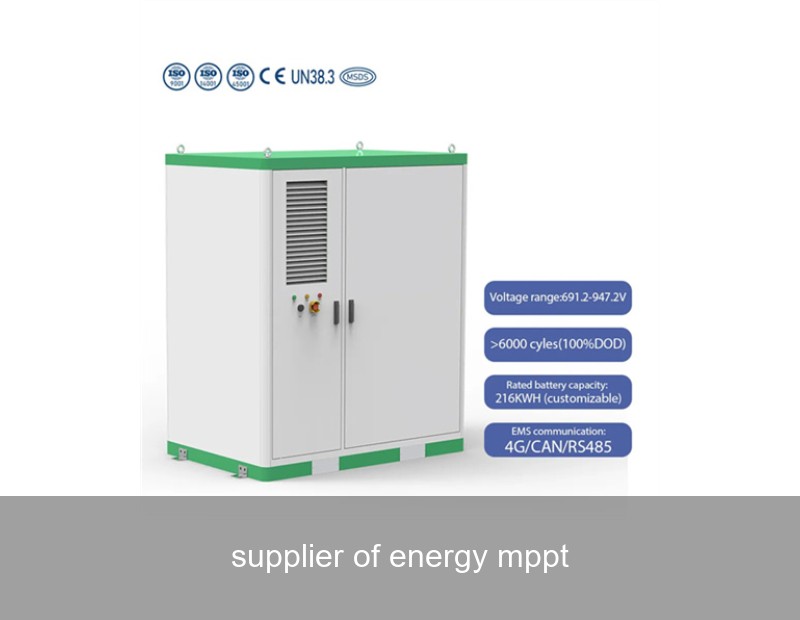
If you've invested in solar panels, you're already harnessing the sun's power. But are you capturing every possible watt? That's where the magic of Maximum Power Point Tracking (MPPT) comes in. Think of your solar panels as a powerful engine; an MPPT charge controller is the high-performance transmission system that ensures every ounce of that engine's power is efficiently delivered to your battery or grid. Choosing the right supplier of energy MPPT technology isn't just about buying a component—it's about selecting a partner who guarantees the intelligence, reliability, and longevity of your entire energy storage system. This guide will walk you through why this choice is critical and how it defines the success of your renewable energy project.
Table of Contents
- What is an MPPT Charge Controller & Why is it the Brain of Your Solar System?
- Why Your Choice of MPPT Supplier Matters: Beyond the Spec Sheet
- From Theory to Reality: A German Industrial Case Study
- The Highjoule Approach: Intelligent MPPT Within Integrated Storage Systems
- Key Criteria for Selecting Your Energy MPPT Supplier
- The Future of MPPT: AI, Grid Services, and Beyond
What is an MPPT Charge Controller & Why is it the Brain of Your Solar System?
Let's break down the science simply. Solar panel output isn't constant; it fluctuates with temperature, shading, and sunlight intensity. Each condition creates a unique "sweet spot" (the Maximum Power Point) for voltage and current. A basic charge controller misses this nuance. An MPPT controller, however, continuously scans and tracks this point in real-time, dynamically adjusting its input to extract up to 30% more power from the same array compared to older technologies.
For system owners, this translates directly to your bottom line:
- Higher Energy Yield: More kilowatt-hours (kWh) harvested daily, especially in non-ideal weather.
- Faster ROI: Maximized production accelerates the payback period on your solar investment.
- System Flexibility: Allows for higher voltage array designs (like string configurations), reducing wire costs and energy losses over long distances.

Image: The intelligence of modern MPPT technology is embedded within sophisticated hardware. Source: Unsplash
The Data Behind the Efficiency
According to the National Renewable Energy Laboratory (NREL), advanced power electronics like MPPT are pivotal in reducing the Levelized Cost of Energy (LCOE) for solar. Their research indicates that incremental improvements in inverter and controller efficiency have a compounding effect on overall system lifetime yield. This isn't minor tweaking; it's fundamental to making solar energy more competitive and reliable.
Why Your Choice of MPPT Supplier Matters: Beyond the Spec Sheet
Many suppliers offer boxes with impressive-looking MPPT specs. But the true value of a supplier of energy MPPT lies in the embedded software algorithms, the robustness of the hardware, and the depth of system integration. A low-cost, generic MPPT might claim 98% efficiency, but that's often a peak, laboratory-condition figure. In the real world, with partial shading or rapid cloud cover, its performance can plummet.
A leading supplier differentiates itself through:
- Advanced Algorithms: Sophisticated tracking logic (like perturb-and-observe or incremental conductance) that reacts swiftly to changing conditions without "getting lost."
- Thermal & Electrical Durability: Components built to withstand decades of temperature cycles and electrical stress.
- Seamless Integration: MPPT that communicates intelligently with the battery management system (BMS) and grid interface for holistic control.
From Theory to Reality: A German Industrial Case Study
Consider a manufacturing plant in Bavaria, Germany. They installed a 500 kWp rooftop solar array to offset high daytime energy costs and ensure production resilience. Their initial system used standard inverters with basic MPPT. An energy audit revealed they were losing an estimated 12-15% of potential yield due to complex shading from ventilation units and suboptimal tracking.
The solution involved partnering with a technology provider to upgrade the power conversion system. By implementing a decentralized inverter setup with advanced, multi-channel MPPT controllers, they could manage smaller, independent array sections. The results, monitored over one year, were compelling:
| Metric | Before Upgrade | After Upgrade | Change |
|---|---|---|---|
| Annual Solar Yield | 485,000 kWh | 548,000 kWh | +13% |
| Self-Consumption Rate | 68% | 79% | +11% |
| Grid Energy Cost Savings | €58,200/yr | €78,500/yr | +€20,300/yr |
This case, documented in part by the Fraunhofer Institute for Solar Energy Systems (ISE), highlights that the choice of MPPT technology, when applied thoughtfully, has a direct, measurable impact on commercial viability.
The Highjoule Approach: Intelligent MPPT Within Integrated Storage Systems
At Highjoule, we understand that MPPT is not a standalone widget. It is a core intelligence layer within our comprehensive energy storage solutions. Since 2005, we have engineered our Helios Series Hybrid Inverters and Atlas Commercial Battery Systems with proprietary MPPT algorithms that are fine-tuned for real-world volatility.
What does this mean for our clients in Europe and North America?
- Hyper-Fast Tracking: Our MPPT reacts to changing irradiance up to 5x faster than industry standard, minimizing power dips during passing clouds.
- Battery-Synced Charging: The MPPT doesn't work in a vacuum. It communicates directly with our high-density lithium-ion battery BMS to optimize charging curves, extending battery cycle life by reducing stress.
- Scalable Architecture: For large-scale commercial or microgrid applications, multiple Highjoule units with independent MPPTs can be configured to manage massive, complex arrays with different orientations, ensuring no single point of failure.
By choosing Highjoule as your supplier of energy MPPT and integrated storage, you're not just buying hardware; you're acquiring a system engineered for holistic performance and durability.

Image: Monitoring performance is key for large-scale systems. Source: Unsplash
Key Criteria for Selecting Your Energy MPPT Supplier
Ready to evaluate potential partners? Move beyond the basic efficiency percentage and ask these questions:
- Tracking Efficiency vs. Peak Efficiency: "What is the weighted or European efficiency rating across a range of power levels?"
- Partial Shading Performance: "How does your MPPT algorithm handle multiple power peaks caused by shading? Can you provide test data?"
- Warranty & Longevity: "Does your warranty cover 10+ years, and what is the projected lifespan of the key capacitors in your design?"
- Grid & Storage Integration: "How does your MPPT controller interact with battery storage for off-grid backup or time-of-use optimization?"
- Local Support: "Do you have technical support and service capabilities in my region (EU/U.S.)?"
The Future of MPPT: AI, Grid Services, and Beyond
The evolution of MPPT is moving from simple tracking to predictive energy management. Imagine controllers that use AI and weather forecast data to pre-adjust operating points. Or MPPT systems that can intentionally curtail output in a controlled manner to provide grid frequency regulation services—a concept known as advanced inverter functions mandated in markets like California and Hawaii.
The leading supplier of energy MPPT today is already investing in these software-defined capabilities. The question is, will your chosen partner's technology be ready to adapt, or will it become obsolete?
Your Next Step: A Question of Optimization
We've explored the critical role of MPPT and the substantial impact of your supplier choice. The technology is advancing rapidly, turning solar arrays from passive generators into active, grid-supportive assets. As you plan your next project or consider an upgrade, ask yourself this: Is my current energy system simply generating power, or is it intelligently optimizing every single photon for maximum financial and operational resilience?
 Inquiry
 Online Chat