


Choosing the Right Bateria para Energia Solar Off Grid: Your Guide to Reliable Freedom
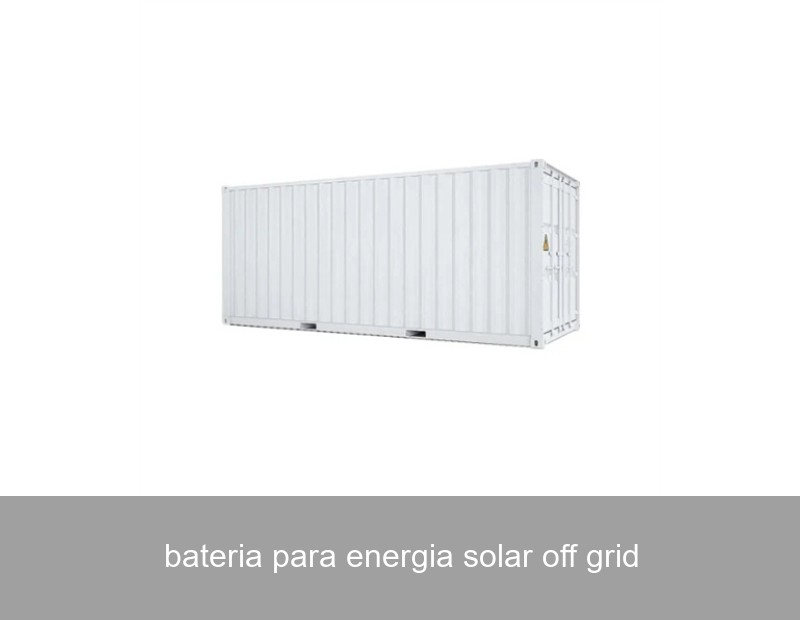
Imagine a home, farm, or remote business, humming with activity, entirely powered by the sun. No grid connection, no monthly bills, just clean, self-sufficient energy. This is the promise of off-grid solar. But ask anyone who lives this reality, and they'll tell you the true hero of the system isn't just the solar panels—it's the bateria para energia solar off grid, the battery bank that stores sunshine for a rainy day (or a quiet night). Choosing the wrong battery can turn this dream of energy independence into a cycle of frustration and premature replacement costs. This article will guide you through the critical considerations, backed by data and real-world examples, to ensure your off-grid investment is solid, efficient, and sustainable for the long haul.
Table of Contents
- The Core Challenge: More Than Just Storing Watts
- Key Metrics for Your Off-Grid Solar Battery
- Technology Showdown: Lead-Acid vs. Lithium-Ion
- Sizing Your System: A Real-World Case Study
- Beyond the Battery: The System Integration Imperative
- The Highjoule Solution: Engineered for Off-Grid Resilience
- Future Trends and Your Next Step
The Core Challenge: More Than Just Storing Watts
Off-grid living means your battery bank is your sole backup. It's not just a component; it's your lifeline during consecutive cloudy days or periods of high demand. The primary challenge isn't simply capacity—it's cycle life and depth of discharge (DoD). A typical off-grid battery undergoes one full charge/discharge cycle nearly every day. Over 10 years, that's over 3,650 cycles. A standard automotive battery would fail in months under this strain.
This is where purpose-built bateria para energia solar off grid differs. They are engineered for deep, regular cycling. According to data from the National Renewable Energy Laboratory (NREL), the lifetime cost of an energy storage system is heavily influenced by how deeply you can use the battery daily without significantly degrading it.

Image source: Unsplash - A robust battery bank is the heart of any reliable off-grid solar system.
Key Metrics for Your Off-Grid Solar Battery
When evaluating a bateria para energia solar off grid, focus on these four pillars:
- Usable Capacity (kWh): The actual energy you can use after accounting for Depth of Discharge (DoD). A 10kWh battery with 90% DoD offers 9kWh of usable energy.
- Cycle Life at a Given DoD: The number of charge/discharge cycles the battery can deliver before its capacity drops to a specified percentage (often 80%) of its original capacity. Look for data at 80-90% DoD.
- Round-Trip Efficiency: The percentage of energy put into the battery that you can get back out. Higher efficiency (e.g., 95-98% for lithium) means less solar energy is wasted as heat.
- Temperature Range & Self-Discharge: Off-grid systems face environmental extremes. A good battery must operate reliably in both cold and heat and lose very little charge when idle.
| Metric | Advanced Lead-Acid (AGM/Gel) | Lithium Iron Phosphate (LiFePO4) | Why It Matters for Off-Grid |
|---|---|---|---|
| Typical Cycle Life (to 80% capacity) | 1,000 - 1,500 cycles at 50% DoD | 6,000+ cycles at 90% DoD | Directly determines the system's lifespan and long-term cost. |
| Depth of Discharge (Safe) | ~50% | ~90% | For the same usable energy, a lithium battery needs only half the nameplate capacity. |
| Round-Trip Efficiency | ~80-85% | ~95-98% | Higher efficiency reduces the size and cost of your solar array. |
| Maintenance | Periodic equalization; must be kept fully charged | Essentially maintenance-free | Reduces operational hassle and risk of accidental damage. |
Technology Showdown: Lead-Acid vs. Lithium-Ion
For decades, flooded lead-acid batteries were the default choice. Today, Lithium Iron Phosphate (LiFePO4) chemistry has become the new standard for demanding off-grid applications. Let's break down why.
The Legacy Workhorse: Lead-Acid
They have lower upfront cost per kWh of nameplate capacity. However, their need for a shallow DoD (often 50%) means you can only use half of what you pay for. They require ventilation, regular maintenance, and degrade faster if not kept at 100% state of charge—a challenge with variable solar input.
The Modern Powerhouse: LiFePO4
While the initial investment is higher, the total cost of ownership over 15+ years is typically lower. The ability to use nearly the full capacity daily without harm, coupled with a cycle life 4-6 times longer, translates to fewer replacements. Their compact size, lighter weight, and plug-and-play installation are significant advantages. As noted by the U.S. Department of Energy's Solar Energy Technologies Office, advancements in lithium-ion batteries are a key driver for reducing the cost and improving the reliability of solar-plus-storage systems.
Sizing Your System: A Real-World Case Study
Let's move from theory to practice with a case from the Rocky Mountains, USA.
Project: A family of four's off-grid homestead.
Daily Energy Need: 12 kWh (including well pump, refrigerator, lighting, and occasional power tools).
Autonomy Requirement: 3 days of backup without sun (common in winter).
Battery Sizing Comparison:
- Option A (Lead-Acid, 50% DoD): Needed 24 kWh of nameplate capacity to get 12 kWh usable. For 3 days: 72 kWh nameplate capacity required.
- Option B (LiFePO4, 90% DoD): Needed 13.3 kWh nameplate to get 12 kWh usable. For 3 days: 40 kWh nameplate capacity required.
The result? The lithium-based system required nearly 45% less physical battery capacity to meet the same resilience goal, saving substantial space and balance-of-system costs. The family chose a Highjoule HPS-15 lithium battery stack, providing 15.36 kWh of storage per unit. With three units configured for 90% DoD, they achieved over 41 kWh of usable storage, exceeding their requirement with a compact, wall-mounted solution guaranteed for 10 years.

Image source: Unsplash - Modern, compact LiFePO4 battery systems save space and simplify installation.
Beyond the Battery: The System Integration Imperative
A battery is only as good as the ecosystem it lives in. The battery management system (BMS), inverter compatibility, and system monitoring are critical. A weak BMS can lead to cell imbalance and failure. An inverter that can't communicate with the battery may not charge it optimally, reducing lifespan.
This is where choosing an integrated solution from a single provider pays massive dividends in reliability and performance.
The Highjoule Solution: Engineered for Off-Grid Resilience
At Highjoule, with nearly two decades of experience in advanced energy storage, we've designed our HPS (Highjoule PowerStack) Series specifically for the rigors of off-grid living. We understand that a bateria para energia solar off grid must be more than a commodity; it must be a resilient power asset.
Our LiFePO4-based HPS batteries feature:
- Ultra-Long Cycle Life: Engineered for 6,000+ cycles at 90% DoD, ensuring a lifespan that matches your long-term commitment to energy independence.
- All-Climate Resilience: An integrated thermal management system allows for safe operation and charging in a wide temperature range (-20°C to 50°C), crucial for unheated cabins or sun-exposed installations.
- Scalable Architecture: Start with a single 15.36 kWh module and stack up to form a massive storage bank, allowing your system to grow with your needs.
- Seamless Integration: Our batteries come with a sophisticated BMS that communicates flawlessly with our own line of Highjoule Hybrid Inverters and most major third-party inverters, ensuring optimal charge profiles and system health monitoring through our user-friendly Highjoule Energy Cloud app.
For complex microgrid or large commercial off-grid applications, our engineering team provides custom design services, ensuring every component from solar arrays to generator backups works in perfect harmony with the storage core.
Future Trends and Your Next Step
The landscape of bateria para energia solar off grid is evolving. We see trends like AI-driven energy forecasting to optimize usage, and even second-life EV batteries finding applications in large-scale off-grid storage. The core principle remains: investing in quality, chemistry-appropriate, and well-integrated storage is non-negotiable.
Your energy independence journey is unique. What specific challenge—be it sizing for a seasonal load, integrating an existing generator, or simply navigating the initial investment—is your biggest question as you plan your off-grid power system?
 Inquiry
 Online Chat