


Choosing the Right Supplier of PV Combiner for a Safe and Efficient Solar Array
If you're planning a commercial or industrial solar installation, you've likely encountered a long list of critical components. Beyond the panels and inverters, there's one unsung hero that plays a pivotal role in the safety, performance, and monitoring of your entire system: the PV combiner box. Selecting a reliable supplier of PV combiner solutions isn't just a procurement task; it's a foundational decision for your project's long-term health. A high-quality combiner box consolidates multiple strings of solar panels, provides overcurrent protection, and often serves as the first point of monitoring data collection. Conversely, a subpar unit can become a single point of failure, risking downtime, revenue loss, and even safety hazards. So, how do you navigate this crucial choice? Let's break down what matters.
Table of Contents
The Critical Role of a PV Combiner Box: More Than Just a Junction Box
Think of your PV array as a team of athletes. Each string of panels is like a runner generating power. The PV combiner box is the coach that gathers all their individual efforts, monitors their performance, and protects them from harm. Its primary functions are:
- Consolidation: Combining the DC output from multiple panel strings into a single set of conductors leading to the inverter.
- Protection: Housing fuses or circuit breakers to protect each string from overcurrent faults and reverse currents.
- Isolation: Providing a safe means to disconnect strings for maintenance via DC disconnect switches.
- Monitoring (in advanced models): Integrating current sensors, voltage monitors, and communication devices to provide real-time, string-level performance data.
Given its role, the quality and design of the combiner box directly impact system safety (mitigating fire risk from DC arcs), efficiency (minimizing power loss), and operational intelligence. This is why your choice of supplier of PV combiner equipment must be based on more than just price per unit.
5 Essential Traits of a Top-Tier PV Combiner Supplier
Not all suppliers are created equal. When evaluating a potential partner, look for these five non-negotiable traits:
| Trait | Why It Matters | What to Look For |
|---|---|---|
| 1. Deep Electrical Engineering Expertise | Combiner boxes deal with high-voltage DC, which poses unique arc flash and safety challenges. The design must be robust. | Suppliers with in-house engineering teams and a focus on UL and IEC standards compliance for your region (e.g., UL 1741, IEC 62933). |
| 2. Proven Quality & Durability | These boxes live outdoors for 20+ years, exposed to UV, moisture, heat, and corrosion. | IP65 or higher ingress protection ratings, corrosion-resistant materials (e.g., stainless steel hardware), and a track record of reliability. |
| 3. System Integration Capability | A combiner shouldn't be an island. It should seamlessly communicate with your broader energy management system. | Suppliers who offer integrated solutions with monitoring platforms, inverters, and battery storage for holistic control. |
| 4. Customization & Scalability | Every project is unique. Off-the-shelf boxes may not fit complex layouts or future expansion plans. | A willingness and ability to provide custom configurations, extra ports, or specific monitoring protocols. |
| 5. Global Support & Certification | For projects in Europe and the US, local certifications and accessible technical support are mandatory. | CE marking, UL listings, and a responsive support network with local language service. |
Case Study: Enhancing Uptime and Visibility for a European Logistics Hub
Let's look at a real-world application. A major logistics company in Germany operates a 2.1 MW rooftop solar array across its distribution center. The initial installation used basic, off-the-shelf combiner boxes with no monitoring. When a 5% dip in overall yield occurred, technicians spent weeks manually checking strings to locate the fault—a combination of partial shading and a single failing module in one string.
They partnered with Highjoule to retrofit the system with our IntelliCombine Series of smart PV combiner boxes. These units feature integrated, per-string current monitoring and wireless data transmission to Highjoule's EnergyOS platform.
The Results?
- Fault Detection Time Reduced: From weeks to less than 2 hours. The platform immediately pinpointed the underperforming string.
- Operational Savings: Estimated 35% reduction in annual O&M costs for the solar asset.
- Yield Recovery: By quickly addressing the faulty module and optimizing string layouts, the site recovered over 97% of its expected annual output.
This case underscores that the right supplier of PV combiner technology provides not just a component, but a diagnostic tool that protects your investment's ROI. NREL research consistently shows that advanced monitoring is key to maintaining optimal PV system performance.

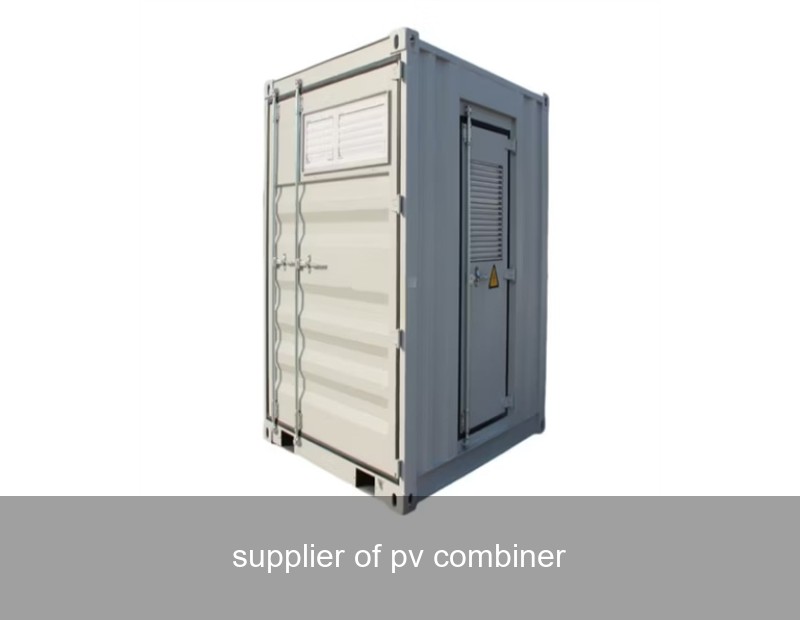
Image: A robust, properly installed PV combiner is essential for commercial-scale solar reliability.
Beyond the Box: The Integrated System Advantage from Highjoule
At Highjoule, we view the PV combiner not as a standalone commodity, but as a critical node in an intelligent energy network. Founded in 2005, our approach has always been system-first. Our IntelliCombine Series is designed to be the eyes and ears of your solar array, but its true power is unlocked when connected to our broader ecosystem.
- Seamless Integration: Our combiners feed granular, string-level data directly into the Highjoule EnergyOS platform. This gives you a unified dashboard for your entire energy asset—solar, storage, and consumption.
- Proactive Alerts & Analytics: Move from reactive maintenance to proactive management. Get instant notifications on string imbalances, ground faults, or performance deviations before they impact your bottom line.
- Storage-Ready Design: Planning to add a Battery Energy Storage System (BESS)? Our combiner architecture is designed to interface cleanly with Highjoule's GridTitan BESS, facilitating smoother DC coupling options and more efficient system design. This holistic thinking is what sets a true solution provider apart from a mere component supplier of PV combiner boxes.
For more on the importance of system integration, the International Energy Agency (IEA) highlights the growing need for innovation across the entire solar PV supply chain to ensure reliability and sustainability.
The Future of PV Combiner Technology: What's on the Horizon?
The humble combiner box is getting smarter. As a leading supplier of PV combiner and advanced energy solutions, Highjoule is investing in next-generation features:
- Advanced Safety: Integration of rapid shutdown devices (mandatory under NEC 2017 and later in the US) and enhanced arc-fault detection within the combiner unit itself.
- AI-Powered Diagnostics: Moving beyond simple monitoring to predictive analytics. Can the data from your combiners predict a failing connector or degrading cable before it causes an outage? We're working on it.
- Plug-and-Play Microgrid Integration: Combiners that can autonomously interact with other microgrid components (like our battery systems) to form stable, islandable grids during utility outages.

Image: The future lies in transforming combiner data into actionable intelligence.
Your Next Step: Key Questions to Ask Your Potential Supplier
Choosing a partner is a conversation. Before you decide on a supplier of PV combiner equipment, we encourage you to ask them these pointed questions:
- Can you provide a specific, documented case study of your combiner boxes performing in a climate and application similar to mine?
- How does your combiner's monitoring system integrate with other major inverter or BESS brands, or with your own energy management software?
- What is your process for providing custom configurations, and what is the typical lead time?
- What does your post-installation support structure look like? Do you offer remote diagnostics based on the data from my combiners?
The energy landscape is complex, but your choice for critical components shouldn't add to that complexity. Are you ready to evaluate your solar project's components not just as parts, but as partners in long-term performance?
 Inquiry
 Online Chat