


How Much Does TM Solar Power Really Cost? A Real-World Breakdown
You've likely seen the ads and heard the buzz: "Go solar, save money." But when you start digging into the details for your home or business, one question quickly rises to the top: how much does TM solar power actually cost? The initial price tag you get quoted is just the beginning of the story. The true cost—and more importantly, the true value—of a solar power system is a blend of technology, financing, long-term performance, and the often-overlooked hero: intelligent energy storage. Let's demystify the real economics behind your switch to solar.
Breaking Down the "Sticker Price": More Than Just Panels
Asking "how much does TM solar power cost?" is like asking "how much does a house cost?" The answer depends dramatically on size, quality, and location. For a typical residential system in the US or Europe, you might see averages between $15,000 and $25,000 before incentives. But what does that buy you?
- Solar Panels (The Generators): Typically 40-50% of the cost. Efficiency and warranty differ.
- Inverters (The Translators): Converts DC solar energy to usable AC power for your home.
- Mounting & Hardware (The Foundation): The crucial skeleton on your roof.
- Installation & Permitting (The Expertise): Labor, engineering, and navigating local regulations.
However, this traditional breakdown misses a critical component for modern energy independence. A system designed only to offset daytime grid use leaves significant savings and resilience on the table.
The Hidden Variables That Shift the Math
Your final TM solar power cost is influenced by: your region's sunlight (solar irradiance), current electricity rates (soaring in many parts of Europe and the US), available tax credits and rebates (like the US Investment Tax Credit or various EU grants), and your chosen financing (cash purchase, loan, lease).

Image Source: Unsplash - A modern solar installation is a significant investment, but the long-term payoff depends on intelligent design.
The Storage Game-Changer: Why Your Solar Quote is Incomplete Without It
Here's the pivotal insight: solar panels only produce when the sun shines. Without storage, excess energy you don't use immediately is often sold back to the grid at a low rate, only for you to buy it back at night at a high rate. This is where the economics transform.
Adding a battery energy storage system (BESS) turns your solar array into a true 24/7 power plant. You store your cheap, clean solar energy and use it during peak evening hours when grid rates are highest. The question evolves from "how much does TM solar power cost" to "how much can my solar and storage system save me over its lifetime?"
Levelized Cost of Energy (LCOE): The True Metric
Experts use Levelized Cost of Energy (LCOE) to compare energy sources. It's the total lifetime cost divided by total energy produced. For solar plus storage, a key advantage is price predictability. You're locking in energy costs for 25+ years, insulating yourself from volatile utility rates. According to a Lazard's 2023 report, the cost of solar has fallen 90% since 2009, and when paired with storage, it becomes a compelling alternative to traditional peaking power plants.
A Real-World Case Study: Solar + Storage in Action
Let's move beyond theory. Consider a medium-sized commercial bakery in Bavaria, Germany. Facing electricity costs of over €0.32/kWh and frequent grid constraints, they needed a solution.
- Challenge: High operational costs from energy-intensive ovens and refrigeration, compounded by peak demand charges.
- Solution: A 150 kW rooftop solar PV system paired with a 240 kWh Highjoule H2-Stack Commercial battery storage system.
- Outcome: The system was commissioned in early 2023. The solar array covers ~40% of daytime load. The intelligent Highjoule BESS stores excess solar and strategically discharges during peak evening operation and grid price spikes.
| Metric | Before System | After System (First Year) |
|---|---|---|
| Monthly Grid Energy Cost | ~€8,500 | ~€4,200 |
| Peak Demand Charges | High, variable | Reduced by 60% |
| Grid Independence | 0% | ~75% during daylight/sunny periods |
| CO2 Emissions | Baseline | Reduced by 52 tonnes annually |
The bakery's projected payback period is under 7 years, thanks to Germany's high energy prices and the system's intelligent software that maximizes every kilowatt-hour. This is the real answer to "how much does TM solar power cost"—it's an investment with a clear, calculable return.
The Highjoule Solution: Intelligent Systems for Maximum ROI
At Highjoule, we believe the right question isn't about upfront cost, but about lifetime value. Since 2005, we've engineered advanced storage systems that are the perfect complement to TM solar power installations, ensuring you capture the full financial and operational benefit.
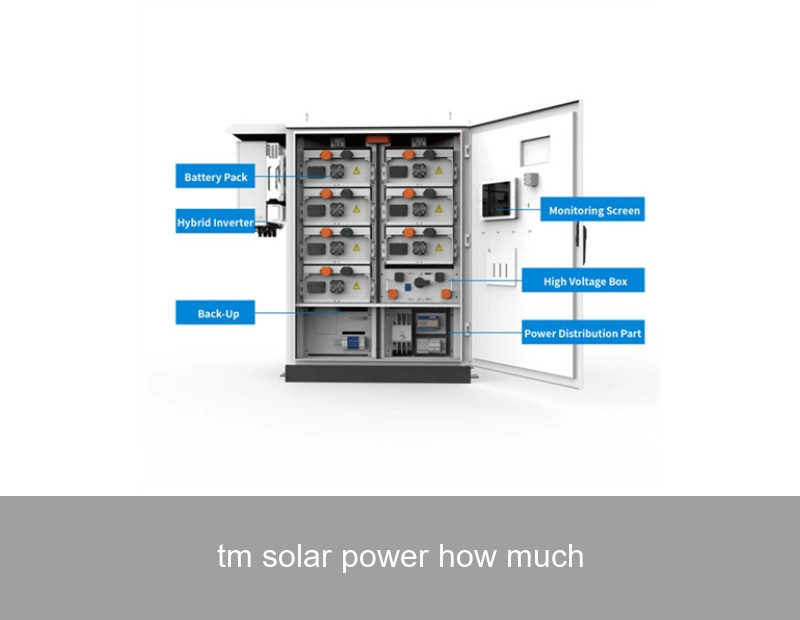
Our H-Series battery storage systems, like the H2-Stack used in the bakery case, are built with longevity and safety in mind. They feature:
- High-Density Lithium Iron Phosphate (LFP) Chemistry: Renowned for safety, long cycle life (10,000+ cycles), and stable performance.
- Adaptive Power Management Software: This is the true brain. It doesn't just store and release energy; it learns your consumption patterns, integrates with weather forecasts, and automatically chooses the most economical moments to charge or discharge, considering time-of-use rates and demand charges.
- Scalable Architecture: From residential (H1-Res series) to large commercial and microgrid applications, systems can be scaled to meet exact needs.

Image Source: Unsplash - A modern BESS unit, similar to Highjoule's H-Series, is compact, safe, and the key to unlocking solar's full potential.
By integrating a Highjoule system, the TM solar power how much equation shifts positively. You increase your self-consumption of solar energy from ~30-40% to 70% or more, dramatically cutting bills. Our systems also provide seamless backup power, a value that's hard to quantify until the grid goes down.
Future-Proofing Your Investment
The energy landscape is shifting. Utilities are moving toward less favorable net metering policies, as seen in California's NEM 3.0 and similar discussions in Europe. These changes make storing your own energy more valuable than ever. A solar-only system under these new rules has a longer payback period, while a solar+storage system is future-proofed, as noted by research from the U.S. Department of Energy's Solar Energy Technologies Office.
Furthermore, with the rise of electric vehicles, a home or business energy system is no longer an island. Your TM solar power setup, coupled with a Highjoule battery, can be the cornerstone for charging your EV with cheap, clean solar energy, further displacing fossil fuels and saving money.
So, What's Your Next Step?
The journey to answering "how much does TM solar power cost" for your specific situation starts with a detailed energy analysis. Look beyond the per-watt panel price. Request quotes that include intelligent storage options and software management. Ask for projected 20-year savings analyses, not just 1-year estimates.
What single energy cost on your utility bill—be it the peak demand charge, the exorbitant evening rate, or the general volatility—is the biggest motivator for you to take control with solar and storage?
 Inquiry
 Online Chat