


Understanding Tubular Battery 150 Ah Price: Value Beyond the Initial Cost
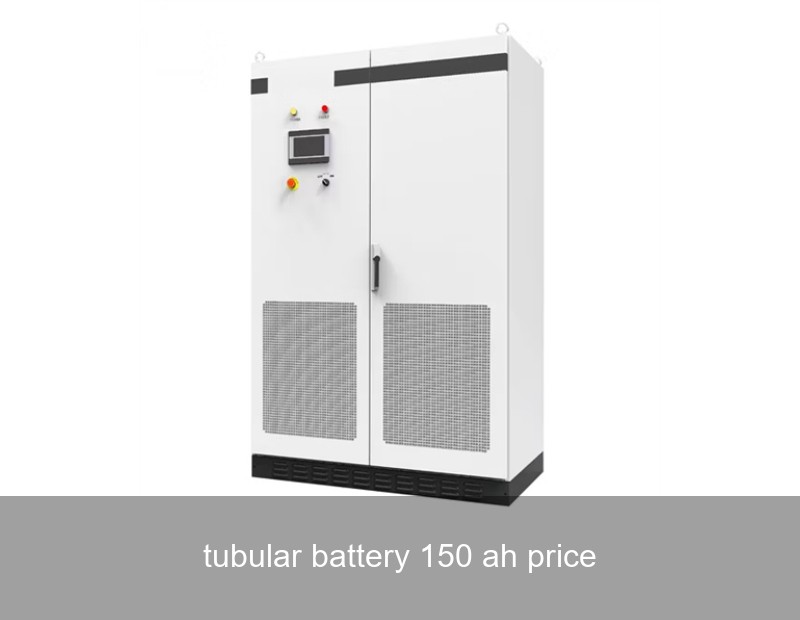
When you start shopping for a reliable energy storage solution, perhaps for your solar setup or as a backup power source, the "tubular battery 150 ah price" is often one of the first things you search for. It's a logical starting point. However, focusing solely on the sticker price can be misleading. The true cost of ownership—and the real value—of a tubular battery is determined by its longevity, performance, and how well it integrates into your overall energy system. As a global leader in advanced energy storage, Highjoule has seen how the right battery technology, paired with intelligent management, can transform energy reliability and ROI. Let's delve into what truly influences the price and performance of a 150Ah tubular battery.
Table of Contents
- The Tubular Battery Advantage: More Than Just Capacity
- Decoding the Price Tag: Key Factors Influencing Cost
- The Real-World Test: A Case Study from Southern Europe
- Beyond the Battery: The System Integration Imperative
- Highjoule's Approach: Smart Storage for Demanding Applications
- Making the Right Investment: Key Questions to Ask
The Tubular Battery Advantage: More Than Just Capacity
First, what makes a tubular plate battery special? Unlike flat plate batteries, tubular batteries feature a unique design where the positive plate consists of a series of vertical tubes filled with active material. This design offers superior resilience against shedding and corrosion, the two main enemies of battery life.
- Enhanced Deep Cycle Capability: They are engineered to be discharged deeply (up to 70-80%) regularly and recharged, making them ideal for renewable energy and backup systems.
- Longer Lifespan: A quality tubular battery can last 5-8 years or more with proper maintenance, compared to 2-4 years for many flat plate alternatives. This directly impacts the total cost of ownership.
- Better Performance in High Temperatures: The robust construction offers better tolerance to the heat, a critical factor in sun-drenched regions of Europe and the US.
So, when you see a tubular battery 150 ah price, you're not just paying for 150 ampere-hours of capacity. You're investing in a more durable and cycle-resistant architecture. The initial price is higher, but the cost per cycle over its lifetime is often significantly lower.

Image Source: Wikimedia Commons (Creative Commons). A close-up view showing the durable tubular plate design.
Decoding the Price Tag: Key Factors Influencing Cost
The price range for a 150Ah tubular battery can vary widely. Understanding why is key to making an informed purchase.
| Factor | Impact on Price & Performance |
|---|---|
| Plate Material & Construction | Batteries with high-purity lead, thicker tubes, and robust spines cost more but ensure longer life and better deep discharge recovery. |
| Brand Reputation & Warranty | Established brands with strong after-sales support and longer warranties (e.g., 5+ years) often command a premium, which is insurance against premature failure. |
| Maintenance Requirements | Low-maintenance or "zero-maintenance" flooded types and sealed AGM/GEL variants have different price points and suit different installation environments. |
| Market & Logistics | Local import duties, shipping costs for heavy items, and regional market competition all affect the final retail price in the EU or USA. |
It's crucial to look at specifications like the expected cycle life at a specific Depth of Discharge (DoD). A battery rated for 1500 cycles at 50% DoD is fundamentally a different product—and offers better long-term value—than one rated for 800 cycles at the same DoD, even if their 150Ah capacity and initial tubular battery 150 ah price appear similar.
The Real-World Test: A Case Study from Southern Europe
Let's move from theory to practice. Consider a mid-sized agri-business in Andalusia, Spain. They installed a 20kW solar PV system with a 48V battery bank comprising four 150Ah tubular batteries for off-grid irrigation and farm building power.
- Challenge: High daily energy demand with deep discharge cycles, coupled with ambient temperatures often exceeding 35°C (95°F) in summer.
- Initial Decision: They opted for a mid-tier tubular battery solution, primarily driven by a lower upfront tubular battery 150 ah price.
- Outcome Data: Within two years, capacity had degraded by nearly 40%. The batteries struggled to hold a full charge and required frequent water topping-up. The intense heat accelerated corrosion and water loss.
- Revised Solution: They replaced the bank with premium, high-temperature tolerant tubular batteries and integrated a smart battery management system (BMS) for precise charging control.
- Result: Three years into the new installation, capacity degradation is measured at less than 15%. The smart BMS optimizes charging voltage based on temperature, extending lifespan. The total cost per kWh stored is now projected to be 30% lower over 7 years.
This case highlights that the cheapest upfront tubular battery 150 ah price can lead to higher long-term costs and operational headaches. The integration of intelligent control was a game-changer.
Beyond the Battery: The System Integration Imperative
A battery does not operate in isolation. Its performance and lifespan are heavily dependent on the charger/inverter and the control logic governing it. An overcharging inverter can boil a battery dry in months, while undercharging leads to sulfation.
This is where modern energy storage systems have evolved. The focus is no longer on the standalone battery but on a complete, optimized storage system. For commercial and industrial applications, this system approach is non-negotiable for reliability and ROI.
Highjoule's Approach: Smart Storage for Demanding Applications
At Highjoule, we view the battery as a core component within a sophisticated energy ecosystem. Since 2005, we have moved beyond providing just components to delivering integrated, intelligent power solutions.
While we specialize in advanced lithium-ion and flow battery systems for large-scale commercial and microgrid applications, our engineering philosophy applies to all storage technologies: intelligence maximizes value. For scenarios where rugged, cost-effective deep-cycle lead-acid like tubular batteries are the right fit, our focus is on optimizing their operation through superior power electronics and software.
Our HPS (Highjoule PowerStack) Series for commercial buildings and the HES (Highjoule Energy Storage) solutions for microgrids exemplify this. These systems can be configured with various battery chemistries and are governed by our proprietary Adaptive Charge Management software. This software dynamically adjusts charging parameters based on battery temperature, age, and usage patterns, effectively extending the service life of any connected battery bank—whether it's a high-end lithium or a robust tubular lead-acid setup.

Image Source: Unsplash. A modern, integrated energy storage system in an industrial setting.
By ensuring each battery, regardless of its individual tubular battery 150 ah price point, operates within its ideal parameters, we unlock its full potential lifespan and performance. This system-level approach is what delivers true sustainability and cost-efficiency for our clients across Europe and North America.
Making the Right Investment: Key Questions to Ask
Before you make a decision based on a quoted tubular battery 150 ah price, ask your supplier these critical questions:
- What is the expected cycle life at my typical daily Depth of Discharge (e.g., 50%, 70%)?
- How does the warranty handle capacity degradation over time (e.g., guaranteed 60% capacity at end of warranty period)?
- What are the recommended charging parameters, and how does my existing inverter/charger comply?
- For my specific application—be it a remote home, a clinic, or a telecom tower—is a standalone battery sufficient, or would a managed storage system provide better protection and ROI?
For authoritative information on battery testing and standards, you can refer to resources from the International Electrotechnical Commission (IEC) or studies published by the National Renewable Energy Laboratory (NREL).
 Inquiry
 Online Chat