


Understanding Weather Station for Solar PV Plant Price: A Smart Investment for Energy Yield
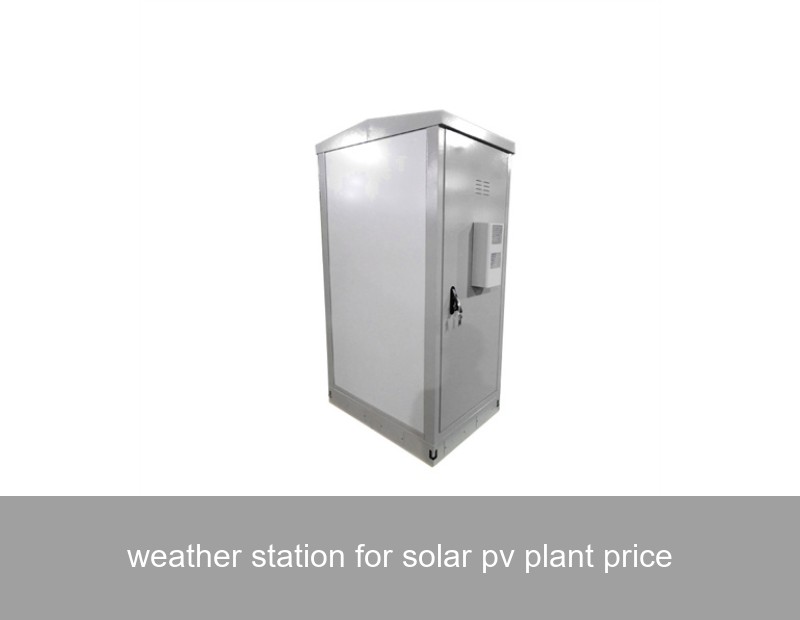
Have you ever wondered how top-performing solar farms consistently meet their energy production forecasts? The secret often lies not just in the panels themselves, but in a small, sophisticated device monitoring the skies above: the weather station for solar PV plants. While the upfront price is a consideration, this technology is a critical component for maximizing return on investment, optimizing maintenance, and ensuring grid stability. For asset managers and plant operators, it's the difference between guessing and knowing exactly how your plant should perform under any condition.
The Hidden Cost of "Blind" Operation
Imagine running a solar plant relying solely on historical weather averages or distant regional data. When actual production dips below expectations, you're left troubleshooting in the dark. Is it a technical fault, soiling, or simply less irradiance than predicted? Without on-site meteorological data, you can't accurately perform performance ratio (PR) calculations, which separate weather-related losses from technical losses. This uncertainty can lead to:
- Undetected underperformance: Revenue losses from unresolved inverter faults or soiling go unnoticed, blamed on "bad weather."
- Inefficient O&M: Scheduling cleaning or maintenance without knowing actual soiling rates or recent rainfall is a guess, not a strategy.
- Financial risk: Inaccurate energy yield assessments can complicate financing, power purchase agreements (PPAs), and insurance claims.
A dedicated solar PV weather station eliminates this blindness, providing the ground-truth data needed for precise plant analytics.
Breaking Down the Price Components
So, what determines the weather station for solar PV plant price? It's not a one-size-fits-all product. The cost spectrum, typically ranging from $5,000 to $20,000+, reflects varying capabilities and accuracy levels. Here’s a breakdown:
| Component | Typical Price Range | Critical Function | Why It Matters |
|---|---|---|---|
| Pyranometer | $1,500 - $4,000 | Measures Global Horizontal Irradiance (GHI) and Plane of Array (POA) irradiance. | The primary sensor for calculating solar energy input. Accuracy class (e.g., ISO 9060:2018 Secondary Standard) significantly impacts price and data reliability. |
| Ambient Sensors | $500 - $2,000 | Measures air temperature, humidity, barometric pressure. | Critical for understanding panel temperature coefficients and predicting performance degradation in extreme conditions. |
| Wind Speed & Direction Sensor | $800 - $2,500 | Monitors anemometer and wind vane data. | Essential for tracking cooling effects on panels, assessing mechanical stress risks, and planning safe maintenance windows. |
| Data Logger & Communication | $1,200 - $4,000 | Collects, processes, and transmits data via cellular, Ethernet, or satellite. | The brain of the system. Robustness, data security, and integration capabilities (like MODBUS, API) are key value drivers. |
| Mounting Mast & Infrastructure | $1,000 - $3,000 | Provides a stable, tiltable platform, often with solar power supply. | Ensures sensor positioning meets IEC 61724-1 standards, avoiding shading and ensuring representative data. |
Remember, the initial hardware price is just one part. Consider ongoing costs like calibration (recommended every 1-2 years for pyranometers), data subscription plans, and integration with your existing SCADA or monitoring platform.
The Real Value: Beyond the Price Tag
Viewing a weather station as a mere cost item misses the point. It's a profitability tool. High-quality data directly contributes to your plant's bottom line by:
- Boosting Revenue: Accurate irradiance data allows you to prove production losses or gains against PPA baselines. It enables precise performance guarantees.
- Reducing O&M Costs: Predictive analytics based on weather trends allow for condition-based maintenance. For instance, cleaning can be scheduled optimally after dust storms (detected by irradiance deviation) and before forecasted rain, maximizing water savings.
- Enhancing Asset Value: A data-rich operational history, backed by certified meteorological data, makes your asset more transparent and lower-risk for future investors or buyers.

Image Source: Illustrative representation of a professional-grade weather station setup. (Conceptual image)
A Real-World Case Study from Spain
Let's look at a concrete example. A 50 MW PV plant in Andalucía, Spain, was experiencing unexplained PR fluctuations of up to 3%. The O&M team, relying on satellite data alone, couldn't determine the cause. They invested in a premium on-site weather station (total installed price approx. €18,000) with a secondary standard pyranometer and a soiling sensor module.
The data revealed a critical insight: Early morning dew, followed by high dust deposition, was causing a "cementing" effect on the lower rows of panels that was not being fully cleared by occasional light rain. The satellite data was not granular enough to detect this micro-climate effect.
Action & Result: Using the precise humidity, irradiance, and soiling loss data, the operator adjusted the cleaning schedule to target post-dew periods and implemented a more effective robotic cleaning cycle. Within one quarter, they recovered an estimated 1.8% of annual energy yield. For this plant, that translated to over €45,000 in additional annual revenue, yielding a payback period for the weather station of less than 5 months.
Integrating Weather Data into Smart Energy Management
The true power of meteorological data is unlocked when it's seamlessly integrated into a broader energy management system. This is where a holistic approach from a provider like Highjoule becomes invaluable. We see weather stations not as isolated devices, but as the sensory organs of the plant's nervous system.
For instance, Highjoule's HiveMind Energy OS can ingest real-time irradiance, temperature, and wind data directly from on-site weather stations. Our platform uses this data not just for performance monitoring, but for predictive energy forecasting and advanced storage optimization.
Imagine your solar plant is coupled with a Highjoule battery energy storage system (BESS). Accurate, on-site weather forecasts (derived from station data) allow HiveMind to predict a cloud passage in 30 minutes. The system can then decide to pre-charge the batteries from the current surplus to discharge during the temporary dip, smoothing grid output and capturing market price arbitrage. This level of intelligent coordination turns raw weather data into direct financial gain and grid service opportunities. For commercial and industrial sites, this integration is key to maximizing self-consumption and reducing demand charges.

Image Source: Representative aerial image of a utility-scale solar farm. Note the meteorological mast at the perimeter. (Conceptual image)
Making the Right Investment Decision
When evaluating a weather station for your solar PV plant, look beyond the sticker price. Ask these questions:
- Does the sensor accuracy meet international standards (like IEC 61724) for commercial reporting?
- How easily does the data integrate with my existing SCADA, monitoring platform, or a sophisticated system like Highjoule's HiveMind?
- What is the provider's expertise in solar, not just meteorology? Do they understand the specific use cases like soiling analysis or performance modeling?
- Is the system future-proof? Can it accommodate additional sensors (e.g., soiling detectors, module temperature sensors) as my needs evolve?
For a deeper dive into performance monitoring standards, the IEA PVPS Task 13 offers authoritative resources on performance and operation.
Your Next Step: From Data to Action
The conversation about weather station for solar PV plant price ultimately leads to a strategic question: Are you ready to transition from passive generation to active, intelligence-driven energy asset management? The marginal increase in initial CapEx for a high-quality system is dwarfed by the long-term operational benefits and revenue assurance it provides.
What specific operational challenge—be it unexplained yield variance, inefficient cleaning cycles, or the need for more accurate forecasting for a planned BESS integration—could you solve with precise, on-site weather intelligence today?
 Inquiry
 Online Chat