


Welche Batterie für Solar? Your Guide to Choosing the Right Solar Battery
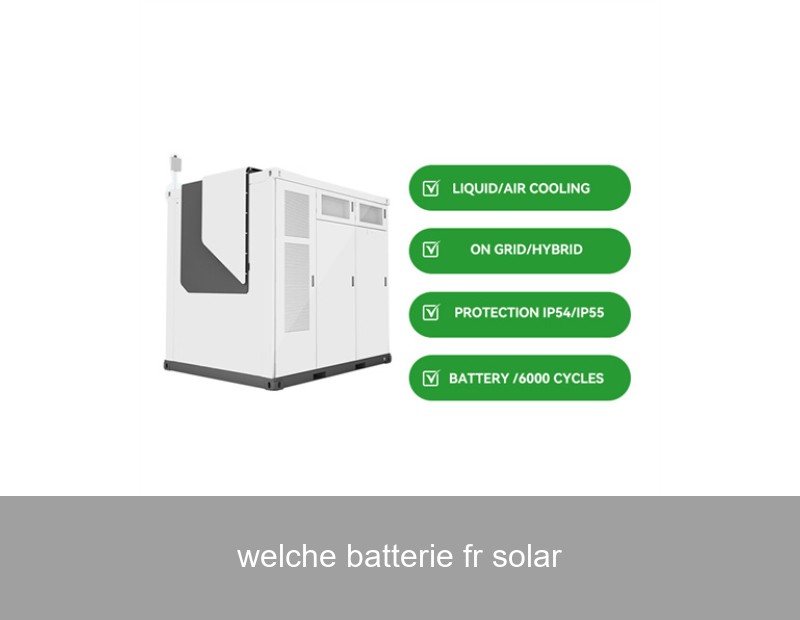
So, you've decided to harness the sun's power with a photovoltaic (PV) system. That's a brilliant first step towards energy independence. But soon, a crucial question arises: Welche Batterie für Solar is the right one for my home or business? With the solar battery market flooded with options, from lithium-ion to emerging technologies, making an informed choice can feel overwhelming. This guide will cut through the complexity. We'll explore the key factors—from battery chemistry and capacity to real-world performance—helping you select the perfect energy storage partner to maximize your solar investment.
Table of Contents
- The Challenge: Solar Power Doesn't Always Shine When You Need It
- Key Factors in Choosing Your Solar Battery
- The Chemistry Showdown: Lithium-Ion vs. Alternatives
- A Real-World Case: The Schmidt Family's Energy Transformation
- Looking Beyond the Battery: The Importance of a Complete System
- Future-Proofing Your Investment
The Challenge: Solar Power Doesn't Always Shine When You Need It
The fundamental reason for adding a battery is simple: solar production and energy consumption are rarely in sync. Your panels produce the most during midday, but your household's peak demand often occurs in the early morning and evening. Without storage, excess solar energy is fed back into the grid, often at a lower rate than the cost of purchasing power later. This mismatch is the core problem a solar battery solves.
Let's look at some data. According to the U.S. Department of Energy, pairing solar with storage can increase the self-consumption of solar electricity from 20-40% to 50-80% or more. This directly translates to lower electricity bills and greater resilience during grid outages. The phenomenon is not just about saving money; it's about taking control of your energy flow and contributing to a more stable, decentralized grid.
Key Factors in Choosing Your Solar Battery
When evaluating welche batterie für solar is suitable, you must consider more than just the price tag. Here are the critical specifications to compare:
- Usable Capacity (kWh): This is the actual amount of energy you can store and use. Some manufacturers advertise the total capacity, but a portion is often reserved to protect the battery's lifespan.
- Power Rating (kW): How much power the battery can deliver at once. A high capacity with a low power rating means you can run your lights for a long time, but not necessarily your oven or air conditioner simultaneously.
- Round-Trip Efficiency: The percentage of energy put into the battery that you can later use. A 90% efficiency means for every 10 kWh you store, you get 9 kWh back. Higher efficiency means less energy loss.
- Depth of Discharge (DoD): The percentage of the battery's capacity that can be safely used. A 90% DoD is better than 80%, as it allows you to use more of your stored energy.
- Warranty & Cycle Life: Look for a warranty that guarantees a certain capacity (e.g., 70%) after a specified number of cycles (e.g., 10,000 cycles) or years (e.g., 10 years). This is a key indicator of long-term value.
| Factor | What It Means | Why It Matters |
|---|---|---|
| Usable Capacity | Energy you can actually use (kWh) | Determines how long you can power your home |
| Power Rating | Instantaneous power output (kW) | Determines what appliances you can run at once |
| Round-Trip Efficiency | Energy retained after storage (%) | Impacts your overall energy savings |
| Depth of Discharge | How much of the battery you can use (%) | Defines the real-world utility of your investment |
The Chemistry Showdown: Lithium-Ion vs. Alternatives
Today, the market is dominated by lithium-ion technology, but not all lithium-ion batteries are the same. The two main types for home storage are Lithium Iron Phosphate (LFP) and Nickel Manganese Cobalt (NMC).
- LFP (LiFePO4): Known for exceptional safety, long cycle life, and stability. It's less energy-dense than NMC but is inherently less prone to thermal issues. This chemistry is increasingly becoming the standard for residential storage due to its longevity and safety profile. At Highjoule, our residential H-Store Prime series utilizes advanced LFP chemistry, providing a safe, reliable, and long-lasting backbone for your solar energy system.
- NMC: Offers higher energy density (more capacity in a smaller space) and can deliver higher power bursts. Historically used in EVs and some home batteries, though the trend is shifting towards LFP for stationary storage.
Alternatives like lead-acid are largely obsolete for daily cycling due to short lifespan and low DoD, while flow batteries remain niche for large-scale applications. For 99% of homeowners, a high-quality LFP battery is the most sensible, future-proof choice. 
A Real-World Case: The Schmidt Family's Energy Transformation
Let's move from theory to practice. The Schmidt family, living in a 4-person household in Bavaria, Germany, installed a 10 kWp solar system in 2020. They were exporting over 60% of their generation to the grid. In early 2023, they decided to address the "welche batterie für solar" question.
Their primary goals were to increase self-consumption and gain backup power during frequent short grid interruptions. After a detailed analysis of their consumption profile (available via their smart meter data), they chose a system with a 15 kWh usable capacity LFP battery with a 5 kW continuous power rating. The results after one year were compelling:
- Self-Consption Rate: Increased from 35% to 82%.
- Grid Independence: Achieved 78% annual energy autonomy.
- Bill Savings: Reduced their annual electricity cost by €1,850, projecting a payback period well within the warranty period.
- Backup Power: Successfully maintained essential loads (refrigeration, lighting, comms) during three grid outages totaling 14 hours.
This case, mirrored by thousands across Europe and the U.S., highlights that the right battery isn't just a component; it's the key that unlocks the full potential of a solar investment.
Looking Beyond the Battery: The Importance of a Complete System
Choosing the battery cell is only half the battle. The battery management system (BMS), the inverter compatibility, and the overall system intelligence are what turn a box of cells into a reliable energy asset. A superior BMS ensures safety, maximizes lifespan by preventing stress, and enables precise monitoring.
This is where integrated solutions from experienced providers shine. Highjoule's approach goes beyond selling batteries. We provide intelligent, AC- or DC-coupled storage systems where the battery, inverter, and energy management software are designed to work in perfect harmony. Our EnergyOS platform allows users to set preferences—like maximizing self-consumption, optimizing for time-of-use rates, or ensuring backup readiness—and the system automatically manages the complex energy flows to achieve those goals. For commercial and industrial clients, our H-Store C&I solutions offer scalable, containerized systems that manage demand charges and provide critical UPS functionality.

Future-Proofing Your Investment
The energy landscape is dynamic. When considering welche batterie für solar, think about scalability and future needs. Can you easily add more battery modules later? Is the system software-upgradable to participate in new grid services like virtual power plants (VPPs)?
VPPs are a game-changer, allowing aggregated home batteries to support the grid during peak demand, often generating revenue for the homeowner. According to a IEA report, the flexibility from distributed storage is a critical asset for grid decarbonization. Choosing a battery system from a provider like Highjoule, which is actively developing VPP partnerships across Europe and North America, means your investment could become a revenue stream, further accelerating your return.
So, as you ponder your final decision, ask yourself this: Is your goal merely to store solar energy, or is it to build an intelligent, adaptable, and resilient energy foundation for your home or business that will pay dividends for the next decade and beyond?
 Inquiry
 Online Chat