


Understanding 100 kWh Lithium Ion Battery Weight: A Key to Efficient Energy Storage
When planning a solar-plus-storage project or upgrading your facility's backup power, one of the most practical questions that arises is: how much does a 100 kWh lithium ion battery weigh? It's not just a matter of logistics. The weight of a battery system directly impacts installation requirements, structural considerations, and ultimately, the total cost of ownership. For businesses and homeowners in Europe and the US looking to harness renewable energy, understanding this critical specification is the first step toward a sound investment. In this article, we'll demystify the factors behind battery weight, explore real-world implications, and show you how advanced engineering, like that from Highjoule, is making high-capacity energy storage more powerful and more manageable than ever.
Table of Contents
- The Weight Basics: What Makes a 100 kWh Battery Heavy?
- Beyond the Number: Why Battery Weight Truly Matters
- The Highjoule Advantage: Engineering for Performance and Practicality
- A Real-World Case: Weight Considerations in Action
- Future Trends: Are Batteries Getting Lighter?
The Weight Basics: What Makes a 100 kWh Battery Heavy?
Let's address the core question directly. A typical 100 kWh lithium ion battery weight can range from approximately 600 kg to over 1,100 kg (1,300 to 2,400 lbs). That's roughly the weight of a grand piano or a small car. Why such a wide range and why so heavy? The answer lies in the battery's chemistry and construction.
The primary contributors to weight are:
- Battery Cells: The core lithium-ion cells (like NMC or LFP) contain heavy metals, electrolytes, and housing.
- Structural Enclosure: A robust metal rack or cabinet is needed to house and protect hundreds of individual cells.
- Thermal Management System: Liquid cooling plates or air cooling ducts add significant mass but are essential for safety and longevity.
- Battery Management System (BMS): The electronic brain that monitors and balances the battery.
Notably, Lithium Iron Phosphate (LFP) chemistry, known for its exceptional safety and long cycle life, often results in a slightly heavier battery per kWh than Nickel Manganese Cobalt (NMC). This is a key trade-off that system designers must consider.

Image Source: Unsplash. A look inside a modern battery energy storage system, showcasing the dense packaging of cells and components that contribute to overall weight.
Beyond the Number: Why Battery Weight Truly Matters
So, you have the number. But what does it mean for your project? The weight of a 100 kWh system isn't just a line on a spec sheet; it influences several critical aspects of your deployment.
- Installation & Logistics: Heavy batteries require specialized equipment for unloading and moving. Doorway dimensions, floor load capacity, and access routes must all be evaluated. A system weighing over 1,000 kg may need a forklift or crane, impacting installation time and cost.
- Structural Engineering: For residential garages, commercial facilities, or especially rooftop installations, the floor's weight-bearing capacity is paramount. You must ensure the structure can safely support the static load of the battery system.
- Energy Density: This is the crucial metric linking weight and performance. Measured in Wh/kg, it tells you how much energy is stored per unit of weight. A higher energy density means a lighter battery for the same capacity, offering more flexibility in siting.
| Chemistry Type | Approx. Energy Density (Wh/kg) | Impact on 100 kWh System Weight |
|---|---|---|
| NMC (Common) | 150 - 220 | Lighter End (~450 - 650 kg) |
| LFP (Common) | 120 - 180 | Heavier End (~550 - 830 kg) |
As a global leader, Highjoule optimizes these factors in our H-Series Commercial & Industrial (C&I) energy storage systems. We design with a holistic view, balancing energy density, thermal performance, and structural integrity to deliver a unit that is not only powerful but also practical to install in diverse settings, from German manufacturing plants to California warehouses.
The Highjoule Advantage: Engineering for Performance and Practicality
At Highjoule, we've tackled the weight challenge head-on since 2005. Our philosophy is that a superior battery system delivers maximum energy with minimal spatial and structural footprint. For our clients across Europe and the United States, this translates to tangible benefits.
Our flagship product for commercial applications, the Highjoule H-Stack 100, is a 100 kWh modular battery unit engineered with precision. Here’s how we address the core issues:
- Advanced Cell Integration: We source high-quality, high-energy-density LFP cells that offer the best balance of safety, lifespan, and weight for C&I applications.
- Patented Compact Cooling: Our integrated liquid cooling system is remarkably efficient and lightweight compared to bulky traditional solutions, ensuring optimal temperature control without excessive added mass.
- Modular & Scalable Design: The H-Stack 100 is designed as a building block. While one unit meets the 100 kWh mark, multiple units can be seamlessly connected. This modularity allows for easier handling (each module is maneuverable) and scalable power, all managed by our intelligent Highjoule Energy Management Platform (HEMP).

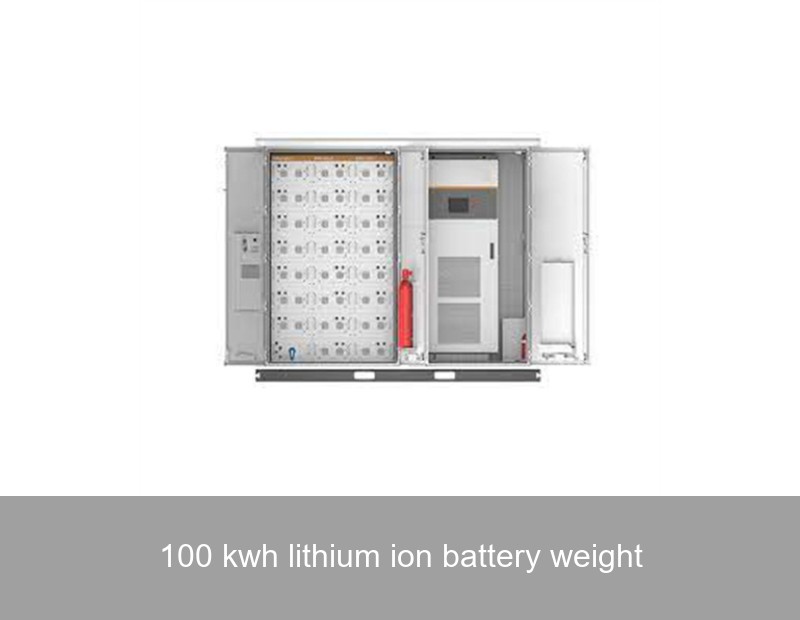
Image Source: Unsplash. Modern, cabinet-style battery storage systems like Highjoule's H-Series are designed for clean integration into commercial and industrial environments.
This thoughtful engineering results in a system where the 100 kWh lithium ion battery weight is optimized not just for the spec sheet, but for the real world—simplifying shipping, reducing installation complexity, and giving our customers more flexibility in where they place their critical energy assets.
A Real-World Case: Weight Considerations in Action
Let's look at a concrete example from our portfolio. A medium-sized dairy processing plant in the Netherlands wanted to reduce its peak demand charges and ensure backup power for critical refrigeration. Their goals were clear: store at least 300 kWh of energy, integrate with existing solar PV, and fit the system into a pre-determined equipment room with a known floor load limit.
The Challenge: The chosen room had a maximum allowable additional load of 3,500 kg. Using standard battery systems of the time, a 300 kWh installation could easily approach or exceed this limit, forcing a costly structural reinforcement or an unsuitable location.
The Highjoule Solution: We proposed three of our H-Stack 100 units. With a system weight of approximately 2,400 kg for the entire 300 kWh configuration, we came in well under the structural limit. Our integrated, stackable design allowed for a compact footprint against a wall, utilizing otherwise wasted space. The modularity meant the units were brought in individually, easily maneuvered through standard doorways with a pallet jack.
The Result: The system was installed without any structural modifications, saving over €15,000 upfront. It now manages the plant's load intelligently, cutting peak demand by 22% and providing peace of mind with seamless backup power. This case underscores that understanding and optimizing for battery weight is not an academic exercise—it's a crucial factor in project feasibility and cost. You can read more about structural considerations for battery storage from the U.S. Department of Energy.
Future Trends: Are Batteries Getting Lighter?
The quest for higher energy density is the holy grail of battery research. Innovations like silicon-anode technology, solid-state electrolytes, and new cell-to-pack architectures promise significant leaps. According to a review in Nature Energy, continued advancements could increase EV battery energy density by 50% or more in the coming decade, a trend that will directly benefit stationary storage.
However, for commercial and industrial applications today, the trade-offs between energy density, safety, cycle life, and cost remain. LFP chemistry, for instance, may be slightly heavier but offers unparalleled stability and longevity—often the top priorities for a business investing in a 20-year asset.
At Highjoule, our R&D team actively integrates proven advancements into our product lines. We focus on system-level energy density—getting more usable kWh out of every kilogram of the total installed system, including power conversion and controls. This holistic approach ensures our clients receive the most advanced, practical, and sustainable storage solutions available.
Your Next Step in Energy Independence
As you contemplate integrating a 100 kWh battery system into your energy strategy, remember that its weight is a gateway to deeper, more important questions about total system design, safety, and value. It's not just about moving a heavy object; it's about enabling a resilient, efficient, and sustainable energy future for your business or home.
What specific site constraint or energy goal is shaping your search for the perfect battery storage solution today?
 Inquiry
 Online Chat