


Understanding the 1000W Solar Grid-Tie Battery System: Your Gateway to Energy Independence
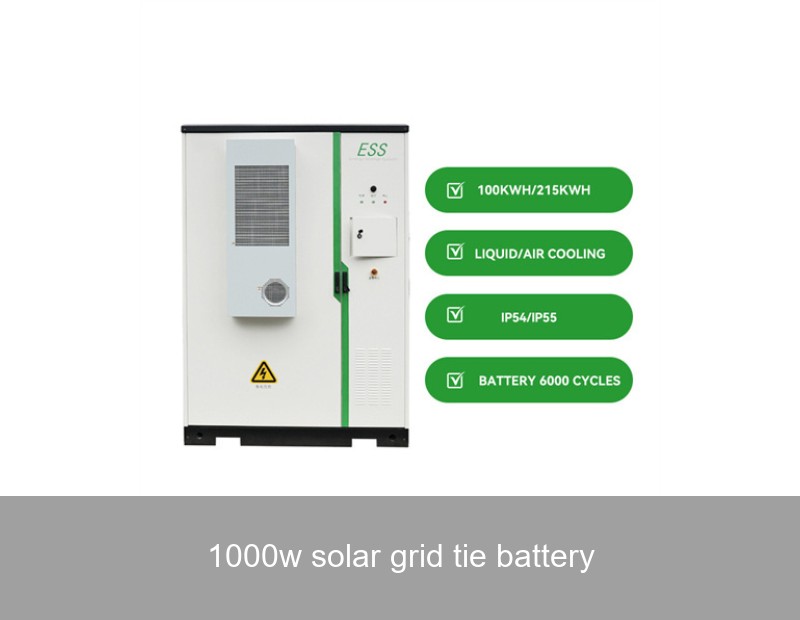
Imagine your solar panels producing clean energy all day, only for you to watch the sun set and immediately start drawing power from the grid again. It's a common frustration for solar homeowners. What if you could capture that excess daytime energy and use it on your own terms, day or night? This is where a 1000W solar grid-tie battery system comes into play. This specific configuration is becoming a popular entry point for residential energy independence, offering a manageable yet powerful way to store solar energy, reduce grid reliance, and gain peace of mind during outages. In this article, we'll demystify this system, explore its real-world benefits, and see how advanced solutions from providers like Highjoule are making smart energy storage more accessible than ever.
Table of Contents
What Exactly is a 1000W Solar Grid-Tie Battery System?
Let's break down the terminology. A 1000W solar grid-tie battery system refers to an energy storage setup with a continuous power output rating of 1000 watts (or 1 kilowatt). This means it can deliver up to 1000 watts of electricity at any given moment to power your home's appliances. Crucially, it's "grid-tie," meaning it works in harmony with both your existing solar panels and the public electricity grid. The system stores surplus solar energy instead of sending it all back to the grid, and then dispatches that stored energy when you need it most—during the evening, on cloudy days, or during a grid outage. It's important to distinguish power (kW) from energy (kWh). Think of power as the flow rate of electricity (like water pressure in a hose), while energy is the total amount stored (like the volume of water in a tank). A typical 1000W system might be paired with a battery capacity of 2-5 kWh, allowing it to power essential loads for several hours.
The Problem: Wasted Sunlight and Rising Grid Uncertainty
The phenomenon is clear: across Europe and the US, millions of homes with solar panels are operating at less than their full potential. During peak sunshine hours, production often exceeds household consumption. In many regions, feed-in tariffs for exporting this surplus have decreased significantly, making it less profitable to send energy back to the grid (U.S. Department of Energy). Simultaneously, grid reliability is a growing concern, with extreme weather events leading to more frequent and prolonged power outages. This creates a dual pain point: economic waste from unused solar energy and operational vulnerability when the grid fails. The home becomes a passive participant in the energy ecosystem, rather than an active, resilient hub.
The Data: Why a 1kW Storage System is a Strategic First Step
You might wonder, "Is 1000W enough for my home?" The data suggests it's a highly strategic and effective starting point for most households. According to analysis from the National Renewable Energy Laboratory (NREL), critical loads in a typical home—such as lighting, refrigeration, internet routers, and select outlets—often fall within a 500W to 1500W continuous draw range. A 1000W system is perfectly sized to form an "essential loads circuit," keeping your basics running seamlessly during an outage.
| Appliance | Estimated Power Draw (Watts) | Runtime on a 1000W System with 5kWh Battery* |
|---|---|---|
| LED Lighting (10 bulbs) | 100W | 50 hours |
| Refrigerator (modern) | 150W (cycling) | ~33 hours |
| Wi-Fi Router & Modem | 20W | 250 hours |
| Laptop Computer | 50W | 100 hours |
| 55" LED TV | 100W | 50 hours |
*Example calculation. Actual runtime depends on specific battery capacity and usage patterns.
This targeted approach makes the system cost-effective to install and scale later. It delivers immediate value by maximizing self-consumption of solar energy—sometimes by 30-50%—and providing core backup, without the upfront cost of a whole-home system.

Credit: Photo by Kindel Media via Unsplash
Real-World Case Study: The Smith Family in California, USA
Let's look at a concrete example. The Smith family in Sacramento, California, had a 6kW solar array but found themselves still drawing 40% of their power from the grid after sunset. Their main goals were to reduce their evening grid consumption and have backup for their frequent, brief grid disturbances.
- System Installed: A 1000W/4.8kWh grid-tie battery system, integrated with their existing solar.
- Results (12-month period):
- Solar self-consumption increased from 55% to 78%.
- Grid electricity purchases during peak evening hours were reduced by over 90%.
- The system automatically provided backup power during 6 short grid outages, keeping lights, refrigeration, and essential devices online seamlessly.
- Their calculated payback period, factoring in California's SGIP incentive and avoided peak charges, was under 7 years.
"It's not about going completely off-grid for us," explained Mr. Smith. "It's about taking control. We now use more of the power we make, and we don't even notice when the grid flickers. It just works."
How Highjoule's Intelligent Systems Elevate a 1000W Solution
At Highjoule, we understand that the value of a battery isn't just in its chemistry, but in its intelligence. Our EcoNode Home Energy Storage System is designed precisely for scenarios like the Smith family's. While modular and scalable to various power ratings, its core architecture ensures that even a 1000W configuration operates with maximum efficiency and insight.
What sets our technology apart in this segment?
- AI-Powered Energy Forecasting: Our system doesn't just react; it predicts. By analyzing weather data and your consumption history, it optimizes charge and discharge cycles to ensure your 4.8kWh battery is fully charged before a predicted cloudy day or peak rate period.
- Seamless Hybrid Inverter Technology: The Highjoule inverter is the true brain, managing the complex three-way flow between solar, battery, and grid with zero interruption. This is what guarantees the "it just works" experience during outages.
- Granular Energy Monitoring: Through our intuitive app, you can see exactly where every watt is going—how much the solar produced, what the home consumed, what the battery stored, and what was drawn from the grid. This transparency turns you from a utility customer into an energy manager.
For homeowners considering a 1000w solar grid tie battery, this level of smart management is crucial. It ensures your relatively compact storage capacity is deployed in the absolute most effective way, squeezing the maximum financial and resiliency benefit from every kilowatt-hour stored.

Credit: Photo by Andreas Gücklhorn via Unsplash
Choosing and Sizing Your System: Key Questions to Ask
Deciding if a 1000W system is right for you involves a simple self-assessment:
- What are your primary goals? (Backup for essentials, bill savings, increasing green energy use?)
- What is your essential load? List the circuits (refrigerator, lights, modem, etc.) you must keep on during an outage and sum their typical wattage.
- What is your solar production surplus? Review your inverter or utility bills to see how much excess energy you typically export on a sunny day.
A qualified installer, especially one partnered with a technology provider like Highjoule, can help you analyze this data. They can model your home's energy profile to confirm if a 1000W/4.8kWh system is your ideal starting point, or if a slightly larger capacity would deliver a better return. The beauty of modular systems is that you can often add more battery capacity later as your needs or budget change.
The Future is Modular and Intelligent
The trend in residential energy is clear: moving from simple solar to integrated, intelligent storage. A 1000W solar grid-tie battery represents the pragmatic first step on this journey. It's a manageable investment that delivers tangible resilience and savings, while future-proofing your home for a more dynamic energy landscape. With smart software and high-cycle battery chemistry, as seen in Highjoule's EcoNode system, these compact units become powerful tools for energy independence.
What's the first appliance you would want to power with your own stored sunshine during the next grid outage?
 Inquiry
 Online Chat