


10MW Generator: How Much Does It Cost and What Are Your Modern Alternatives?
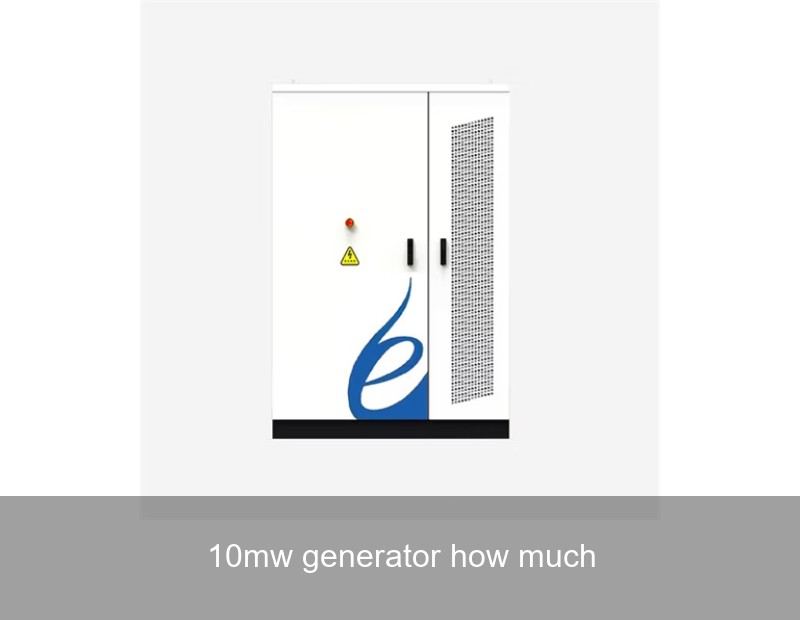
If you're searching for "10MW generator how much?", you're likely planning a significant power project. Traditionally, the answer pointed to a large, expensive diesel or gas genset. But in today's energy landscape, that question opens the door to a more intelligent conversation. The true cost isn't just the capital expenditure (CapEx); it's the long-term operational expense (OpEx), environmental impact, and integration with a modern grid. As a global leader in advanced energy storage, Highjoule is here to guide you through the evolving economics of reliable, multi-megawatt power.
Table of Contents
- The Traditional 10MW Generator: Upfront Price & Hidden Costs
- The Paradigm Shift: From Pure Generation to Smart Storage
- Breaking Down a 10MW/40MWh Battery Energy Storage System (BESS)
- Real-World Application: A European Microgrid Case Study
- The Highjoule Solution: Engineered for Commercial & Industrial Scale
- Your Next Step: What's the Right Investment for Your Energy Future?
The Traditional 10MW Generator: Upfront Price & Hidden Costs
Let's address the initial query directly. A new 10MW diesel or natural gas generator set can have a capital cost ranging from $5 million to $10 million USD, depending on the manufacturer, fuel type, and required ancillary systems (like switchgear and sound attenuation). However, this is merely the entry ticket.
The real financial story unfolds over its operational life. You must factor in:
- Fuel Costs: A 10MW diesel genset running at 80% load consumes roughly 200-250 gallons of fuel per hour. Price volatility can make long-term budgeting a nightmare.
- Maintenance: High runtime requires stringent maintenance schedules for engine components, leading to significant labor and parts costs.
- Empliance Costs: In many European and U.S. regions, carbon taxes, emissions trading schemes, and stringent air quality regulations add substantial financial and compliance burdens.
- Limited Grid Services: A traditional generator is typically a single-purpose asset for backup or peak shaving. It cannot easily provide modern grid services like frequency regulation.
The Paradigm Shift: From Pure Generation to Smart Storage
The energy sector is undergoing a fundamental transformation. The integration of volatile renewable sources like solar and wind has created a need for flexibility and stability. This is where Battery Energy Storage Systems (BESS) have emerged as a technically superior and increasingly cost-competitive alternative to traditional "spinning" generation for many applications.
Think of it this way: instead of *making* more power (and emissions) whenever you need it, what if you could *store* cheap, clean power when it's abundant and dispatch it precisely when it's most needed and valuable? This is the core value proposition of a large-scale BESS.

For a 10MW-class project, you're no longer just buying a generator; you're investing in a versatile power asset.
Breaking Down a 10MW/40MWh Battery Energy Storage System (BESS)
When discussing storage, we need two metrics: Power (MW) and Energy (MWh). A "10MW/40MWh" system can deliver 10 megawatts of instantaneous power for 4 hours. This is analogous to a 10MW generator with a 4-hour fuel tank. So, what's the cost structure?
According to market analyses from sources like Energy-Storage.news, the all-in turnkey cost for a grid-scale BESS has fallen dramatically. While prices vary by region and configuration, current benchmarks provide a clear picture.
| Component | Cost Consideration | Key Differentiator |
|---|---|---|
| Battery Cells & Packs | ~$120-$180/kWh (declining) | Lithium-ion chemistry (LFP for safety), cycle life, degradation warranty. |
| Power Conversion System (PCS) | ~$50-$100/kW | Bi-directional inverters, grid-forming capability, efficiency (>97%). |
| Balance of Plant (BOP) & Integration | ~$50-$100/kW | Containerization, thermal management, fire suppression, SCADA, and grid connection. |
| Software & Controls | Integrated or separate cost | The "brain." Enables revenue stacking (arbitrage, frequency response, capacity markets). |
For a 10MW/40MWh system, the total turnkey project cost could range from $8 million to $16 million. Crucially, this asset can generate multiple revenue streams or cost savings over its 15-20 year life, fundamentally changing its ROI calculation compared to a fuel-dependent generator. A study by the National Renewable Energy Laboratory (NREL) highlights the economic potential of stacking these value streams.
Real-World Application: A European Microgrid Case Study
Let's move from theory to practice. Consider a large industrial facility in Germany facing high demand charges and seeking backup power and carbon reduction. They evaluated a 10MW diesel generator versus a 8MW/32MWh BESS paired with their existing rooftop solar.
- Challenge: Reduce peak grid draw, ensure production continuity during brief grid outages, and lower carbon footprint.
- Solution Deployed (BESS): An 8MW storage system was installed. It performs daily peak shaving, stores excess solar, and provides seamless backup for critical loads.
- Results:
- Demand Charge Reduction: Cut peak demand from the grid by over 30%, saving ~€150,000 annually.
- Fuel & Maintenance Savings: Eliminated the need for weekly diesel genset testing and potential fuel costs during outages.
- Emission Avoidance: Prevented an estimated 1,200 tons of CO2 annually compared to frequent diesel use.
- ROI: Achieved a payback period of under 7 years through direct savings alone, not accounting for ancillary service market participation.
This case illustrates the multi-faceted value of storage. The BESS wasn't just a backup; it became a daily profit center and sustainability tool.
The Highjoule Solution: Engineered for Commercial & Industrial Scale
At Highjoule, we specialize in translating this potential into reliable, high-performance reality. Our H-Series Industrial BESS platform is designed precisely for projects in the 1MW to 100MW+ range, making a 10MW system a core competency.
What sets a Highjoule system apart when you're evaluating your "10MW" option?
- Grid-Forming Inverter Technology: Our systems can "black start" and stabilize a microgrid independently, mimicking the inertia of traditional generators—a critical feature for facilities going off-grid or in weak grid areas.
- Advanced AI-Driven Energy Management System (EMS): This isn't just monitoring software. It's an optimization engine that automatically maximizes your financial return by deciding when to charge, discharge, or hold, based on real-time electricity prices, weather forecasts, and your load patterns.
- Uncompromising Safety with LFP Chemistry: We utilize Lithium Iron Phosphate (LFP) battery cells, renowned for their thermal stability and long cycle life. This is coupled with a multi-layered, proactive safety system designed to international standards.
- Full Lifecycle Partnership: From initial feasibility and financial modeling to EPC, grid compliance, and long-term performance guarantees, Highjoule provides a single point of accountability.

For a commercial or industrial client, this means your 10MW power asset is smarter, cleaner, and more financially robust from day one.
Your Next Step: What's the Right Investment for Your Energy Future?
The question "10MW generator how much?" has evolved. It's no longer a simple price check. It's a strategic decision about resilience, economics, and environmental responsibility. The comparison is between a single-tool solution with high, unpredictable running costs and a multi-functional, smart asset that can pay for itself.
So, we leave you with this: What specific challenge is driving your search for 10MW of power—is it purely backup, reducing peak demand charges, integrating renewables, or creating a new revenue stream? And how would a solution that addresses all four change your project's business case?
 Inquiry
 Online Chat