


Demystifying the 20 Kilowatt Energy Storage Cabinet Price: Value Beyond the Quote
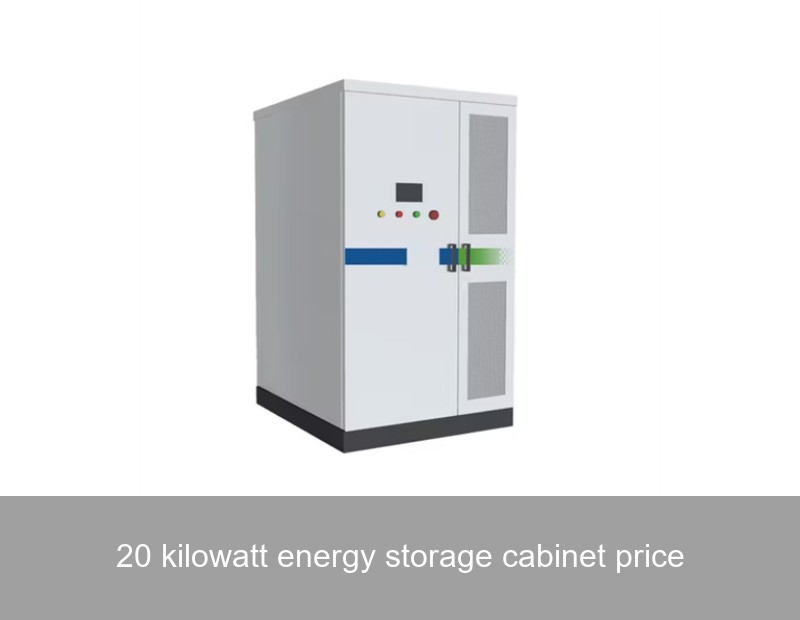
If you're researching a 20 kilowatt energy storage cabinet price, you've likely encountered a wide range of figures online. It can be frustrating, right? One quote seems surprisingly low, while another is double the amount. The truth is, the price tag on a cabinet is just the beginning of the story. As a product expert in the renewable energy sector, I often tell clients that focusing solely on the upfront cost is like buying a car based only on the showroom price—without considering fuel efficiency, maintenance, or safety features. A 20kW system represents a significant investment for a business, farm, or large home, and understanding what drives its cost is crucial for making a smart, long-term decision.
What's Inside a 20kW Energy Storage Cabinet? A Cost Component Breakdown
Let's open the cabinet, metaphorically speaking. A 20kW rating typically refers to the power output—how much electricity it can deliver at any given moment. However, the often more critical specification is its energy capacity, measured in kilowatt-hours (kWh), which determines how long it can power your loads. The price is a sum of its sophisticated parts:
- Battery Cells & Modules: The heart of the system. Chemistry (like Lithium Iron Phosphate/LFP, known for safety and longevity), brand, and overall quality account for 40-60% of the total cost. LFP is now the dominant choice for stationary storage.
- Power Conversion System (PCS): This includes the inverter and rectifier, which manage AC/DC conversion. Its efficiency and grid-support capabilities are major price drivers.
- Battery Management System (BMS): The brain. A high-quality BMS ensures safety, balances cells, and maximizes lifespan. Don't cut corners here.
- Thermal Management: Cooling systems (liquid or air) are essential for performance and safety. More advanced thermal control adds cost but protects your investment.
- Enclosure & Safety Systems: The physical cabinet, integrated fire suppression, and cybersecurity features.
- Software & Intelligence: The "smart" in smart storage. Advanced energy management software (EMS) that can optimize for self-consumption, peak shaving, or grid services adds significant value.

Credit: Unsplash - A modern energy storage cabinet's interior requires high-quality components, which directly influence the 20 kilowatt energy storage cabinet price.
Key Factors Influencing Your 20kW Energy Storage Cabinet Price
Now, why do quotes vary so dramatically? Several factors are at play:
| Factor | Impact on Price | Why It Matters |
|---|---|---|
| Battery Chemistry & Quality | High | LFP batteries may have a higher upfront cost than some older chemistries but offer 2-3x longer cycle life and superior safety, reducing TCO. |
| System Integration & Engineering | Medium-High | A pre-integrated, UL/Certified cabinet from a provider like Highjoule commands a premium over a pieced-together "kit" due to guaranteed compatibility and safety. |
| Installation & Grid Interconnection | Variable | Site-specific electrical work, permits, and utility fees can add 20-50% to the equipment cost. This is often the most overlooked part of a budget. |
| Scalability & Future-Proofing | Medium | Modular designs that allow easy capacity expansion may cost slightly more initially but protect your investment long-term. |
| Warranty & Service | Medium | A comprehensive 10-year warranty with performance guarantee is a sign of quality and is factored into the price. It's your insurance policy. |
A Real-World Case: Commercial Bakery in Bavaria
Let's move from theory to practice. A family-owned bakery in southern Germany was facing steep demand charges and wanted to increase the self-consumption of their rooftop solar. They needed reliable power for refrigerators and ovens during early morning peaks. They evaluated three quotes for a 20kW / 40kWh storage system.
- Quote A (Low-Cost): €28,000. Used lesser-known battery cells, basic EMS, and a short 5-year warranty.
- Quote B (Mid-Range): €35,000. Featured tier-1 LFP cells, better software, and a 10-year warranty.
- Quote C (Highjoule Solution): €38,500. Included our Highjoule H-Cube 20 integrated cabinet with grade-A LFP cells, advanced AI-driven EMS for predictive peak shaving, and a full 10-year warranty covering 70% residual capacity.
The bakery chose the Highjoule system. Why? Our detailed financial modeling showed that our system's higher efficiency (98.5%) and intelligent peak shaving software would save them €4,200 annually on their energy bill, compared to €2,800 from Quote A. The payback period was actually shorter despite the higher initial 20 kilowatt energy storage cabinet price. Two years in, the system has exceeded savings projections and provided crucial backup during a grid outage, preventing spoilage. Fraunhofer ISE studies consistently show that operational savings, not just capital cost, determine the true ROI of storage.
The Highjoule Difference: Engineering Value Beyond the Price Tag
At Highjoule, founded in 2005, we engineer our storage solutions with a Total Cost of Ownership perspective. Our H-Cube Commercial Series, which includes the 20kW cabinet, is built for the demands of European and North American markets.
- Proprietary Adaptive EMS: Our software doesn't just react; it learns your load patterns and weather forecasts to optimize charge/discharge cycles, maximizing your financial return.
- Unmatched Safety Architecture: We go beyond standard certifications with cell-level fusing, multi-zone gas detection, and passive thermal runaway containment—non-negotiable for peace of mind.
- Seamless Grid Integration: Our systems are designed for future grid services (like frequency response), offering potential revenue streams that can further improve ROI.
- Global Support Network: Your investment is backed by our remote monitoring and local service partners, ensuring system health and performance for decades.
When you receive a Highjoule 20 kilowatt energy storage cabinet price, it's a comprehensive value proposition, not just a component list.

Credit: Unsplash - A commercial storage installation, similar to the Bavarian bakery case, where intelligent software maximizes ROI.
Thinking in Total Cost of Ownership (TCO)
So, what's the ballpark figure? In today's market (2024), for a high-quality, commercial-grade 20kW / 40kWh storage cabinet including installation, you should expect a range of **€35,000 to €55,000 in Europe, and $40,000 to $65,000 in the US**. The vast range hinges directly on the factors we discussed.
Instead of fixating on the lowest price per kW, I urge you to calculate TCO. Use this simple mental model:
TCO = (Upfront Price - Incentives) + (Estimated Annual Op Cost * Years) - (Annual Energy Savings * Years)
A cheaper system might have higher operational losses, shorter lifespan, and negligible software, leading to lower savings and a higher TCO. Resources like the U.S. DOE Solar Energy Technologies Office provide excellent frameworks for evaluating long-term storage value.
Your Next Step: Asking the Right Questions
The journey to a resilient and cost-effective energy system starts with informed inquiry. When you receive your next quote for a 20 kilowatt energy storage cabinet, what specific questions will you ask about battery degradation rates, the granularity of the energy management software, or the true scope of the warranty? Are you ready to look beyond the initial price and partner with a provider who can deliver guaranteed performance for the next decade?
 Inquiry
 Online Chat