


Unlocking Energy Independence: A Deep Dive into the 50 kW Solar Power System
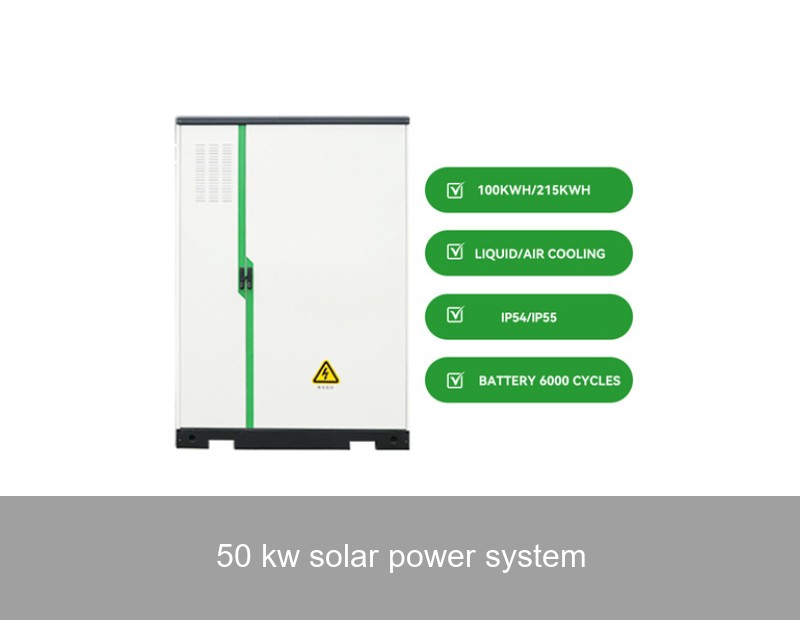
Have you ever looked at your commercial electricity bill and wondered, "There must be a better way"? For businesses, farms, and large property owners across Europe and the US, that "better way" is increasingly taking the form of a 50 kW solar power system. This isn't just a collection of panels on a roof; it's a strategic energy asset. It represents a sweet spot in solar—powerful enough to make a serious dent in operational costs and carbon footprints, yet manageable in scale and increasingly accessible. But how does it work in the real world, and what does it truly take to make it a reliable, round-the-clock power solution? Let's explore.
Table of Contents
- The Phenomenon: Why 50 kW is the Commercial Sweet Spot
- The Data: Understanding Output, Savings, and ROI
- The Case Study: A Real-World Application in Agriculture
- The Key Insight: It's Not Just Solar, It's a System
- The Storage Imperative: Maximizing Your Solar Investment
- The Highjoule Solution: Intelligent Energy Management
- Your Next Step Towards Energy Resilience
The Phenomenon: Why 50 kW is the Commercial Sweet Spot
Solar energy is scaling down to empower the individual. While utility-scale solar farms grab headlines, the real revolution is happening at the local level. A 50 kW solar power system is perfectly sized for a wide range of energy consumers who are no longer content being passive ratepayers. Think about a small to medium-sized manufacturing workshop, a rural agricultural operation, a community center, a car wash, or a multi-unit residential building. These entities share a common challenge: significant daytime energy consumption that aligns perfectly with solar production cycles.
This system size bypasses the complexities of massive projects while delivering transformative results. It's substantial enough to require professional design and grid interconnection approvals, yet it often falls within permitting thresholds that simplify the process. For many businesses, it's the ideal entry point into generating their own clean power, reducing operational volatility tied to energy prices, and taking a visible stand on sustainability—a value increasingly important to customers on both sides of the Atlantic.
The Data: Understanding Output, Savings, and ROI
Let's move from concept to numbers. What can you actually expect from a 50 kW system? Of course, output depends heavily on location (solar irradiance), panel orientation, and shading.
- Annual Production: In sunnier parts of Southern Europe or the Southwestern US, a well-designed 50 kW system can produce 70,000 to 85,000 kWh per year. In Northern Europe or the Northeastern US, a realistic range is 50,000 to 65,000 kWh annually.
- Peak Output: Under ideal conditions, the system will generate at or near its 50 kW (50,000-watt) capacity for a few hours around solar noon.
- Financial Impact: With commercial electricity rates in many European countries and US states ranging from $0.15 to $0.30 per kWh, the annual savings can be substantial—anywhere from $7,500 to over $20,000 per year. When you factor in available incentives like tax credits, rebates, and accelerated depreciation, the payback period can often be brought down to 5-8 years, after which the electricity is virtually free for the remaining 15+ years of the system's life.
But here's the critical nuance the data doesn't always show: consumption patterns rarely match production perfectly. Your facility might not use all 50 kW at the exact moment the sun is shining brightest. So, where does that excess, valuable energy go?

Image: A commercial-scale solar installation. Source: Unsplash (License: Free to use)
The Case Study: A Real-World Application in Agriculture
Let's ground this in reality. Consider a family-owned dairy farm in Bavaria, Germany. The farm operates milking machines, cooling tanks, ventilation systems, and lighting nearly 24/7, with a significant daytime load. Their annual consumption was 120,000 kWh, with a steep and unpredictable energy cost structure.
In 2022, they installed a 50 kW ground-mounted solar system. The results were illuminating:
| Metric | Before Solar | After Solar (Year 1) |
|---|---|---|
| Annual Grid Import | 120,000 kWh | 65,000 kWh |
| Annual Energy Cost | €28,800 (at €0.24/kWh) | €15,600 |
| Solar Self-Consumption | 0 kWh | ~40,000 kWh (used directly) |
| Solar Exported to Grid | 0 kWh | ~15,000 kWh (feed-in tariff) |
The system provided an immediate 46% reduction in grid electricity costs. However, the farm managers noticed a challenge: their highest energy need for cooling often extended into the evening, when solar production was zero. They were still reliant on the grid during peak rate periods, and exporting solar power at noon earned them a feed-in tariff far lower than the retail price they paid to import it later. This gap between production and consumption is the single biggest hurdle to maximizing the value of a 50 kW solar power system. This is where the story evolves from solar generation to intelligent energy management.
The Key Insight: It's Not Just Solar, It's a System
The Bavarian farm's experience is universal. A solar array is a generator, not a solution. The true power lies in integrating it into a complete, intelligent energy system. This is the core difference between simply installing panels and achieving genuine energy resilience and cost optimization.
An effective system must do three things:
- Generate (the solar panels).
- Store excess energy for use when the sun isn't shining.
- Manage the flow intelligently between generation, storage, consumption, and the grid.
Without storage and smart management, a significant portion of your solar investment's potential value is literally fed back to the utility. To truly capitalize on your 50 kW asset, you need to pair it with a brain and a battery.
The Storage Imperative: Maximizing Your Solar Investment
Adding battery energy storage is the game-changer. It transforms your solar array from a daytime-only supplement into a 24/7 power plant for your property. For a 50 kW solar system, a battery bank in the range of 40 kWh to 100 kWh of capacity is often ideal. This allows you to:
- Increase Self-Consumption: Store your midday surplus to power your evening and morning operations, sometimes boosting the direct use of your solar energy from 30-40% to over 80%.
- Provide Backup Power: Keep critical loads running during grid outages—a vital feature for businesses with refrigeration, data centers, or essential services.
- Avoid Peak Demand Charges: For many commercial customers, a major portion of the bill is based on the highest 15-minute power draw (demand charge). A battery can discharge to "shave" these peaks, leading to dramatic savings.
- Participate in Grid Services: In some markets, you can earn revenue by allowing your aggregated storage to provide grid stability services.
But not all storage is created equal. The chemistry, thermal management, power conversion, and—most importantly—the software that controls it are what determine safety, longevity, and return on investment.
The Highjoule Solution: Intelligent Energy Management
This is precisely where Highjoule's expertise comes into play. Since 2005, we've moved beyond simply providing batteries to delivering integrated, smart energy ecosystems. For an owner of a 50 kW solar power system, our value proposition is clear: we help you capture and utilize every kilowatt-hour you produce.
Our approach centers on the Highjoule Hive Energy Management System (EMS). Think of the Hive as the conductor of your energy orchestra. It doesn't just connect solar and storage; it intelligently orchestrates them in real-time based on your consumption patterns, weather forecasts, utility rate schedules, and grid conditions.
For a commercial or industrial application, we might recommend pairing your solar with our Highjoule Cobalt-Ion Commercial Battery Series. These systems are engineered for high cycle life and safe operation, and they are seamlessly governed by the Hive EMS. The Hive can be programmed to prioritize self-consumption, ensure backup power reserves, or even dispatch stored energy to capitalize on time-of-use rate differentials automatically.
In the case of our Bavarian farm, integrating a Highjoule 80 kWh storage system with the Hive EMS allowed them to shift their solar surplus to cover evening cooling loads. Their grid import dropped by an additional 30%, and they virtually eliminated expensive peak-time electricity purchases. The solar + storage system, managed intelligently, became the predictable, low-cost heart of their operational energy.

Image: A modern battery energy storage system (BESS). Source: Unsplash (License: Free to use)
Why Highjoule Stands Out
- Grid-Forming Inverters: Our systems can create a stable "microgrid" during outages, allowing not just battery backup, but also continued solar generation even when the main grid is down—a feature many standard systems lack.
- Open Protocol Integration: The Hive EMS is designed to communicate with a wide range of existing equipment, making it a future-proof hub for your energy assets.
- Global Support: With deep experience in both the European and North American markets, we understand local regulations, incentives, and grid requirements, ensuring a compliant and optimized installation.
For deeper technical insights on battery storage integration, the U.S. Department of Energy provides excellent foundational resources, and the latest market trends can be followed through analysts like BloombergNEF.
Your Next Step Towards Energy Resilience
The journey to energy independence starts with a clear understanding of your own energy profile. A 50 kW solar power system is a formidable starting point, but its true potential is unlocked only when it's part of a smarter, storage-enabled whole. The technology is proven, the economics are compelling, and the need for sustainable, resilient power has never been greater.
So, here is the pivotal question to consider: When you examine your facility's energy consumption curve, what percentage of your solar potential are you currently leaving on the table, and what would capturing that value mean for your operational independence and bottom line over the next decade?
 Inquiry
 Online Chat