


Navigating the World of Battery Container Suppliers: Your Guide to Scalable Energy Storage
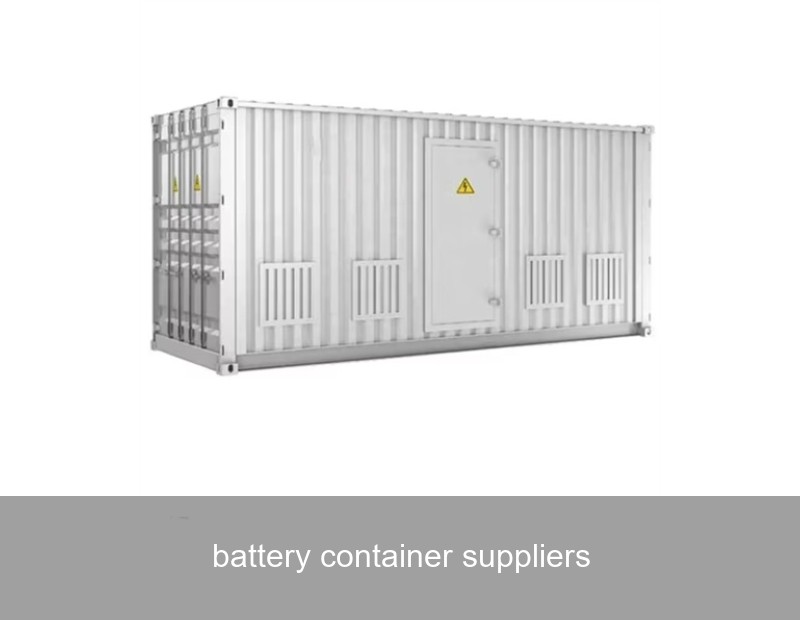
Imagine having a power plant that you can deliver on a truck, commission in weeks, and scale as needed. That’s the promise of containerized battery energy storage systems (BESS). For project developers, utilities, and businesses seeking reliable and flexible energy storage, choosing the right battery container suppliers is a critical first step. This isn't just about buying a metal box with batteries; it's about procuring a complete, high-performance power asset. In this guide, we'll demystify the market, explore what truly matters, and show you how to partner with a supplier that delivers more than just hardware.
Table of Contents
- What is a Battery Container Solution?
- Key Considerations When Evaluating Battery Container Suppliers
- Looking Beyond the Box: The Importance of Integrated Intelligence
- Case Study: Grid Stability in Germany
- The Highjoule Approach: Engineered for Performance and Safety
- Future Trends in Containerized Storage
- Your Next Step
What is a Battery Container Solution?
A battery container is a pre-assembled, plug-and-play energy storage system housed within a standardized shipping container. These units typically integrate lithium-ion battery racks, a thermal management system (cooling/heating), fire suppression, power conversion systems (PCS), and an energy management system (EMS). The primary advantage is scalability and speed. Instead of constructing a bespoke building, you can deploy multiple 20-foot or 40-foot containers to achieve megawatt-hour (MWh) scale storage capacity. This modular approach is revolutionizing how we add flexibility to grids, integrate renewable energy, and provide backup power for industrial sites.

Image Source: Unsplash (Representative image of energy storage containers)
Key Considerations When Evaluating Battery Container Suppliers
Not all suppliers are created equal. Moving beyond the basic specifications requires a deep dive into several core areas:
- Core Technology & Battery Chemistry: Are they using LFP (Lithium Iron Phosphate) or NMC (Nickel Manganese Cobalt)? LFP, known for its superior safety and long cycle life, is becoming the dominant choice for stationary storage. A reputable supplier will transparently discuss the trade-offs.
- Safety & Certification: This is non-negotiable. Look for UL 9540 (system level) and UL 1973 (battery unit) certifications in North America, and equivalent IEC standards in Europe. The fire suppression system design—often using aerosol or gas-based systems—should be clearly explained.
- Thermal Management: The lifespan of a battery is heavily dependent on operating temperature. Does the container use simple air conditioning or a more efficient liquid cooling system? Liquid cooling, like that employed in Highjoule's IntelliCube series, offers superior temperature uniformity, leading to better performance and longevity, especially in demanding climates.
- Grid Compliance & Software Intelligence: The container must "speak the language" of the local grid. Can it provide frequency regulation, voltage support, or peak shaving as required? The supplier’s Energy Management System (EMS) software is the brain that unlocks these revenue streams and operational benefits.
| Feature | Basic Supplier | Advanced Supplier (e.g., Highjoule) |
|---|---|---|
| Battery Chemistry | May offer limited choice | Focus on safe, long-life LFP |
| Cooling System | Air Conditioning (less efficient) | Liquid Cooling (precise thermal control) |
| System Certification | Component-level only | Full system certification (UL 9540, IEC) |
| Software & Controls | Basic monitoring | AI-powered EMS for grid services & optimization |
| Warranty & Support | Standard warranty | Performance-guaranteed warranty with remote monitoring |
Looking Beyond the Box: The Importance of Integrated Intelligence
The hardware is just the beginning. The real value of a modern containerized BESS lies in its software and system integration. A superior supplier acts as a technology partner, providing an EMS that can autonomously optimize the system's operation for multiple value streams. For instance, during the day, the system might store excess solar energy, in the evening it could perform peak shaving for a factory, and at night it could participate in grid frequency regulation markets. This requires sophisticated, grid-forming inverter technology and intelligent controls—capabilities that differentiate market leaders from simple packagers.
Case Study: Enhancing Grid Stability in Northern Germany
Let's look at a real-world application. In 2023, a regional grid operator in Schleswig-Holstein, Germany, faced challenges with frequency volatility due to the high penetration of wind energy. They needed a fast-responding asset to provide primary frequency control (PFC) and stabilize the local grid.
The Solution: They partnered with Highjoule to deploy a 12 MWh battery storage system comprised of four 40-foot IntelliCube Pro containers. These units were chosen for their high C-rating (allowing rapid charge/discharge) and their advanced grid-forming inverters, which are crucial for providing synthetic inertia—a key service for grids with high renewable share.
The Results (Data): Within six months of operation:
- The system achieved a 99.8% availability rate for grid service calls.
- It successfully responded to frequency deviations in under 100 milliseconds, well within the German grid code requirements.
- The project is estimated to reduce grid balancing costs for the operator by approximately €1.2 million annually.
This case illustrates how choosing a battery container supplier with deep grid integration expertise translates directly into technical and economic success. You can read more about the importance of frequency regulation in modern grids from the U.S. Department of Energy.

Image Source: Unsplash (Representative image of wind energy grid)
The Highjoule Approach: Engineered for Performance and Safety
At Highjoule, with nearly two decades of experience since 2005, we view ourselves not just as battery container suppliers, but as full-scope solution architects. Our IntelliCube product line is the culmination of this philosophy. Every container is engineered as a unified system:
- Proprietary Liquid Cooling: Ensures every battery cell operates within a ±3°C range, maximizing cycle life and safety.
- Highjoule Neuron EMS Platform: An AI-driven software suite that enables automated, multi-market optimization, allowing our clients to stack revenue streams seamlessly.
- End-to-End Service: We support projects from initial feasibility studies and financial modeling through to commissioning, long-term operations, and eventual repurposing or recycling—a true cradle-to-grave partnership.
Whether for a commercial peak-shaving application in California, a renewable integration project in Spain, or a critical microgrid for an industrial plant, our systems are built to deliver reliable, sustainable, and intelligent power.
Future Trends: What's Next for Containerized Storage?
The industry is moving towards even greater integration and sustainability. We're seeing trends like:
- Hybrid Containers: Integrating not just batteries, but also solar inverters and control systems for "all-in-one" renewable hubs.
- Second-Life Batteries: Repurposing EV batteries into stationary storage containers, a sustainable approach that requires sophisticated testing and balancing technology. Research on this is ongoing, as noted by institutions like the International Energy Agency.
- Standardization & Interoperability: Efforts to create plug-and-play standards for containers, simplifying deployment and multi-vendor setups.
Your Next Step
The journey to a successful energy storage project starts with asking the right questions. As you evaluate battery container suppliers, consider this: Is your potential partner equipped to be a long-term ally in the evolving energy landscape, or are they merely a hardware vendor? What specific challenge—be it energy cost reduction, renewable firming, or grid service revenue—are you aiming to solve first?
We invite you to share your current project's biggest hurdle. Is it navigating complex grid interconnection rules, or perhaps modeling the financial returns with confidence? Let's start a conversation.
 Inquiry
 Online Chat