


Unlocking Grid Independence: The Power of the Battery-Less Hybrid Energy Storage Cabinet
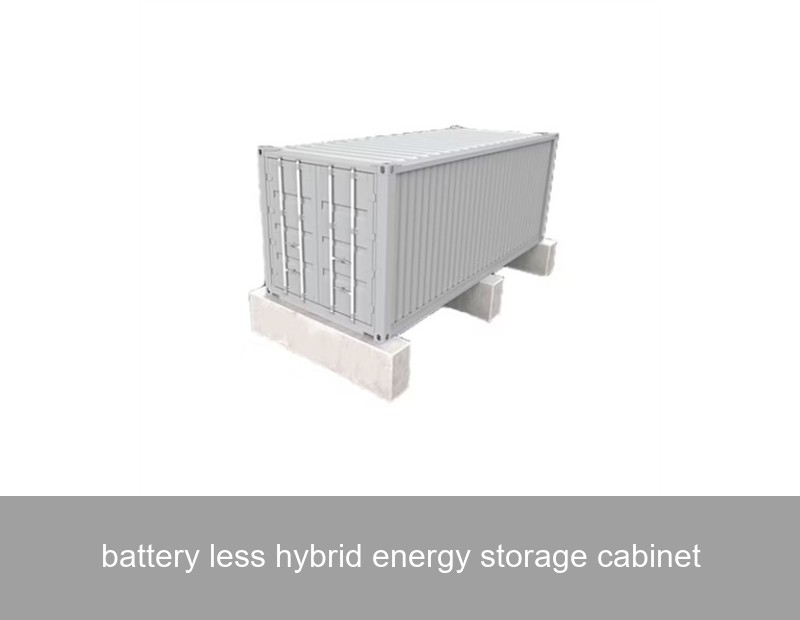
Imagine a future where your business or community isn't just powered by renewable energy, but is intelligently managed by it. As solar and wind adoption skyrockets across Europe and the U.S., a critical challenge emerges: how do we balance the intermittent nature of these clean sources with the constant demand for power? The answer isn't always just adding more batteries. Enter an innovative solution gaining serious traction: the battery-less hybrid energy storage cabinet. This isn't about storing electrons in chemical cells; it's about harnessing the kinetic energy of a spinning mass to provide instantaneous grid stability and backup power. Let's delve into how this technology works and why it's becoming a cornerstone of resilient, modern energy systems.
Table of Contents
- The Grid Stability Challenge: More Than Just Blackouts
- What is a Battery-Less Hybrid Energy Storage Cabinet?
- The Highjoule Advantage: Engineering Resilience with Flywheel Technology
- Real-World Case Study: Stabilizing a German Industrial Microgrid
- The Future is Hybrid: Combining Strengths for Optimal Performance
- Is a Battery-Less Hybrid Solution Right for Your Operation?
The Grid Stability Challenge: More Than Just Blackouts
When we think of power problems, we picture blackouts. But for grid operators and large energy consumers, the more insidious issues are frequency fluctuations, voltage sags, and momentary interruptions. These events, often lasting mere seconds, can crash sensitive industrial processes, data centers, and laboratory equipment. With traditional baseload power plants being phased out, the grid loses its natural rotational inertia—the kinetic energy in spinning turbines that helps buffer these disturbances. Renewable sources like solar PV, while clean, don't inherently provide this inertia. This creates a critical stability gap that needs to be filled, and fast. According to a U.S. Department of Energy article, the transition to inverter-based resources requires new tools for frequency and voltage support.

Image: Modern flywheel systems provide critical grid inertia. (Source: Unsplash)
What is a Battery-Less Hybrid Energy Storage Cabinet?
At its core, a battery-less hybrid energy storage cabinet is a self-contained unit that provides short-duration, high-power energy services without using electrochemical batteries. The most common technology inside such a cabinet is a flywheel energy storage system (FESS). Here’s the simple principle: electrical energy is used to spin a heavy rotor (the flywheel) at very high speeds in a low-friction environment. When the grid needs a power boost—say, to correct a frequency dip—the kinetic energy of the spinning rotor is converted back to electricity and discharged in a matter of seconds.
Think of it like a mechanical battery. But instead of storing energy in a chemical reaction, it stores it as motion. This comes with distinct advantages for specific applications:
- Instantaneous Response: Can deliver full power in milliseconds, far faster than most battery systems.
- Virtually Unlimited Cycles: No chemical degradation means it can charge and discharge millions of times over a 20+ year lifespan.
- Minimal Maintenance: No electrolytes to manage, no thermal runaway risk, and often lower long-term operational costs.
- Wide Operating Temperature Range: Performs consistently without the climate-controlled environments some batteries need.
The Highjoule Advantage: Engineering Resilience with Flywheel Technology
At Highjoule, we've been at the forefront of advanced energy storage since 2005. Our H-I³ (Highjoule Inertia & Instantaneous Intervention) Cabinet embodies the battery-less hybrid principle. We've engineered it not as a replacement for battery energy storage systems (BESS), but as a perfect complement. The H-I³ cabinet is designed for missions where speed, longevity, and reliability are non-negotiable.
Our system features a high-strength composite rotor levitated on magnetic bearings, spinning in a vacuum to minimize friction. This allows it to sit in a ready state with 95%+ round-trip efficiency, waiting to support the grid or your critical load. It's the ideal solution for:
- Frequency Regulation: Continuously absorbing and injecting power to keep grid frequency at 50 Hz or 60 Hz.
- Microgrid Stabilization: Providing the "synthetic inertia" that renewable-heavy microgrids lack during generator start-ups or cloud transients.
- Uninterruptible Power Supply (UPS): Bridging the critical 10-30 second gap until backup generators come online, protecting data centers and manufacturing lines.
By integrating our H-I³ cabinet into a broader energy management system, we create true hybrid storage solutions that leverage the best of both kinetic and chemical storage worlds.
Real-World Case Study: Stabilizing a German Industrial Microgrid
Let's look at a concrete example from Bavaria, Germany. A mid-sized automotive parts manufacturer committed to 100% renewable power. They installed a 2.5 MW rooftop solar array and a 1 MW wind turbine. However, their power quality suffered—voltage swings during cloudy/windy transitions were causing automatic shutdowns in their precision machining centers, costing over €150,000 in downtime and scrap parts in one year.
The Solution: Highjoule deployed a hybrid system centered on a 500 kW / 5 kWh H-I³ Flywheel Cabinet, paired with a smaller 200 kW / 400 kWh lithium-ion battery system. The architecture was clever:
| Component | Role | Response Time |
|---|---|---|
| H-I³ Flywheel Cabinet | Primary frequency & voltage stabilizer; handles sub-second fluctuations. | < 100 ms |
| Lithium-ion BESS | Load shifting (solar time-shift); provides longer-duration backup. | ~500 ms |
| Highjoule Energy Management System (EMS) | Intelligently dispatches each asset based on need and capability. | Continuous |
- Power quality events reduced by 99.7%.
- Annual downtime costs related to power issues eliminated.
- The flywheel handled over 800,000 micro-cycles with zero performance degradation.
- The battery was spared from stressful, short-cycle duty, extending its projected life.
This case exemplifies the hybrid philosophy: using the right tool for each job. The International Energy Agency notes the importance of diverse storage technologies to address different grid needs.

Image: Modern energy management requires intelligent control of hybrid systems. (Source: Unsplash)
The Future is Hybrid: Combining Strengths for Optimal Performance
The narrative isn't "flywheels vs. batteries." It's about intelligent integration. A battery-less hybrid energy storage cabinet like Highjoule's H-I³ is the ultimate "first responder." It takes the brunt of the high-power, short-duration events that would otherwise degrade a battery's lifespan. Meanwhile, the battery component handles the longer-duration energy shifting—like storing midday solar for evening use.
This synergy creates a system that is greater than the sum of its parts: more reliable, more cost-effective over a 20-year horizon, and capable of providing a wider range of grid services. For a commercial or industrial entity, this means not just backup power, but also potential new revenue streams by participating in grid service markets like Frequency Response, as seen in the UK's National Grid ESO services.
Is a Battery-Less Hybrid Solution Right for Your Operation?
So, how do you know if this technology fits your needs? Ask yourself and your energy team these questions:
- Do we experience frequent, brief power disturbances that impact our operations?
- Are we expanding our on-site renewables (solar/wind) and concerned about grid stability on-site?
- Do we have a critical load that requires seamless backup power for the 15-30 seconds until generators start?
- Are we looking for a low-maintenance, long-life asset to complement a larger battery storage project?
If you answered "yes" to any of these, the battery-less hybrid approach warrants a closer look. At Highjoule, we specialize in designing these tailored, hybrid energy ecosystems. Our process starts with a deep analysis of your load profile, power quality data, and sustainability goals to determine the optimal mix of technologies.
What specific power quality challenge is your business or community facing as you integrate more renewables, and how might a hybrid approach transform not just your resilience, but also your bottom line?
 Inquiry
 Online Chat