


Finding the Best Battery System for Solar: A Guide to Maximizing Your Renewable Investment
You've made the smart decision to install solar panels. You're generating clean energy, reducing your carbon footprint, and watching your electricity bills drop. But have you ever noticed your panels working hard all day, only for that precious energy to vanish into the grid when the sun sets? This common experience highlights the missing piece in many solar setups: storage. Choosing the best battery system for solar is the key to unlocking true energy independence, resilience, and financial savings. This article will guide you through the critical factors, using real-world data and insights, to help you select a system that turns your solar array into a 24/7 personal power plant.
Table of Contents
The Phenomenon: Wasted Sunlight and Grid Dependence
For most solar homeowners and businesses, the energy flow is a one-way street during the day. Excess power gets exported to the utility grid, often for a credit (feed-in tariff) that is significantly lower than the retail price you pay to buy electricity back at night. This mismatch is the fundamental economic driver for battery storage. When the grid fails—an event becoming more common due to extreme weather—a solar-only system typically shuts down for safety, leaving you in the dark. A battery system changes this dynamic entirely, allowing you to store your surplus solar energy for use on your own terms.
The Data: Why Storage is the Game Changer
The numbers speak volumes. According to the U.S. Department of Energy, the average U.S. household uses about 29 kWh per day. A typical solar system might produce 30+ kWh on a sunny day, but almost none after sunset, precisely when demand peaks. In Europe, with high grid electricity prices, the financial case is even stronger. A study by Fraunhofer ISE indicates that adding storage can increase a household's self-consumption of solar power from 30% to over 70%, dramatically reducing reliance on the grid. This isn't just about backup; it's about optimizing every kilowatt-hour you produce.

Image source: Unsplash. A modern home integrating solar generation with battery storage for a seamless energy solution.
Key Factors Defining the Best Battery System for Solar
Not all battery systems are created equal. The "best" system is the one that best matches your specific energy profile, goals, and local conditions. Here are the non-negotiable criteria to evaluate:
1. Capacity & Power: The "Tank" and the "Hose"
Think of capacity (kWh) as the size of your fuel tank—it determines how much energy you can store. Power (kW) is the size of the hose—it dictates how many appliances you can run simultaneously from the battery. A system with high capacity but low power might keep your lights on for days but couldn't start your air conditioner. The best systems offer a balanced, scalable approach.
2. Battery Chemistry: The Heart of the System
Lithium-ion is the standard, but not all Li-ion is the same. Two prevalent types are:
- Lithium Iron Phosphate (LFP): Known for exceptional safety, long cycle life (often over 6,000 cycles), and stability. It's less energy-dense but is ideal for stationary storage where safety and longevity are paramount.
- Nickel Manganese Cobalt (NMC): Offers higher energy density in a smaller space and can handle higher power bursts. Historically used in EVs, its chemistry and management systems have also advanced significantly for home use.
The choice hinges on your priority: maximum decades of service (LFP) or compact size with high power (NMC).
3. Depth of Discharge (DoD) & Warranty
Manufacturers specify a recommended Depth of Discharge. A 10 kWh battery with a 90% DoD means you can safely use 9 kWh of its stored energy without degrading it prematurely. Always pair the DoD with the warranty terms. A robust warranty (e.g., 10 years, 70% retained capacity) is your best indicator of the manufacturer's confidence in their product's longevity.
4. System Intelligence & Integration
This is where premium systems truly separate themselves. A smart battery system doesn't just store energy; it optimizes it. Can it learn your consumption patterns? Can it be programmed to charge from the grid during off-peak low rates and discharge during expensive peak times (load shifting)? Does it integrate seamlessly with your existing or new solar inverter? This brain is as important as the battery itself.
| Feature | What It Means | Why It Matters |
|---|---|---|
| Usable Capacity (kWh) | The actual energy you can use after accounting for DoD. | Determines how long you can power essentials during an outage. |
| Continuous Power (kW) | The max load the battery can support at once. | Defines if you can run high-power appliances like HVAC or electric vehicle chargers. |
| Round-Trip Efficiency | Percentage of energy put in that you get back out (e.g., 95%). | Higher efficiency means less energy lost in the storage process. |
| Scalability | Ability to add more battery modules later. | Protects your investment, allowing you to expand as needs or budgets grow. |
Case Study: A German Business Powers Through the Night
Let's look at a real example. A medium-sized bakery in Bavaria, Germany, installed a 50 kWp solar rooftop system in 2020. Despite good solar production, they faced high electricity costs during early morning baking hours (4 AM - 8 AM) before the sun was up. Their solar surplus was being sold to the grid for €0.08/kWh, but they were buying power back for €0.32/kWh.
In 2022, they integrated a Highjoule HES-30 commercial battery storage system with 30 kWh usable capacity and 20 kW power output. The system was programmed to store the midday solar surplus and discharge it during the early morning peak. The result? Their grid electricity purchases during the peak morning window dropped by over 85%. The system paid for itself in under 5 years based on electricity arbitrage alone, not counting the value of increased resilience against grid fluctuations, which are critical for their refrigeration units. This case perfectly illustrates how the best battery system for solar isn't just hardware; it's a tailored financial and operational solution.

Image source: Unsplash. Energy-intensive businesses gain significant savings and stability from solar-plus-storage systems.
Beyond the Basics: The Highjoule Intelligent Edge
At Highjoule, with nearly two decades of experience since 2005, we believe the best battery system for solar must be intelligent, adaptable, and built to last. Our solutions for residential, commercial, and microgrid applications are designed with this philosophy.
Our Residential HES-Series features modular LFP battery cabinets known for their safety and 10,000+ cycle design. They are paired with our proprietary Energy Hub Controller, a true brain for your home energy system. It doesn't just react; it predicts. By integrating weather forecasts and real-time electricity price data (where available), it autonomously optimizes your energy flow—prioritizing solar self-consumption, then cost-effective grid charging, and finally grid export, all while ensuring your backup reserve is maintained.
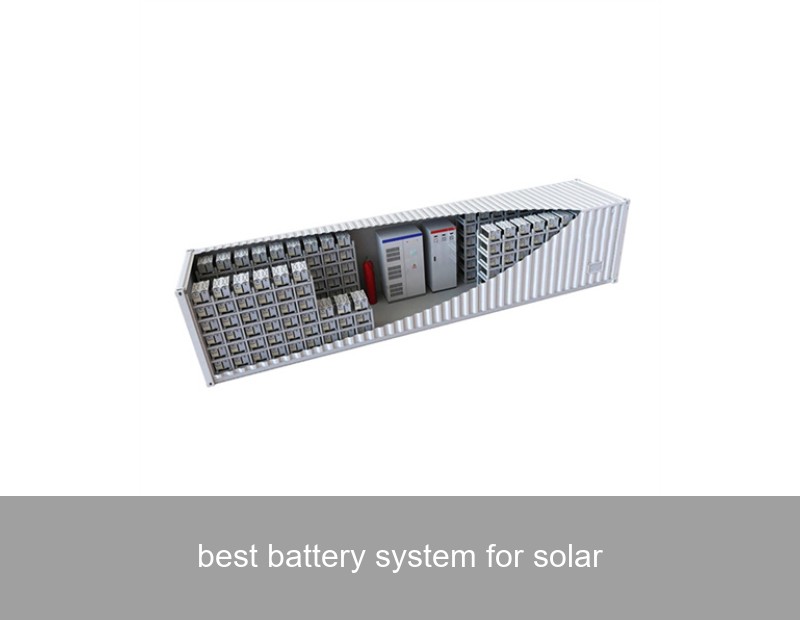
For larger-scale needs, our Commercial and Industrial (C&I) HES-M Series provides containerized or skid-mounted solutions that can scale into the megawatt-hour range. These systems are engineered for demanding duty cycles and can be configured for advanced applications like peak shaving, demand charge reduction, and even grid services, creating an additional revenue stream for our clients.
What unites all Highjoule systems is a unified software platform that gives you visibility and control over your energy assets from a single dashboard, whether you're managing a single home or a distributed microgrid.
Making Your Choice: Questions to Ask
As you evaluate systems, move beyond simple specs. Ask potential providers:
- How does the system's software actively manage my energy to save me the most money?
- Can you show me a simulated analysis of my specific load profile with and without the battery?
- What is the total installed cost, and what does the warranty actually cover over its entire term?
- How does the system perform in extreme temperatures, which are becoming more common?
The right partner will welcome these questions and provide clear, data-backed answers.
Your solar panels are a source of potential. The right battery system is what unlocks it, transforming sunlight into security, savings, and true sustainability. The journey to energy independence is a detailed one, but the destination is worth it. What will your first night of powering your home entirely with the sun you captured that day feel like?
 Inquiry
 Online Chat