


Finding the Best Solar Panel for Your Motorhome: A Complete Energy Independence Guide
Imagine cruising down the open road, your motorhome a self-sufficient haven, powered silently by the sun. No more scrambling for a hookup, no more generator noise—just pure freedom. This isn't a distant dream; it's the reality for a growing number of RV enthusiasts across Europe and the US. But with so many options, how do you choose the best solar panel for your motorhome? The answer isn't just about the panel on your roof; it's about a complete, intelligent energy ecosystem that ensures reliable power wherever your adventures take you.
Table of Contents
- The Phenomenon: Why Solar is Revolutionizing Motorhome Travel
- Key Criteria for the Best Motorhome Solar Panel
- Beyond the Panel: The Heart of Your System - Battery & Intelligence
- A Real-World Case Study: Boondocking in the Arizona Desert
- The Highjoule Solution: Integrated Power for Limitless Adventure
- Your Next Step Towards Energy Freedom
The Phenomenon: Why Solar is Revolutionizing Motorhome Travel
The trend is undeniable. A recent report by the European Commission highlighted a surge in demand for mobile renewable solutions, driven by a desire for sustainability and off-grid capability. In the US, RV industry surveys consistently show solar power as the #1 desired upgrade for serious campers. The appeal is clear: liberation from crowded campsites with electrical hookups (which can cost $50-$80 per night in peak season) and the ability to explore remote, pristine locations—a practice known as "boondocking."
But here's the common pitfall many face: they invest in high-wattage solar panels but pair them with an undersized or outdated battery bank. The result? The sun charges the batteries by noon, but they're depleted by evening, forcing the gas-guzzling generator back into action. The true best solar panel for a motorhome is one that's part of a perfectly balanced system.

Image Source: Unsplash - Representative image of a motorhome with solar panels.
Key Criteria for the Best Motorhome Solar Panel
Not all solar panels are created equal, especially for the demanding environment of a moving vehicle. Let's break down the essentials:
- Panel Type: Monocrystalline vs. Polycrystalline: For limited roof space, monocrystalline panels are the undisputed champion. They offer the highest efficiency (often 20%+), meaning they generate more power per square meter—a critical factor on an RV roof. They also perform better in low-light conditions, like cloudy days or early mornings.
- Durability & Build: Your panels must withstand vibrations, wind, hail, and temperature extremes. Look for panels with a robust anodized aluminum frame, tempered glass, and strong bypass diodes to manage partial shading.
- Flexible vs. Rigid: While flexible panels seem attractive for curved roofs, they typically have shorter lifespans, lower efficiency, and can suffer from heat buildup. High-efficiency rigid panels, properly mounted with an air gap, remain the most reliable long-term choice.
| Feature | Monocrystalline (Best Choice) | Polycrystalline | Flexible Thin-Film |
|---|---|---|---|
| Efficiency | High (20%+) | Medium (15-17%) | Lower (10-13%) |
| Space Requirement | Low (Best for small roofs) | Medium | High |
| Durability on RV | Excellent | Good | Variable/Prone to Degradation |
| Cost | Higher upfront | Lower | Medium to High |
Beyond the Panel: The Heart of Your System - Battery & Intelligence
Think of your solar panels as the diligent workers harvesting energy. The battery is the bank where you store that harvest, and the inverter/charge controller is the brilliant manager deciding how to use it. This is where most systems fail and where true innovation lies.
Traditional lead-acid batteries are heavy, have a shallow depth of discharge (DoD), and degrade quickly. The modern solution is Lithium Iron Phosphate (LiFePO4) battery technology. They are lighter, last 5-10 times longer, and allow you to use 80-90% of their capacity safely versus maybe 50% in lead-acid. This means more usable power from the same solar input.
But even the best battery needs a brain. An advanced Energy Management System (EMS) is what transforms a collection of parts into a seamless "smart" system. It optimizes charging from solar, shore power, or the alternator; protects the battery; and gives you precise, remote control over your power via a smartphone app.
A Real-World Case Study: Boondocking in the Arizona Desert
Let's look at data from a real enthusiast, Mark and Sarah, who live full-time in their 35-foot Class A motorhome in the Southwestern US. Their goal was to boondock for 4-5 days without running their generator.
- Old Setup: 600W of polycrystalline panels + 4x 100Ah AGM (Lead-Acid) batteries (400Ah total, ~200Ah usable).
- Problem: By the second evening, their batteries would drop below 50%, triggering low-voltage alarms on their fridge. Running a coffee maker or microwave would cause a significant voltage sag. They had to run their generator for 3-4 hours daily to recharge, disrupting the peace.
- Solution & Data: They upgraded to 800W of high-efficiency monocrystalline panels and, crucially, installed a Highjoule HPS 5.1kWh LiFePO4 battery system with an integrated smart inverter/charger. The results were transformative:
- Usable Capacity: Jumped from ~200Ah to over 4000Wh (roughly 330Ah at 12V) of usable energy.
- Autonomy: They now comfortably last 5 full days, running a 12V fridge, LED lights, laptops, a 55-inch TV for 3 hours nightly, and a 900W microwave for 10 minutes daily. Their state of charge (SOC) rarely drops below 40% by morning.
- Quiet & Control: Generator use dropped by over 90%. The Highjoule app shows them real-time solar production, consumption, and battery SOC, allowing them to manage loads confidently.
This case underscores that the panel wattage was only part of the equation. The high-density, high-cycle-life lithium storage and intelligent management were the game-changers. (For more on RV energy consumption, see this helpful guide from the U.S. Department of Energy).

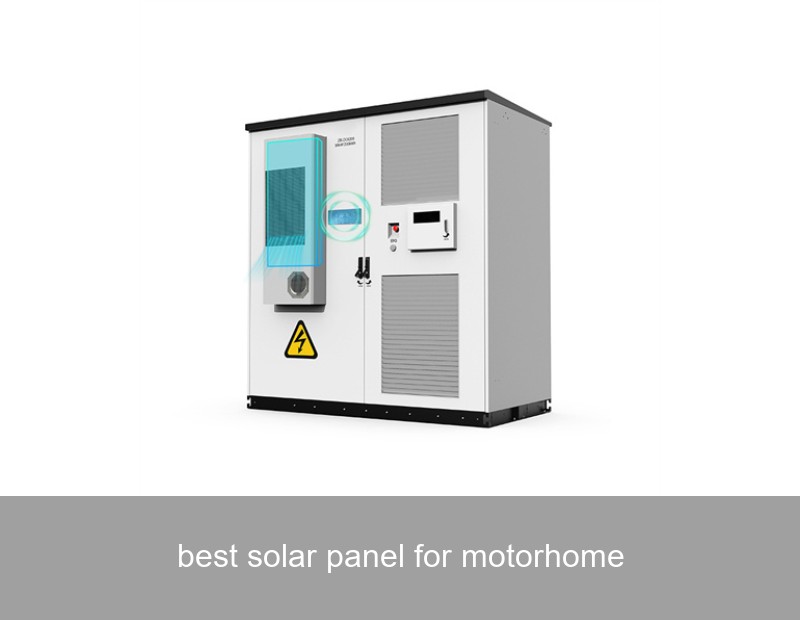
Image Source: Unsplash - Representative image of a clean energy storage installation.
The Highjoule Solution: Integrated Power for Limitless Adventure
At Highjoule, with nearly two decades of expertise in advanced energy storage, we understand that the best solar panel for a motorhome is only as good as the system it feeds. That's why we don't just sell components; we provide integrated, intelligent power solutions designed for the mobile lifestyle.
Our approach for motorhome and RV owners focuses on three pillars:
- High-Performance Components: We recommend and can source top-tier, RV-optimized monocrystalline solar panels known for their durability and output. But our core expertise lies in what happens next.
- Core Technology - The Highjoule HPS Series: Our Highjoule HPS LiFePO4 battery systems are the heart of the solution. They are specifically engineered for the vibration and temperature variability of mobile use. With built-in Battery Management Systems (BMS) and scalable capacity (from 2.5kWh to 15kWh+), they provide safe, deep-cycle power that lasts.
- Intelligent Control: Paired with our smart hybrid inverters and the Highjoule Energy Gateway, your system becomes self-aware. It automatically prioritizes solar power, blends charging sources for efficiency, and provides you with remote monitoring and control—all from your phone. You're always in charge of your power, even if you're away from the vehicle. (Learn about system sizing from a trusted source like the Photovoltaic Education Network).
Whether you're a weekend warrior in the Alps or a full-time RVer exploring North America's national parks, our systems are designed to deliver reliability, safety, and total peace of mind, making your motorhome a truly independent, sustainable home on wheels.
Your Next Step Towards Energy Freedom
Choosing your solar setup is an exciting step towards greater freedom. Start by auditing your real power needs: list every appliance, its watts, and estimated daily use. This will give you a clear picture of your required battery capacity and solar charging needs.
Remember, the goal isn't just to buy panels; it's to design a resilient power ecosystem. So, as you research the best solar panel for your motorhome, ask yourself this: What does true energy independence look like for my adventures, and is my chosen system smart and robust enough to deliver it reliably for the next decade?
 Inquiry
 Online Chat