


Powering Your Water Pump with the Sun: A Guide to Solar-Powered Water Pumps
Have you ever considered how the sun beating down on your property could be the key to a reliable, cost-effective, and sustainable water supply? For farms, remote homes, and businesses worldwide, the bomba de agua con energia solar (solar-powered water pump) is transforming this idea into reality. No longer just a niche technology, these systems are a mainstream solution for irrigation, livestock watering, and domestic use, especially in areas with limited or no grid access. In this article, we'll dive deep into how solar water pumps work, their undeniable benefits, real-world applications, and how pairing them with advanced energy storage, like solutions from Highjoule, can unlock 24/7 water security.
Table of Contents
How Does a Solar Water Pump System Work?
At its core, a bomba de agua con energia solar is elegantly simple. It converts sunlight into electricity to power a pump that moves water from a source—like a well, borehole, or pond—to where it's needed. The main components are:
- Solar Photovoltaic (PV) Panels: These capture sunlight and generate direct current (DC) electricity.
- Solar Pump Controller: This crucial device acts as the brain. It regulates the voltage and current from the panels, protects the pump, and often includes features like soft-start to reduce stress on the motor.
- Water Pump: Pumps can be either DC-powered directly or AC-powered via an inverter. Submersible pumps are common for deep wells, while surface pumps are used for shallow sources.
- Water Storage Tank/Reservoir: Since the sun doesn't shine at night, water is typically pumped into a storage tank during daylight hours, creating a buffer for use anytime.
Unlike traditional pumps tied to the grid or diesel generators, a solar pump's output varies with sunlight intensity. This is where modern technology shines: advanced controllers maximize efficiency even on partly cloudy days, ensuring water flow correlates with solar gain, which often aligns perfectly with peak irrigation needs.
Key Benefits of Switching to Solar-Powered Pumps
The shift to solar water pumping isn't just about being green; it's a smart economic and operational decision. Let's break down the advantages:
- Dramatically Lower Operating Costs: After the initial investment, the "fuel" from the sun is free. This eliminates volatile diesel fuel costs or rising electricity tariffs. The International Renewable Energy Agency (IRENA) consistently highlights the long-term cost-competitiveness of solar solutions.
- Energy Independence & Reliability: For remote locations, running power lines can be prohibitively expensive. Solar pumps provide a self-sufficient solution, immune to grid outages and fuel supply disruptions.
- Low Maintenance & Durability: With few moving parts compared to diesel engines, solar pump systems require minimal maintenance—mainly keeping panels clean and checking connections.
- Environmental Sustainability: Zero on-site emissions, no fuel spills, and a silent operation make it a clean technology that reduces your carbon footprint.

Image Source: Unsplash - A solar array powering agricultural operations.
A Real-World Case: Vineyard Irrigation in California
Let's look at a concrete example from Sonoma County, California. A 50-acre vineyard faced escalating electricity costs and wanted to reduce its environmental impact for a more sustainable brand. Their challenge: pumping water from a well to a central reservoir 100 feet above, requiring a consistent 5 HP (≈3.7 kW) pump.
The Solution & Data: They installed a 8 kW solar array directly coupled to a submersible pump via a smart controller. The results were compelling:
| Metric | Before (Grid) | After (Solar) | Change |
|---|---|---|---|
| Annual Energy Cost | $4,800 | ~$200 (controller minimal draw) | 96% Reduction |
| Annual CO2 Emissions | Approx. 4.2 tons | 0 tons (on-site) | 100% Reduction |
| System Payback Period | N/A | 4.2 years | Driven by state incentives & savings |
| Water Pumped per Day (Avg.) | Varies | ~50,000 gallons (sunny day) | Fully meets peak summer demand |
This case, echoed by many in agriculture across the US and Europe, shows the tangible return on investment. The vineyard now uses its solar pump as a cornerstone of its eco-friendly marketing, appealing to a conscious consumer base.
Beyond the Pump: The Role of Energy Storage for 24/7 Operation
A common question is: "What happens when it's cloudy or I need water at night?" This is where the conversation evolves from a simple bomba de agua con energia solar to a comprehensive, resilient water-energy system. Integrating a battery energy storage system (BESS) is the game-changer.
Think of it this way: the solar panels are your water pump's "workday," and the battery is its "night shift and rainy day fund." With a BESS, excess solar energy generated during the day is stored instead of being wasted. The pump can then draw from this reserve during low-light periods or on demand, ensuring uninterrupted water supply. This is critical for dairy farms requiring twice-daily watering, emergency water supply for remote clinics, or any operation where timing is crucial.
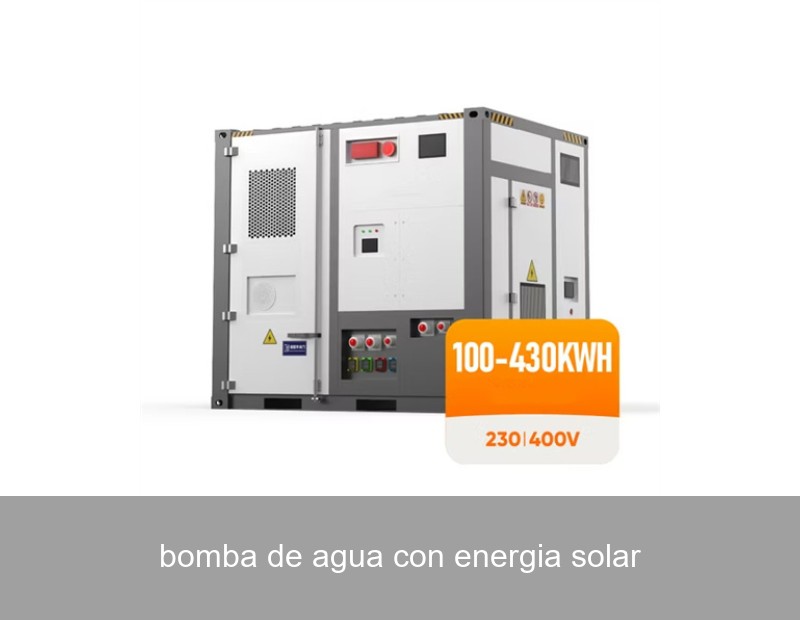
This is precisely where Highjoule's expertise becomes vital. As a leader in advanced energy storage since 2005, we design systems that seamlessly integrate with solar generation. Our Highjoule HES Series commercial and industrial battery systems are engineered for reliability in demanding environments. With smart energy management, these systems can prioritize solar power for the pump, store excess energy, and even provide backup power for other critical loads, maximizing the value of your entire solar investment. For residential and smaller-scale needs, our Home Energy Vault offers the same intelligent storage principles.

Image Source: Unsplash - A modern battery storage unit for solar energy.
Choosing the Right System for Your Needs
Designing an optimal solar water pumping system requires careful consideration. Key factors include:
- Water Requirement: Daily volume needed (in gallons/liters).
- Total Dynamic Head (TDH): The total height (vertical lift) plus friction losses in pipes the pump must overcome.
- Solar Resource: The average daily peak sun hours at your location.
- Storage Strategy: Will you rely on larger water tanks, integrate a battery system like Highjoule's, or a combination of both?
Partnering with an experienced provider is crucial. Highjoule doesn't just supply batteries; our technical experts work with solar installers and pump specialists to model your energy usage, ensuring the storage solution is perfectly sized to complement your bomba de agua con energia solar, guaranteeing performance and durability. We provide solutions for microgrids that can run an entire farm's operations, including multiple pumps, to residential systems ensuring a family's water security.
Ready to Harness the Sun for Your Water Needs?
The technology for clean, affordable, and independent water pumping is here and proven. Whether you're irrigating crops, watering livestock, or supplying a remote home, a solar-powered system is a robust solution. And when you're ready to take the next step toward complete energy resilience and 24/7 water availability, consider how an integrated storage system could elevate your project. What would 100% energy independence for your critical water supply mean for your operation or home?
 Inquiry
 Online Chat