


Demystifying the Key Components of a Solar Photovoltaic System
You've seen them gleaming on rooftops and sprawling across fields—solar panels capturing the sun's power. But have you ever wondered what makes a complete solar photovoltaic (PV) system tick? It's more than just the panels. Understanding the components of a solar photovoltaic system is the first step to appreciating how this technology converts abundant sunlight into reliable electricity for your home or business. As we move towards a more sustainable energy future, the efficiency and intelligence of each component determine not just how much power you generate, but how much you save and how resilient your energy supply becomes. Let's break down this remarkable system piece by piece.
Table of Contents
- The Power Core: Solar Panels and Their Makeup
- The Brains of the Operation: Inverters and Power Conversion
- The System's Backbone: Mounting, Racking, and Balance of System
- The Modern Game-Changer: Energy Storage Systems
- Real-World Impact: A Case Study from Bavaria
- Choosing Your System: What to Consider for Your Project
The Power Core: Solar Panels and Their Makeup
Naturally, the most visible components of a solar photovoltaic system are the solar panels themselves, or modules. These are arrays of photovoltaic cells, typically made from silicon, which create an electric current when exposed to sunlight through the photovoltaic effect. But not all panels are created equal. The market offers three primary types:
- Monocrystalline Silicon: High efficiency and a sleek, dark appearance. Made from single-crystal silicon, they perform better in low-light conditions but come at a higher cost.
- Polycrystalline Silicon: Recognizable by their blue, speckled look. They have slightly lower efficiency but are more cost-effective, made from fragments of silicon crystals melted together.
- Thin-Film: A lightweight, flexible alternative often used for large-scale commercial roofs or unique applications. While less efficient per square meter, they can perform better in high heat and diffuse light.
Your choice here directly impacts the energy yield of your entire system. It's not just about picking the panel with the highest wattage rating; it's about matching the technology to your available space, local climate, and energy goals.

Image source: Unsplash - Close-up of solar photovoltaic cells.
The Brains of the Operation: Inverters and Power Conversion
Here's a crucial fact: solar panels produce direct current (DC) electricity, but our homes and the grid run on alternating current (AC). This is where the inverter, arguably the most critical component after the panels, comes in. It's the system's brain, performing the essential DC-to-AC conversion while also managing performance and providing system data.
Inverter technology has evolved dramatically:
- String Inverters: The traditional, cost-effective choice where panels are connected in series into "strings." However, shade on one panel can reduce the output of the entire string.
- Microinverters: Small units attached to each individual panel. They optimize each panel's output independently, mitigating shade issues and providing detailed per-panel monitoring. They often offer longer warranties.
- Power Optimizers: A hybrid solution. Optimizers are installed at each panel (like microinverters) to condition the DC power, which is then sent to a central string inverter. This offers panel-level optimization with some of the economies of a central inverter.
For modern systems, especially those paired with storage, the role of the inverter expands. This leads us to the heart of intelligent energy management: the hybrid inverter or energy management system. Companies like Highjoule have pioneered this integration. Our Highjoule HPS Series Hybrid Power Station isn't just an inverter; it's an integrated unit that combines a high-efficiency multi-mode inverter, a MPPT solar charge controller, and grid connectivity in one robust chassis. This seamless design simplifies installation, enhances reliability, and provides a single point of control for your entire solar and storage ecosystem.
The System's Backbone: Mounting, Racking, and Balance of System
Often overlooked, the physical and electrical infrastructure is what holds everything together—literally. This "balance of system" (BOS) is essential for safety, durability, and performance.
| Component Category | Purpose & Importance |
|---|---|
| Mounting & Racking | Secures panels to roof or ground. Must withstand decades of wind, snow, and weather. Proper design ensures correct tilt and orientation for maximum sun exposure. |
| Wiring & Cabling | UV-resistant, weatherproof cabling connects the system. Correct sizing minimizes power losses over distance. Includes DC cables, AC cables, and grounding wires for safety. |
| Combiner Boxes & Disconnects | Electrical boxes that bring together multiple strings of panels. Include safety disconnects to allow technicians to isolate the system for maintenance. |
| Monitoring Systems | Hardware and software that provide real-time and historical data on energy production, consumption, and system health, often accessible via a smartphone app. |
Neglecting BOS components can lead to underperformance or even system failure. A high-quality installation uses corrosion-resistant materials, plans for thermal expansion, and ensures all electrical work meets the strictest national and local codes, such as the NFPA 70 National Electrical Code (NEC) in the US.
The Modern Game-Changer: Energy Storage Systems
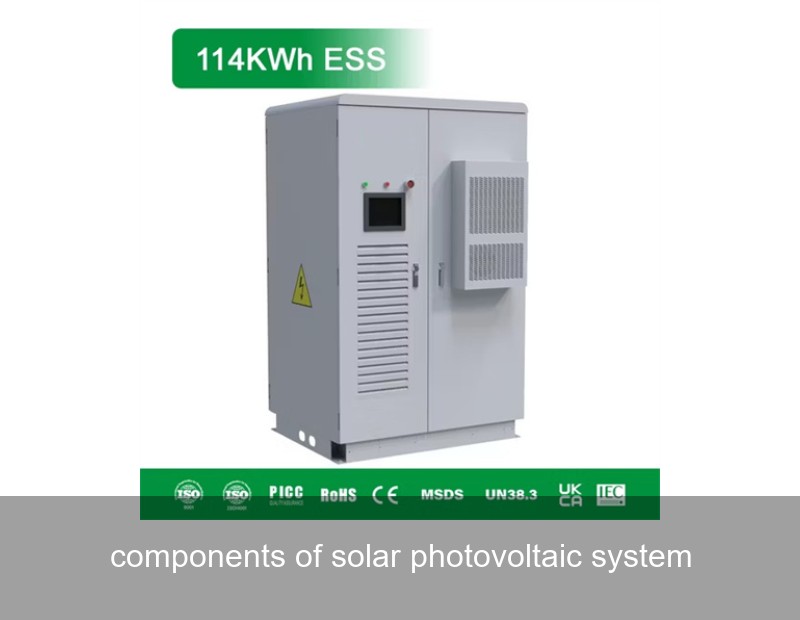
The conversation about the components of a solar photovoltaic system is no longer complete without discussing storage. Batteries transform a solar system from a daytime-only generator into a 24/7 personal power plant. They store excess solar energy produced during the day for use at night, during peak utility rate periods, or during grid outages.
The battery itself is the star, with Lithium Iron Phosphate (LFP) chemistry now dominating the market due to its long life, safety, and stability. But the battery management system (BMS) is the unsung hero. A sophisticated BMS monitors cell voltage, temperature, and state of charge, ensuring safety, longevity, and optimal performance.
This is where Highjoule's expertise truly shines. We don't just supply batteries; we deliver integrated, intelligent storage solutions. Our Highjoule HES Series Energy Storage systems feature industry-leading LFP battery cells managed by an advanced, self-learning BMS. Paired with our HPS Hybrid Power Station, the system can be configured for numerous modes: maximizing self-consumption, providing backup power for essential loads during a blackout, or even participating in grid services programs. For commercial clients, our Highjoule C&I Energy Platform offers scalable, containerized solutions that manage complex demand charges and provide critical backup power for operations.

Image source: Unsplash - A modern residential battery storage unit.
Real-World Impact: A Case Study from Bavaria
Let's look at how these components come together in a real project. A medium-sized dairy farm in Bavaria, Germany, faced rising energy costs and sought energy independence. Their goal was to cover 80% of their annual consumption, which included consistent cooling for milk storage.
The Challenge: High daytime consumption with a significant evening load spike. The local grid connection was limited.
- Solar Array: 120 kWp of high-efficiency monocrystalline panels installed on two large barn roofs.
- Power Conversion: A Highjoule HPS-50 Hybrid Power Station, chosen for its robust three-phase output and seamless storage integration.
- Energy Storage: A 60 kWh Highjoule HES system to shift solar energy to the evening milking and cooling cycles.
- Intelligent Management: The system was programmed to prioritize self-consumption, with excess energy used to heat water for sanitation before feeding back to the grid.
The Data-Driven Outcome: Within the first year, the system achieved 78% self-sufficiency. It reduced the farm's grid electricity purchases by over €11,000 annually. Crucially, the battery provided backup power during two brief grid outages, preventing spoilage in the milk cooling tanks—a risk mitigation that added significant value beyond simple savings. The project payback period is estimated at under 7 years, thanks in part to intelligent component selection that maximized the use of every kilowatt-hour generated.
Choosing Your System: What to Consider for Your Project
As you contemplate your own solar journey, remember that a PV system is a synergistic sum of its parts. The right combination depends on your unique situation. Ask yourself:
- What is my primary goal? (Lower bills, backup power, sustainability, all of the above?)
- What is my roof's orientation, shading, and structural condition?
- What are my local utility's net metering or feed-in tariff policies? (Check resources like the Database of State Incentives for Renewables & Efficiency (DSIRE) for US-specific policies).
- Do I have critical loads that need protection during an outage?
Partnering with an experienced provider like Highjoule means you get more than just components in a box. You get a customized solution designed for durability, performance, and long-term value. Our global team provides support from initial design through commissioning and long-term monitoring.
So, as you look at those gleaming panels on your neighbor's roof, you now know the sophisticated ecosystem working behind the scenes. The real question is, which component in your future system will you prioritize first to maximize your energy independence and resilience?
 Inquiry
 Online Chat