


Cuánto Cuesta el Panel Solar: A Realistic Breakdown for Homeowners in 2024
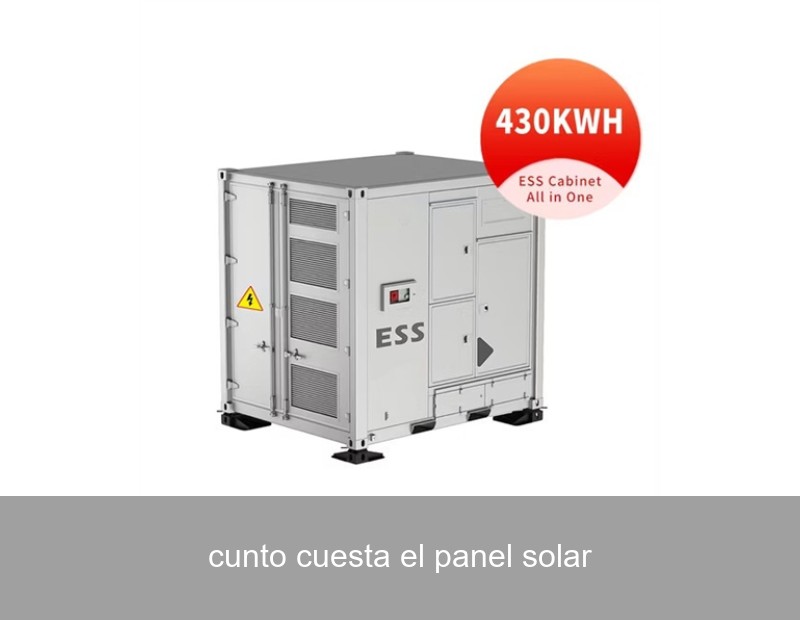
So, you're thinking about going solar. It's a brilliant move for your wallet and the planet. But the first question that pops into everyone's mind is, inevitably: ¿Cuánto cuesta el panel solar? The answer isn't a single number. It's a puzzle where pieces like your energy needs, roof type, local incentives, and the quality of the entire system come together. Today, we'll demystify the real cost of solar panels, moving beyond just the price tag per panel to show you how a holistic energy solution delivers true value.
Table of Contents
- What's Really Included in "Solar Panel Cost"?
- The Data: Falling Hardware Prices, Rising System Value
- A Real-World Case: The Johnson Family Home in Arizona
- The True Cost-Saver: Integrating Solar with Smart Storage
- Highjoule's Integrated Approach: Maximizing Your Solar Investment
- Is Your Home Ready for the Full Solar & Storage Experience?
What's Really Included in "Solar Panel Cost"?
When installers quote you a price for "solar panels," they're typically bundling several critical components. Understanding this breakdown is key to comparing offers.
- Hardware (The Physical Equipment): This includes the photovoltaic (PV) panels themselves, inverters (which convert DC solar power to usable AC power), mounting racks, and wiring. Panel efficiency and inverter type significantly affect the price.
- Soft Costs (The Behind-the-Scenes Work): Often 50-60% of the total! This covers permitting, inspections, interconnection fees to your utility, design work, and the installer's labor and profit margin.
- The "Hidden" Component: System Design & Intelligence. A premium, often overlooked, is the system's brain. How well does it optimize energy production, monitor consumption, and integrate with the grid or future batteries? This is where long-term value is created.
A Typical Cost Range for a Residential System
In the U.S., as of 2024, the average cost for a residential solar panel system before incentives ranges between $18,000 and $36,000 for a typical 6kW to 10kW system. After the 30% federal investment tax credit (ITC), the net cost can drop to $12,600 - $25,200. In Europe, prices vary widely by country but follow a similar structure, with strong subsidies available in nations like Germany, Italy, and Spain.
The Data: Falling Hardware Prices, Rising System Value
The National Renewable Energy Laboratory (NREL) reports that the price of solar modules has dropped by over 80% in the last decade. However, the focus is shifting. The real economic question is no longer just "cuánto cuesta el panel solar," but "how much value does my entire energy system provide?"
Consider this phenomenon: In sun-rich markets like California and Spain, midday solar production is so high that it can depress grid power prices (the "duck curve" effect). Without a way to store that cheap, self-produced energy, you end up selling it back to the grid at low rates only to buy expensive power in the evening. This drastically reduces the financial return of a panels-only system.

Image Source: Unsplash - A modern residential solar installation.
A Real-World Case: The Johnson Family Home in Arizona
Let's look at concrete data from a 2023 installation in Phoenix, Arizona—a prime solar market.
| System Component | Specification | Cost | Notes |
|---|---|---|---|
| Solar Panels | 8.5 kW (22 panels) | $16,500 | High-efficiency monocrystalline |
| Standard String Inverter | 1 unit | Included above | Covers basic conversion |
| Installation & Permits | - | $7,500 | Typical soft costs |
| Total System Cost (Pre-ITC) | - | $24,000 | - |
| Net Cost (After 30% ITC) | - | $16,800 | - |
The Initial Outcome: The system covered 85% of their daytime usage. However, they still relied 100% on the grid from sunset to sunrise. Their monthly bill dropped from $220 to about $45—a solid saving.
The Lost Opportunity: Their system exported ~40% of its daily production to the grid, earning a credit of just $0.03 per kWh. At night, they imported power at $0.28 per kWh. The financial and energy independence gap was clear.
The True Cost-Saver: Integrating Solar with Smart Storage
This is the pivotal insight. To truly maximize the answer to "cuánto cuesta el panel solar," you must think in terms of a complete system. Adding a battery energy storage system (BESS) transforms the economics.
- Energy Time-Shifting: Store your excess midday solar energy and use it during peak evening hours, avoiding high tariff rates.
- Backup Power: Maintain power during grid outages—a value that's increasingly important.
- Grid Services: In some markets, advanced systems can participate in grid-balancing programs for additional revenue.
Adding storage increases the upfront investment but dramatically improves the long-term return on investment (ROI) and energy self-consumption rate, often to 80% or more.

Image Source: Unsplash - A residential battery storage unit.
Highjoule's Integrated Approach: Maximizing Your Solar Investment
This is where Highjoule, as a global leader in advanced energy storage systems since 2005, redefines the equation. We don't just sell solar panels or batteries; we provide intelligent, integrated power solutions.
For homeowners, our Residential Energy Ecosystem is designed to answer the true cost question holistically:
- High-Efficiency Solar Compatibility: Our systems seamlessly pair with top-tier solar panels, but we focus on the intelligence behind them.
- Core Technology: The Highjoule Smart Battery System: Our lithium-ion battery systems, like the H-Joule HomePower series, feature built-in AI-driven energy management. This software learns your consumption patterns, weather forecasts, and utility rate schedules to autonomously optimize when to store solar energy, use it, or even sell it back at the most profitable times.
- Scalable & Modular Design: Start with what you need and expand capacity as your needs evolve, protecting your initial investment.
- Reliability & Safety: Engineered with commercial-grade standards for safety and longevity, offering industry-leading warranties and 24/7 system monitoring.
By integrating Highjoule's smart storage, a system like the Johnsons' could increase their self-consumption to over 90%, potentially reducing their net monthly energy cost to near zero and providing uninterrupted backup power. The levelized cost of energy (LCOE) over the system's 25+ year life becomes the most competitive metric.
What About Commercial & Industrial Applications?
For businesses, the "cuánto cuesta" calculation shifts to peak shaving, demand charge reduction, and sustainability goals. Highjoule's C&I and Microgrid solutions deliver even greater scale and grid-interactive capabilities, turning energy management into a strategic asset. According to a IRENA report, renewable energy coupled with storage is now consistently outcompeting fossil fuels on cost for new power projects.
Is Your Home Ready for the Full Solar & Storage Experience?
The journey to solar is exciting. Moving beyond the initial question of "cuánto cuesta el panel solar" to "what is the optimal system for my energy independence and financial goals?" is where the real power lies. With incentives like the ITC in the U.S. and various European subsidies still strong, now is an excellent time to invest in a comprehensive solution.
What would your ideal energy day look like—maximizing every kilowatt-hour your roof produces, securing your home against outages, and taking control of your energy costs for the next two decades?
 Inquiry
 Online Chat