


Evolve Energy: How Much Can You Really Save and Generate?
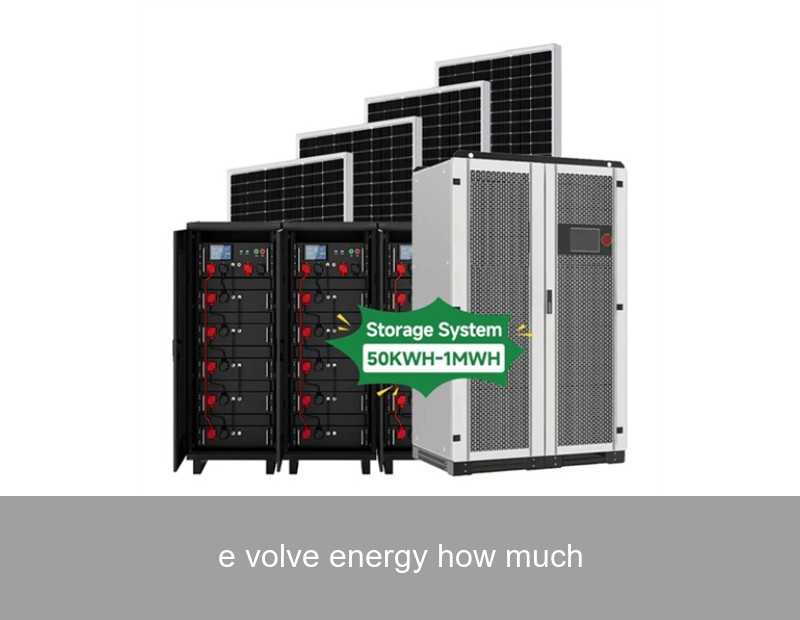
You've likely seen the ads: "Slash your energy bills!" or "Become energy independent!" The promise of evolving your home or business energy with solar and storage is compelling. But the central question remains: Evolve energy, how much? How much can you save, how much backup power do you get, and crucially, how much does it cost to transform your power profile? As energy volatility becomes the new normal, moving from a static consumer to an active energy manager isn't just eco-friendly—it's an economic imperative. Let's break down the real numbers and potential.
Table of Contents
- The Phenomenon: From Static Bills to Dynamic Energy Management
- The Data: Quantifying the "Evolve" Equation
- The Case Study: A European Business's Transformation
- The Insight: It's Not Just Hardware, It's Intelligence
- The Highjoule Difference: Smart, Scalable Systems
- Your Next Step: From Question to Clarity
The Phenomenon: From Static Bills to Dynamic Energy Management
For decades, energy was a one-way street. You consumed, you paid the bill—often a confusing amalgam of rates, tariffs, and seasonal hikes. The rise of distributed generation, primarily rooftop solar, began to change that. But solar alone has a limitation: it generates when the sun shines, which often doesn't align with peak usage or peak electricity prices. This mismatch leads to the phenomenon of sending cheap, self-generated power back to the grid only to buy back expensive power at night.
Enter the battery energy storage system (BESS). This is the true catalyst for the energy evolution. It allows you to store your surplus solar energy and use it on your terms. Now, the question evolves from "How much solar?" to "How much can a smart storage system save me, protect me, and even earn for me?" The system's intelligence in deciding when to charge, when to discharge, and when to interact with the grid is where the real value is unlocked.
The Data: Quantifying the "Evolve" Equation
Let's talk numbers. The financial return hinges on several key variables: your local utility rate structure, solar production, battery capacity, and software intelligence.
- Demand Charge Reduction (Commercial/Industrial): For businesses, a significant portion of the bill can be "demand charges"—fees based on your highest power draw in a month. A BESS can "peak shave," discharging to cap that draw. Reductions of 15-30% on the total bill are common.
- Time-of-Use (TOU) Arbitrage (Residential & Commercial): With TOU rates, electricity costs more during peak evening hours. A smart system stores solar or cheap off-peak grid energy and uses it during expensive peaks. In California, for example, the delta between off-peak and peak rates can exceed $0.25 per kWh. For a household using 20 kWh during peak, that's over $5 saved per day, or $1,800+ annually, just from strategic shifting.
- Backup Power Value: How much is uninterrupted power worth? For a homeowner, it's food safety, security, and connectivity. For a small business, an outage can mean lost revenue and data. A typical 10-15 kWh battery system can power essential loads (lights, fridge, router, critical machinery) for 12-24 hours or more.

Image Source: Unsplash - A modern home integrated with solar and battery storage.
According to the U.S. Department of Energy's Solar Energy Technologies Office, the levelized cost of solar+storage continues to fall, making the payback period increasingly attractive, often within 6-10 years for a robust system.
A Real-World Case: Boutique Hotel in Southern Spain
Let's make this concrete. A 40-room boutique hotel in Andalusia faced high seasonal energy costs, especially during summer months with air conditioning running constantly. Their grid power rates were volatile, and they had limited roof space for solar.
- Challenge: Reduce energy costs by at least 20% and ensure power quality for guest comfort.
- Solution: A tailored Highjoule system featuring a 100 kW / 215 kWh battery storage unit integrated with a existing 50 kW solar PV array. The system was designed for maximum solar self-consumption and peak shaving.
- Outcome (18-month data):
Metric Result Annual Energy Cost Savings €28,500 (24% reduction) Solar Self-Consumption Increase From 55% to 92% Demand Charge Reduction 35% Projected Payback Period 6.2 years
The hotel manager noted, "The system doesn't just save money; it gives us predictability. We can now forecast our energy expense accurately, which is a huge advantage for budgeting."
The Insight: It's Not Just Hardware, It's Intelligence
The core insight from thousands of installations is that the physical battery is only part of the answer. The "how much" is overwhelmingly determined by the Energy Management System (EMS)—the brain of the operation. A sophisticated EMS like the one in Highjoule's Nexus Platform does more than just switch the battery on and off. It:
- Continuously forecasts solar production and load consumption.
- Ingests real-time and forecasted grid electricity prices (where available).
- Optimizes for multiple objectives: maximize self-consumption, minimize cost, or ensure backup readiness.
- Can integrate with grid services programs, potentially creating a new revenue stream.
This is where generic, off-the-shelf systems often underperform. They lack the adaptive learning and grid-aware intelligence to maximize returns in complex, real-world conditions.
The Highjoule Difference: Smart, Scalable Systems for Your Evolution
At Highjoule, we've been answering the "evolve energy, how much" question since 2005. Our approach is to provide not just products, but a holistic power resilience and optimization solution.
Our flagship product line, the Highjoule Apex Series, is designed for commercial and industrial applications. These modular, containerized or skid-mounted BESS solutions are built with industry-leading lithium-iron-phosphate (LFP) battery cells for safety and longevity. They come integrated with our proprietary Nexus EMS, ensuring every kilowatt-hour stored is deployed for maximum economic benefit.

Image Source: Unsplash - Technician monitoring an industrial-scale energy storage system.
For residential and small commercial sites, our Highjoule Unity Home System offers seamless integration with new or existing solar. Its compact design, quiet operation, and intuitive user app let homeowners see, in real-time, exactly how much they are saving and generating, directly answering the "how much" question daily.
Our services extend beyond installation. We offer comprehensive energy audits, financial modeling to project your specific savings and payback, and ongoing performance monitoring. We partner with you to navigate incentives like the EU's smart grid initiatives or the U.S. Investment Tax Credit (ITC), which can significantly impact your system's upfront cost.
Your Next Step: From Question to Clarity
So, "evolve energy, how much?" The answer is uniquely yours. It depends on your location, energy profile, goals, and the intelligence of the system you choose. The transformation from passive consumer to active energy manager is not a distant future concept—it's a practical, financially sound decision being made by businesses and homeowners today.
What specific energy challenge—be it a monthly bill you want to dissect, a resilience concern, or a sustainability target—would you need to solve to make your own energy evolution not just a possibility, but a priority?
 Inquiry
 Online Chat