


Powering the Future: How the Gensol Group of Companies is Reshaping Energy with Advanced Storage
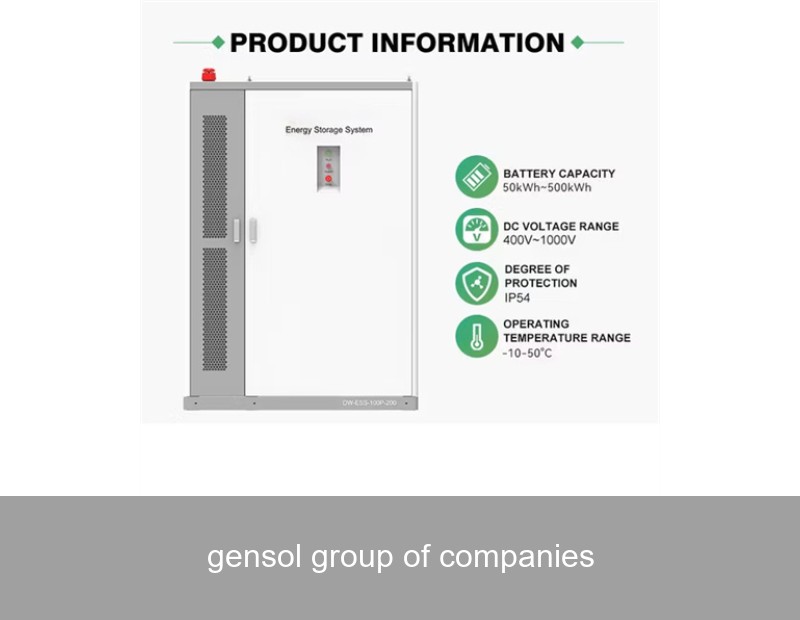
Have you ever watched a solar farm sit idle on a cloudy day, or wondered how we can truly harness the wind that blows at night? This intermittent nature of renewable energy is one of the biggest puzzles we need to solve for a sustainable future. The answer, increasingly, lies in sophisticated battery energy storage systems (BESS). At the forefront of integrating these solutions into the global energy landscape is the Gensol Group of Companies. This dynamic conglomerate has evolved from its roots in solar consulting to become a major force in engineering, electric vehicle manufacturing, and crucially, large-scale energy storage. Their journey mirrors the industry's shift: recognizing that generating clean power is only half the battle; storing and intelligently managing it is the key to grid stability and decarbonization.
Table of Contents
- The Storage Imperative: Beyond Solar Panels and Wind Turbines
- The Gensol Blueprint: From Consultants to Integrated Energy Players
- Case Study: Stabilizing the Grid in the UK – A 50 MW Success Story
- The Technology Core: What Makes a Modern BESS Tick?
- The Highjoule Role: Delivering Reliability for Demanding Applications
- Future Horizons: What's Next for Storage and Grids?
The Storage Imperative: Beyond Solar Panels and Wind Turbines
Let's talk numbers for a moment. The International Energy Agency (IEA) reports that global renewable capacity additions jumped nearly 50% in 2023, with solar PV accounting for three-quarters of that growth. That's phenomenal. But the phenomenon creates a new challenge: the duck curve. This is the term grid operators use to describe the steep drop in net electricity demand during the day when solar floods the grid, followed by a sharp ramp-up in the evening as the sun sets but demand persists. Without a buffer, this curve can cause grid instability, voltage fluctuations, and even force renewable sources to be curtailed—turned off—wasting clean energy.
This is where entities like the Gensol Group of Companies step in. They don't just see the problem; they provide the integrated solutions. Energy storage acts as a shock absorber, smoothing out the duck curve by storing excess midday solar and discharging it during the evening peak. It transforms renewable energy from a weather-dependent resource into a reliable, dispatchable one.

Image: Modern renewable projects are incomplete without storage infrastructure. Source: Unsplash
The Gensol Blueprint: From Consultants to Integrated Energy Players
Understanding the Gensol Group of Companies requires looking at its evolution. Initially focused on solar advisory services, Gensol leveraged its deep understanding of project development and financing to vertically integrate. Today, their portfolio is a testament to a holistic energy vision:
- Gensol Engineering: Provides full EPC (Engineering, Procurement, and Construction) and advisory services for solar and storage projects.
- Gensol EV: Develops and manufactures electric vehicles, including the unique Belectric solar-powered car.
- Gensol BESS: A critical arm focused on developing, owning, and operating grid-scale battery storage assets.
This integrated model is powerful. It means Gensol can assess a project's feasibility, design it, build it, supply the storage technology, and even manage its commercial operation. For clients, this reduces complexity, ensures compatibility between components, and can accelerate project timelines.
Case Study: Stabilizing the Grid in the UK – A 50 MW Success Story
The UK's National Grid is aggressively decarbonizing, with a target of a zero-carbon electricity system by 2035. To manage this transition, they rely on services like Dynamic Containment (DC), a fast-frequency response service that helps maintain grid stability within seconds of a disturbance.
In 2023, a Gensol Group of Companies subsidiary successfully commissioned a 50 MW / 100 MWh battery storage facility in the East Midlands of England. This project wasn't just about energy shifting; it was built specifically to provide these critical grid-balancing services. Here's the impact:
| Metric | Value | Significance |
|---|---|---|
| Capacity | 50 MW / 100 MWh | Can power ~100,000 homes for 2 hours. |
| Response Time | Under 1 second | Instantly injects or absorbs power to correct grid frequency. |
| Service Provided | Dynamic Containment (DC) | Essential for a grid with high wind penetration. |
| CO2 Displacement | Estimated 25,000 tonnes/year | By enabling more renewables and reducing reliance on gas peaker plants. |
This project exemplifies the Gensol strategy: identifying a specific market need (grid services in the UK) and deploying tailored storage solutions to meet it profitably and sustainably.
The Technology Core: What Makes a Modern BESS Tick?
Behind every successful storage project is a combination of hardware and intelligence. A grid-scale BESS is far more than just a box of batteries.
- Battery Cells: Typically lithium-ion (LFP chemistry is now dominant for safety and longevity), arranged into modules and racks.
- Power Conversion System (PCS): The "translator" between the battery's DC power and the grid's AC power. Its efficiency and response speed are critical.
- Energy Management System (EMS): The brain of the operation. It decides when to charge, when to discharge, and at what power level, based on market signals, grid conditions, and asset health.
- Thermal Management & Safety: Sophisticated cooling systems and multi-layered fire detection/suppression are non-negotiable for safe, decade-long operation.
Choosing the right technology partner for these components is what separates a project that merely functions from one that excels over a 15-20 year lifespan.
The Highjoule Role: Delivering Reliability for Demanding Applications
This is where Highjoule's expertise becomes pivotal. As a global leader in advanced储能系统 founded in 2005, Highjoule specializes in the very technology that powers ambitious projects like those undertaken by the Gensol Group of Companies. For commercial, industrial, and utility-scale applications, reliability isn't a feature—it's the requirement.
Highjoule's IntelliBESS product line is engineered for this reality. These containerized, all-in-one systems integrate high-cycle life LFP batteries, a high-efficiency PCS, and an AI-driven EMS that can be configured for multiple revenue streams—from peak shaving and energy arbitrage to providing grid services like frequency regulation. For a developer like Gensol, this means a streamlined supply chain, reduced on-site integration risk, and a partner that understands the rigorous performance demands of grid operators in markets like Europe and the U.S.

Image: A technician performs checks on a containerized BESS unit. Source: Unsplash
Furthermore, Highjoule's focus on sustainability extends beyond the operational phase. Their systems are designed for recyclability at end-of-life, aligning with the circular economy principles that forward-thinking conglomerates now demand. When integrated into a Gensol project, a Highjoule system becomes the reliable, intelligent heart of the asset, ensuring it delivers financial and environmental returns for years to come.
Future Horizons: What's Next for Storage and Grids?
The trajectory is clear. The energy storage news landscape is buzzing with announcements of ever-larger projects. We're moving from standalone storage to "storage-plus" – hybrids that combine solar, wind, and batteries with a single grid connection and control system. The next frontier is virtual power plants (VPPs), where thousands of distributed assets, from home batteries to industrial storage units, are aggregated to act like a single, flexible power plant.
Pioneers like the Gensol Group of Companies, with their fingers on the pulse of EV manufacturing, storage development, and renewable engineering, are uniquely positioned to orchestrate these complex, interconnected systems. The success of their UK project is just a single data point in a much larger trend.
So, as you look at the energy transition, the question is no longer just "How much renewable capacity can we build?" The more strategic question is: How will we build the intelligent, flexible, and resilient infrastructure to make every megawatt of clean power count? The answer is being written today through the collaboration of visionary developers and cutting-edge technology providers.
 Inquiry
 Online Chat