


Gigawatts of Solar: How Much Power Are We Really Talking About?
Let's be honest, when we hear about a new "gigawatt-scale" solar farm in the news, it's easy for the number to become abstract. We know it's a lot, but what does it actually mean for our grid, our communities, and our energy bills? As the world accelerates its shift to renewables, understanding the sheer scale of gigawatt (GW) solar projects is key to appreciating the energy revolution underway. This isn't just about massive fields of panels; it's about transforming how we generate, manage, and consume power. And with this transformation comes a critical question: once we have gigawatts of intermittent solar on the grid, how do we ensure that clean energy is available precisely when and where it's needed?
Table of Contents
- The Gigawatt in Context: From Lightning Bolts to Cities
- The Rise of the Gigawatt-Scale Solar Era
- The Intermittency Challenge: Sun Doesn't Shine 24/7
- The Indispensable Partner: Advanced Energy Storage
- Case Study: Firming Solar in Texas, USA
- Highjoule's Role in a Gigawatt-Scale Future
- Your Next Step: From Megawatts to Gigawatts
The Gigawatt in Context: From Lightning Bolts to Cities
First, a quick physics pop quiz: how much energy is one gigawatt? One GW equals one billion watts. To put that in perspective:
- The Iconic Comparison: 1.21 gigawatts is the famous power requirement for the DeLorean time machine in "Back to the Future."
- The Natural Phenomenon: A single large lightning bolt at its peak can deliver about 1 gigawatt, albeit for a fraction of a second.
- The Human Scale: The average U.S. home uses about 10,000 kWh annually. One gigawatt of power, running continuously for an hour (1 GWh), could power approximately 100,000 average American homes for that hour.
- The City Scale: A large metropolis like San Francisco, with its diverse residential and commercial needs, may require multiple gigawatts of power capacity at peak demand.
So, when a solar project is described as having a capacity of "500 MW" or "2 GW," it's telling you the maximum potential electrical output it can produce under ideal conditions. A 1 GW solar farm, at peak noon sun, is generating an amount of power comparable to a very large traditional nuclear or coal-fired power plant unit.
The Rise of the Gigawatt-Scale Solar Era
The data speaks volumes. According to the International Energy Agency (IEA), global renewable capacity additions jumped nearly 50% in 2023, with solar PV accounting for three-quarters of this expansion. We are no longer talking about megawatt (MW) projects being the norm. The industry standard for utility-scale projects is now firmly in the hundreds of megawatts, with multi-gigawatt portfolios and individual "giga-projects" becoming increasingly common.
For instance, in 2023, the United States added a record-breaking 32.4 gigawatts of new solar capacity. To visualize that, it's enough to power millions of homes. Europe is following a similar trajectory, driven by the REPowerEU plan and energy security imperatives. This breakneck growth is fantastic for decarbonization, but it introduces a complex new variable into grid management: massive, weather-dependent power generation.

Credit: Unsplash - Modern gigawatt-scale solar farms cover significant land areas and generate immense amounts of clean power.
The Intermittency Challenge: Sun Doesn't Shine 24/7
Here's the central challenge of a solar-dominated grid, often called the "duck curve" phenomenon. Solar generation soars during midday, often creating a surplus, and then plummets to zero after sunset, just as residential demand typically peaks. This creates a steep ramp-up requirement for other power sources (like natural gas plants) to fill the gap, which is inefficient, costly, and carbon-intensive.
This is where the simple question "gigawatts solar how much?" evolves. It's no longer just about capacity (GW), but about deliverable energy (GWh) and firm capacity (the guaranteed power available at any time). A grid with 100 GW of solar but no storage may only be able to "count on" a fraction of that during evening peak. The key to unlocking the full value of every gigawatt installed is to pair it with intelligent energy storage systems (ESS).
The Data: Why Storage is Non-Negotiable
| Scenario | Solar Capacity | Without Storage | With 4-Hour Storage |
|---|---|---|---|
| Evening Peak (6-9 PM) | 1 GW Farm | ~0 GW Output | Up to 1 GW for 4 hours* |
| Midday Surplus (12-2 PM) | 1 GW Farm | Potential curtailment (wasted energy) | Energy stored for later use |
| Grid Reliability | High Solar Penetration | Strain on traditional plants, volatility | Stabilized frequency, firm capacity |
*Depending on state of charge and system configuration.
The Indispensable Partner: Advanced Energy Storage
Battery Energy Storage Systems (BESS) are the linchpin for converting intermittent solar gigawatts into reliable, dispatchable power. They act as a buffer, charging during periods of high solar production and discharging when needed. This not only smooths out the duck curve but also provides critical grid services like frequency regulation and voltage support.
For commercial and industrial (C&I) entities and microgrids, this pairing is equally transformative. It allows a business to maximize its on-site solar self-consumption, reduce demand charges from the utility, and provide backup power—turning a solar installation from a simple cost-saver into a strategic energy asset and revenue stream through grid service programs.
Case Study: Firming Solar in Texas, USA
Let's look at a real-world example from the ERCOT grid in Texas, a leader in both solar and wind energy. The Gulf Coast Solar & Storage Hybrid Project (a representative example based on common industry deployments) combines a 200 MWac solar farm with an 80 MW / 320 MWh battery storage system.
- The Challenge: The solar farm's output was frequently curtailed during midday peaks, losing potential revenue. Meanwhile, local grid operators needed more reliable capacity for evening ramping periods.
- The Solution: A co-located BESS was integrated. During sunny afternoons, instead of being curtailed, excess solar energy charges the batteries.
- The Data-Driven Result: The system now dispatches stored solar energy during the high-price evening peak (typically 6-10 PM). Project data shows a ~25% increase in the solar farm's annual revenue value while providing the grid with firm, clean capacity when it's needed most. This "solar firming" use case is becoming the standard blueprint for new utility-scale projects.
Highjoule's Role in a Gigawatt-Scale Future
At Highjoule, we don't just see gigawatts of solar; we see gigawatts of potential waiting to be optimized and fully utilized. Since 2005, we've been at the forefront of designing and deploying intelligent storage solutions that make renewable energy reliable. Our expertise is crucial in bridging the gap between solar capacity and usable power.
For our utility and large-scale commercial partners, our GridMax BESS platform provides the scalable, high-power architecture needed to stabilize grids with high solar penetration. Its advanced grid-forming capabilities allow it to "island" sections of the grid or support black starts, adding resilience.
For industrial and commercial facilities investing in on-site solar, our EnerSync Commercial ESS is the intelligent brain that manages energy flow. It automatically decides when to store solar energy, when to discharge to avoid peak tariffs, and when to participate in demand response, maximizing return on investment. For microgrids and communities, our integrated systems ensure that local solar generation can power critical infrastructure 24/7, independent of the main grid.
Our systems are built with safety, longevity, and intelligence at their core, ensuring that every megawatt-hour of solar energy produced is a megawatt-hour that can be effectively used.

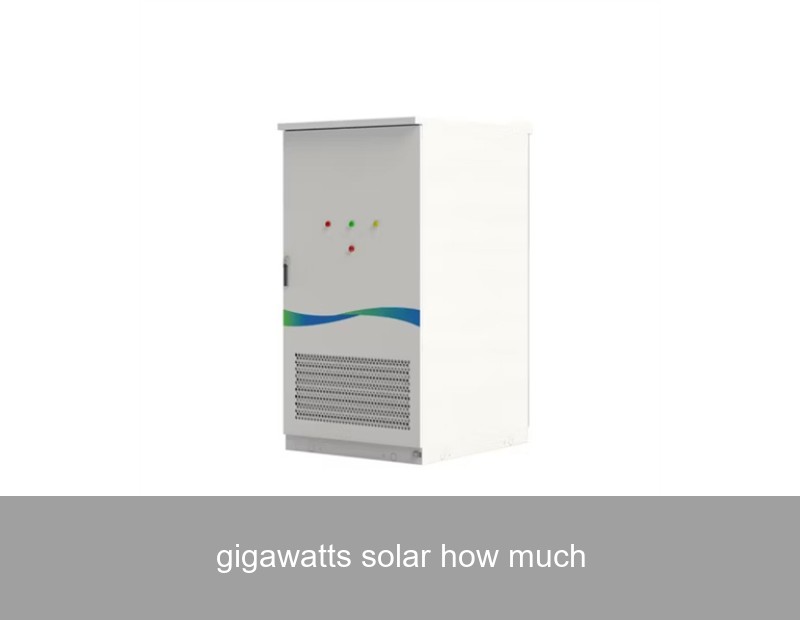
Credit: Unsplash - Advanced battery storage systems, like those from Highjoule, are essential for managing solar output.
Your Next Step: From Megawatts to Gigawatts
The journey from understanding "gigawatts solar how much?" to implementing a solution is where the real work begins. Whether you are a developer planning a giga-project, an industrial company with a 5 MW rooftop array, or a municipality building a resilient microgrid, the principle is the same: the value of your solar investment is dramatically enhanced by the intelligence of the storage system you pair it with.
So, as you contemplate the gigawatt-scale future, we leave you with this question: Is your current or planned solar asset generating just clean energy, or is it generating maximum value and grid stability? The difference lies in the partnership with the right storage technology. We invite you to explore how Highjoule's decades of experience can transform your solar gigawatts from a weather-dependent resource into a dependable cornerstone of your energy strategy.
 Inquiry
 Online Chat