


Understanding the Maximum Capacity of Your Solar Inverter: A Key to Unlocking System Potential
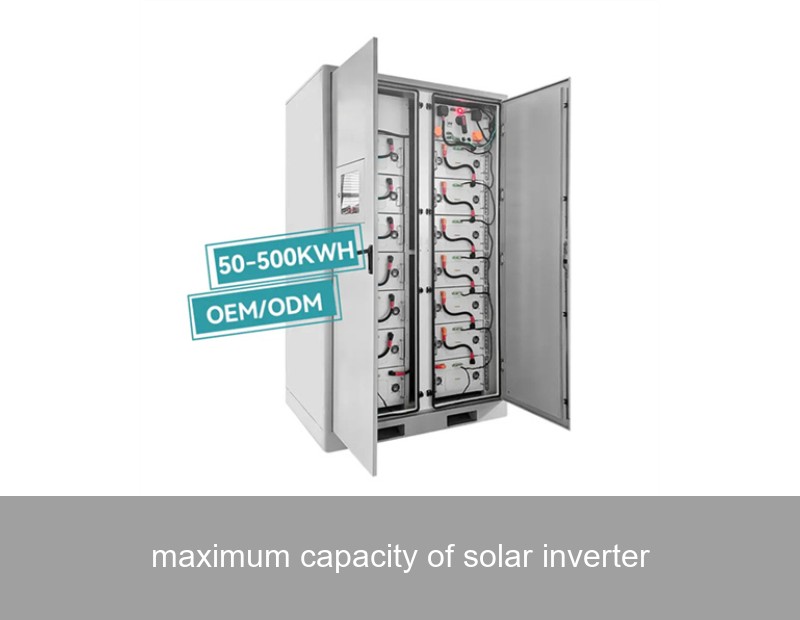
If you've invested in solar panels, you're likely focused on the number on your roof. But the true brain and bottleneck of your energy harvest often sits quietly on your wall: the solar inverter. A critical, yet frequently misunderstood, specification is the maximum capacity of a solar inverter. Getting this number right isn't just technical jargon; it's the difference between a system that underperforms and one that maximizes every ray of sunshine for your home or business. Let's demystify this crucial component and explore how it impacts your return on investment.
Table of Contents
- What is Maximum Inverter Capacity?
- The Phenomenon: Why We "Oversize" Solar Arrays
- The Data: Finding the Optimal DC-to-AC Ratio
- Case Study: A German Bakery's Smart Sizing
- Highjoule's Intelligent Inverter Solutions
- Future-Proofing Your Solar Investment
What is Maximum Inverter Capacity?
Simply put, the maximum capacity of a solar inverter, measured in kilowatts (kW) or megawatts (MW) for large systems, is the highest amount of alternating current (AC) power it can continuously output to your home or the grid. Think of it as the inverter's "peak throughput." Your solar panels generate direct current (DC) power, which the inverter converts to usable AC. However, the key insight is that the DC power from your panels is rarely constant. It fluctuates with sunlight intensity, angle, temperature, and even cloud cover.
This is where a common design strategy comes in: installing a solar array (DC) with a peak power rating that is higher than the inverter's maximum AC capacity. This ratio is known as the DC-to-AC ratio. For instance, a 12kW DC solar array paired with a 10kW AC inverter has a DC-to-AC ratio of 1.2. This intentional "oversizing" is a smart economic move to capture more energy during suboptimal conditions without paying for a larger, more expensive inverter that would only be used at its absolute maximum for a few hours a year.

Image: A modern string inverter, the heart of the PV system. Source: Unsplash
The Phenomenon: Why We "Oversize" Solar Arrays
You might wonder, "If my inverter caps at 10kW, why install 12kW of panels? Isn't that wasted?" This is the core question. Solar panels almost never operate at their nameplate "Standard Test Condition" (STC) rating in the real world. Heat reduces their efficiency, dust accumulates, and the sun's angle changes throughout the day. A 400W panel might only produce 320W during a hot afternoon.
By designing with a higher DC capacity, you effectively extend the shoulders of your power production curve. Your 12kW array might only hit a true 10kW DC output during perfect, cool, sunny hours around noon. For the many other hours of the day—morning, afternoon, and cloudy periods—the array is more likely to be operating in the 5-8kW DC range. With a 10kW inverter, you can convert nearly all of that. If you had paired a 10kW array with a 10kW inverter, those same hours might see only 4-6.5kW of production, leaving potential energy on the table (or rather, on the roof).
The Data: Finding the Optimal DC-to-AC Ratio
So, what's the magic number? Industry data and software modeling from leaders like the National Renewable Energy Laboratory (NREL) show that optimal ratios typically range from 1.1 to 1.5, depending on location and system design. In sun-drenched Arizona with very consistent output, a ratio closer to 1.1 might be ideal. In cloudier parts of Northern Europe or the Pacific Northwest, a higher ratio of 1.3 or more can significantly boost annual energy yield by capturing more diffuse light.
Modern inverters are designed to handle this. They have a "maximum DC input" rating that is safely higher than their AC output rating. The inverter's role is to intelligently "clip" any excess DC power above its maximum AC capacity during those rare peak moments. This "clipping loss" is a small, calculated trade-off for substantially greater energy harvest over the entire year.
| Typical Climate / Location | Recommended DC-to-AC Ratio Range | Primary Reason |
|---|---|---|
| Very Sunny, Consistent (e.g., Southwest USA, Southern Spain) | 1.1 - 1.25 | Minimize clipping loss during long, peak sun hours. |
| Temperate with Seasonal Variation (e.g., Central Europe, Northeast USA) | 1.2 - 1.4 | Balance peak harvest with shoulder-season gains. |
| Cloudy, Diffuse Light-Prevailing (e.g., UK, Pacific Northwest) | 1.3 - 1.5+ | Maximize capture of lower-light energy throughout the year. |
Case Study: A German Bakery's Smart Sizing for Maximum ROI
Let's look at a real-world example from Bavaria, Germany. A family-owned bakery wanted to reduce its high daytime energy costs and secure its power supply. Their roof could fit a 95kWp (kilowatt-peak) DC solar array. A naive approach might pair it with a 95kW AC inverter.
However, their energy consultant, partnering with Highjoule, proposed a different solution. They analyzed the bakery's load profile (high morning energy use) and local weather patterns. The recommendation was to use a Highjoule H-Energy Hub 80 commercial inverter with an 80kW maximum AC capacity, creating a DC-to-AC ratio of 1.19 (95kWp / 80kW).
- Annual Energy Production: 102,000 kWh (exceeding initial estimates).
- Clipping Loss: Less than 2% annually, occurring only on the absolute sunniest days around summer solstice.
- Financial Benefit: The savings from using a slightly smaller, more cost-effective inverter were reinvested into higher-efficiency panels. The system achieved a 12% faster payback period due to superior energy harvest during morning and winter months when the array rarely hit peak DC output.
- Added Value: The Highjoule H-Energy Hub's integrated smart controls allowed the bakery to dynamically shift some non-essential loads (like water heating for cleaning) to peak solar production times, further maximizing self-consumption and savings.
This case illustrates that the right maximum capacity of the solar inverter, chosen strategically, is a cornerstone of economic and technical optimization.

Image: Commercial rooftop solar installation. Source: Unsplash
Highjoule's Intelligent Inverter Solutions: Beyond Basic Capacity
At Highjoule, we view the inverter not just as a converter, but as the intelligent command center for your entire energy ecosystem. Our products, like the H-Power Home series for residences and the scalable H-Energy Hub for commercial use, are engineered with advanced features that make the most of your chosen capacity.
- Wide Operating Voltage Ranges: Our inverters can handle a broad span of DC input voltages, allowing for longer, more flexible string designs that perform better in partial shading and maintain high efficiency even when the array is not at peak power.
- Dynamic Peak Power Management: Advanced algorithms don't just "hard clip" excess power. They manage the DC input to optimize conversion efficiency across a wider power band, squeezing out more energy during the critical shoulder hours.
- Native Storage Readiness: Every Highjoule inverter is built with seamless battery integration in mind. When you're ready to add storage, the system's maximum capacity management extends to intelligently charge batteries with any potential clipped energy or excess production, turning momentary "losses" into stored value.
- Grid Services Compatibility: For our commercial and utility-scale clients, our inverters' precise control over their AC output capacity is key for providing grid-stabilizing services like frequency response, a growing revenue stream in many markets.
Future-Proofing Your Solar Investment
The energy landscape is shifting from one-way flow to interactive, dynamic networks. When considering the maximum capacity of your solar inverter, you must also ask: Is this system ready for my future needs? Will I want to add an electric vehicle charger, a heat pump, or battery storage next year?
This is where Highjoule's philosophy of adaptive energy systems shines. Our platforms are designed for modular expansion. Choosing a Highjoule inverter with a slightly higher capacity headroom than you need today, or one that is part of a modular system like our MicroGrid Controller, can save you tens of thousands in replacement costs down the line. You can start with a 10kW system and later add another 5kW of panels and a battery, with the same intelligent inverter managing the now more complex energy flows.
The Open Question for Your Project
As you plan your solar journey, the technical specifications matter immensely. But the deeper question isn't just "what size inverter do I need?" It's: "What kind of energy partner do I need to ensure this system delivers maximum value not just today, but over its entire 25-year lifespan?" How will your choice today adapt to the energy demands and opportunities of tomorrow?
 Inquiry
 Online Chat