


PDU Gestionable: How Much Do They Cost and Are They Worth the Investment?
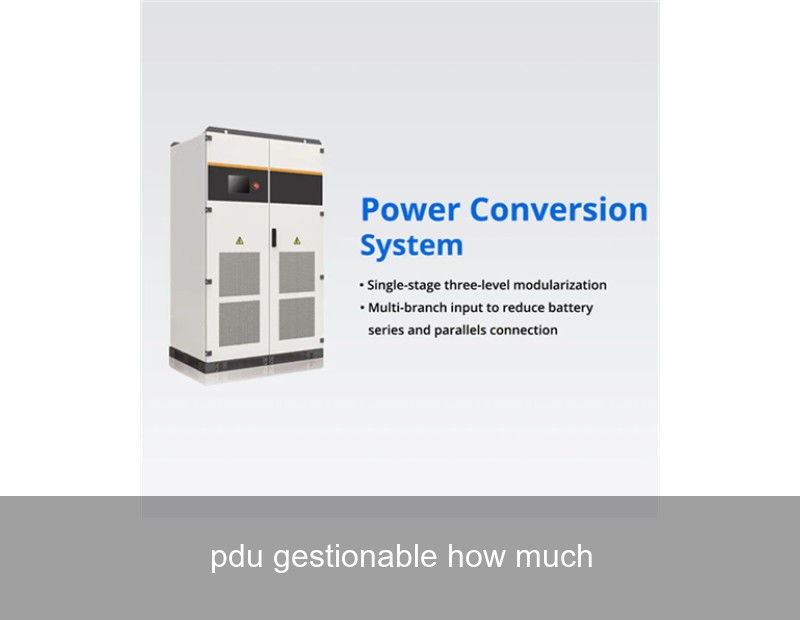
If you're managing a commercial facility, data center, or an industrial operation with a growing reliance on electrical infrastructure, you've likely encountered the term "PDU" or Power Distribution Unit. But when we start talking about a PDU gestionable (managed PDU), the conversation shifts from simple power strips to intelligent energy management. The immediate question that arises is: how much? How much do they cost, and more importantly, how much value can they bring to your operation? This article breaks down the investment in managed PDUs, moving beyond the sticker price to explore their role as a cornerstone for modern, resilient, and efficient energy management, especially when integrated with advanced energy storage systems.
Table of Contents
- What is a Managed PDU (PDU Gestionable)?
- Key Factors Influencing PDU Gestionable Cost
- Beyond Price: The Tangible Value of Intelligent Power Distribution
- Case Study: Enhancing Energy Resilience for a European Manufacturing Plant
- Highjoule's Approach: Integrating PDUs with Smart Energy Storage
- Making the Decision: Is a Managed PDU Right for You?
What is a Managed PDU (PDU Gestionable)?
Let's clear the basics first. A standard PDU is essentially a sophisticated power strip designed for rack-mounted equipment. A PDU gestionable, or managed PDU, is a significant leap forward. It incorporates a network interface (like SNMP, HTTP, or cloud connectivity) that allows for remote monitoring and control of power metrics at the outlet level. Think of it as the nervous system for your critical power chain.
With a managed PDU, you can see real-time data on energy consumption per circuit or even per individual outlet, set power thresholds, remotely reboot equipment, and sequence power on/off. This capability transforms a passive component into an active tool for operational intelligence.

Image: A modern data center rack showcasing organized power distribution. Source: Unsplash
Key Factors Influencing PDU Gestionable Cost
So, how much does a PDU gestionable cost? Prices can range from a few hundred to several thousand dollars or euros per unit. The variance is not arbitrary; it's directly tied to features and capabilities that align with your needs.
- Monitoring Level: Do you need basic outlet-level monitoring (amps, volts) or advanced metering that includes power factor (kVA) and energy consumption (kWh)? The latter increases cost.
- Control Capabilities: Remote outlet switching (on/off/reboot) adds significant functionality and cost compared to monitoring-only models.
- Power Rating & Phase: A single-phase, 120V, 30A PDU will cost less than a three-phase, 400V, 63A unit designed for high-density industrial loads.
- Form Factor & Outlet Count: Vertical vs. horizontal, number of outlets (8, 16, 24, etc.), and outlet types (IEC, NEMA, C13, C19) all affect price.
- Communication & Protocols: Basic network connectivity is standard. Support for advanced protocols like Modbus TCP, integration with DCIM (Data Center Infrastructure Management) software, or cloud-native platforms (like Highjoule's EnergyOS) can influence the price but offer greater ecosystem value.
As a rule of thumb, you are investing not just in hardware, but in the granular data and control that will inform your broader energy strategy.
Beyond Price: The Tangible Value of Intelligent Power Distribution
Evaluating a managed PDU solely on purchase price is like buying a car based only on its tire cost. The real question is: How much can it save or protect for my business? Here’s where the ROI becomes clear.
| Cost Factor | How a Managed PDU Addresses It | Potential Outcome |
|---|---|---|
| Energy Waste | Identifies underutilized or "phantom" loads, enables load balancing across phases. | Direct reduction in electricity bills (typically 5-15% in optimized environments). |
| Downtime & Equipment Failure | Alerts on power anomalies, prevents circuit overloads, allows for safe remote reboots. | Prevents costly outages. The average cost of data center downtime is nearly $9,000 per minute (Source: Vertiv). |
| Operational Inefficiency | Automates power sequencing, provides data for capacity planning and right-sizing. | Reduces manual intervention, optimizes capital expenditure on future power infrastructure. |
| Sustainability Goals | Provides accurate, granular carbon reporting data for Scope 2 emissions. | Supports ESG reporting and helps secure green financing or meet regulatory requirements. |
Case Study: Enhancing Energy Resilience for a European Manufacturing Plant
Let’s look at a real-world application. A mid-sized automotive parts manufacturer in Germany faced two challenges: unpredictable spikes in grid energy costs and the critical need for uninterrupted power for its precision robotic assembly lines. A 15-minute outage could result in over €50,000 in lost production and material waste.
The Solution: They partnered with Highjoule to deploy an integrated system. This included a 500 kWh Highjoule H-Series battery energy storage system (BESS) paired with strategically placed, cloud-managed PDUs on critical production floors. The PDUs provided real-time load profiling of each robotic cell.
The Data & Outcome: The managed PDUs identified specific, non-essential auxiliary loads that could be safely shed during peak grid pricing (€0.40/kWh vs. €0.25/kWh average). By combining this data with the BESS's discharge scheduling, the plant could:
- Reduce peak demand charges by 22% annually.
- Use the BESS for seamless backup during two brief grid disturbances, preventing any production halt.
- Gain a projected ROI on the combined PDU+BESS system in under 4 years, not just from savings but from avoided loss.
This case shows that the value of a PDU gestionable multiplies when it's part of a conscious, integrated energy management strategy.
Highjoule's Approach: Integrating PDUs with Smart Energy Storage
At Highjoule, we view managed PDUs not as isolated devices, but as critical sensory nodes in a larger energy ecosystem. Our EnergyOS platform can aggregate data from a fleet of PDUs across your sites, combining it with data from our H-Series (commercial/industrial) and HomePower (residential) battery storage systems, as well as on-site generation like solar PV.
This integration allows for scenarios a standalone PDU cannot achieve:
- Dynamic Load Management: The system can automatically shift non-critical loads to battery power during peak times, based on real-time PDU data, maximizing savings.
- Enhanced Resilience: During a grid outage, EnergyOS, informed by PDU load status, can prioritize which critical circuits to power from the BESS, extending backup duration for essential operations.
- Predictive Maintenance: Analyzing long-term power quality data from PDUs can predict equipment failure before it happens, scheduling maintenance proactively.
By choosing Highjoule, you're not just buying a PDU or a battery; you're investing in a unified intelligence layer for your entire energy infrastructure.

Image: Centralized monitoring and control is key to modern energy management. Source: Unsplash
Making the Decision: Is a Managed PDU Right for You?
Asking "how much for a PDU gestionable?" is the right starting point, but the journey shouldn't end there. To determine its value for your operation, consider these questions:
- Do I have critical equipment where remote reboot capability would drastically reduce maintenance costs or downtime?
- Am I struggling to understand my facility's true energy consumption patterns, especially under dynamic electricity pricing?
- Is my operation looking to integrate renewable energy or storage, and needs finer control over load matching and self-consumption?
- Do I need verifiable, granular data for sustainability reporting or internal efficiency benchmarks?
If you answered "yes" to any of these, the investment in a managed PDU likely justifies itself. The next logical step is to consider its role within a broader, intelligent energy system.
 Inquiry
 Online Chat