


Finding the Placa Solar Melhor Eficiencia for Your Energy Independence
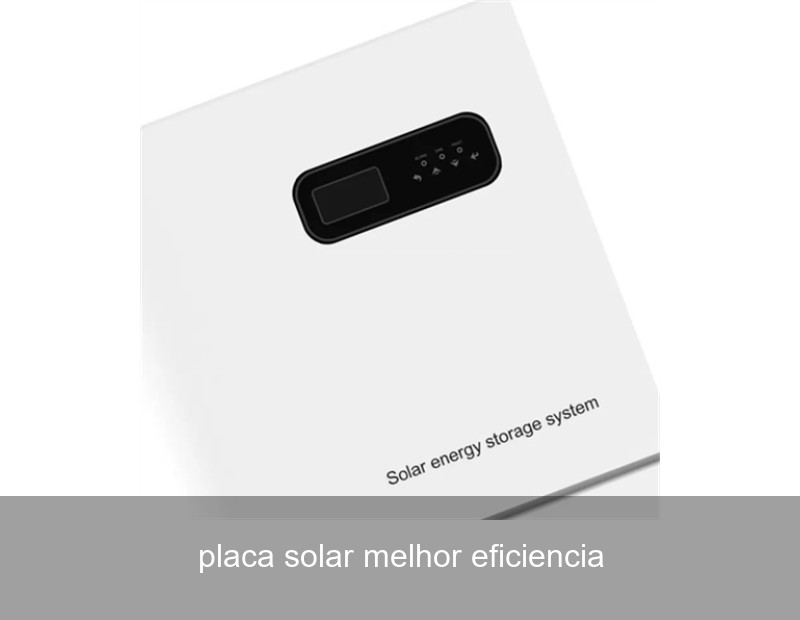
If you're researching solar panels, you've likely encountered the term "eficiencia" or efficiency. It's the golden metric, promising more power from the same roof space. But what does "placa solar melhor eficiencia" truly mean in practice? Beyond the laboratory ratings, real-world performance hinges on a complete, intelligent system. This article cuts through the noise, exploring how maximum efficiency is achieved not just by the panel on your roof, but by the integrated technology that manages, stores, and delivers every kilowatt-hour it produces.
Table of Contents
Beyond the Label: Understanding True Solar Efficiency
Manufacturers tout panel efficiency ratings—often between 19% and 23% for premium models. This number represents the percentage of sunlight hitting the panel that is converted into usable electricity. While crucial, this is a peak laboratory condition figure. The real question is: how much of that potential power actually powers your home or business throughout the year?
Consider this: two homes install panels with the same 22% efficiency rating. Home A uses a standard string inverter. Home B uses a system with module-level power electronics (like microinverters or optimizers) paired with a smart battery. On a partly cloudy day, a shadow from a chimney falls on one panel. In Home A, the output of the entire string can drop significantly. In Home B, only the shaded panel is affected, while the others operate at peak output, and the battery smooths out the intermittent supply. Which system delivered better real-world efficiency? The answer is clear.

Image Source: Unsplash - Real-world efficiency depends on installation and system design.
Key Factors That Define a High-Efficiency Solar Panel
To identify the truly efficient panel, look at its technology and response to environmental factors:
- Cell Technology: Monocrystalline silicon cells (especially N-type or heterojunction designs) offer the highest commercial efficiencies due to their pure silicon structure and better temperature coefficient.
- Temperature Coefficient: A critical, often overlooked spec. Panels heat up in the sun, losing efficiency. A better (lower) coefficient (e.g., -0.26%/°C vs. -0.35%/°C) means less power loss on hot days.
- Low-Light Performance: How well does the panel generate power at dawn, dusk, or on overcast days? Superior cells capture a broader spectrum of light.
- Durability & Degradation: A panel with a lower annual degradation rate (e.g., 0.25% vs. 0.5%) will retain a higher percentage of its original output 25 years later, yielding more lifetime energy.
The System View: Why Your Inverter and Battery Matter Just as Much
Chasing the absolute highest panel efficiency rating can yield diminishing returns at a steep cost premium. A more holistic and cost-effective strategy is to optimize the entire energy ecosystem. This is where companies like Highjoule redefine efficiency.
Since 2005, Highjoule has engineered advanced storage-first systems that ensure not a single watt of your precious solar production is wasted. Our philosophy is that the placa solar melhor eficiencia is only as good as the system it's connected to.
Highjoule's Integrated Approach to Total System Efficiency
- Smart DC-Coupled Storage: Unlike basic AC-coupled systems, Highjoule's HES Series battery systems connect directly to the solar array's DC power. This reduces conversion losses, allowing more solar energy to be stored directly with an efficiency exceeding 96.5%. More stored energy means less reliance on the grid.
- Advanced Inverter Technology: Our hybrid inverters feature industry-leading conversion efficiencies and wide MPPT voltage ranges. This ensures they can harvest more energy from your panels earlier in the morning, later in the evening, and during suboptimal conditions, maximizing the yield from every panel.
- AI-Powered Energy Management (AEGIS): This is the brain of the system. AEGIS learns your consumption patterns, weather forecasts, and utility rate schedules. It autonomously decides the most efficient action: power your home directly, store energy, or even sell back to the grid at the optimal time, maximizing your financial and energy return.
For commercial and microgrid applications, our GridSynk Platform takes this further, allowing for sophisticated energy arbitrage and demand charge management, turning a solar installation into a strategic financial asset. This system-level intelligence is what transforms a high-efficiency panel into a genuinely high-efficiency power plant.
Case Study: Maximizing Output in Northern Germany
Let's examine a real-world application in a challenging climate. A medium-sized dairy farm in Schleswig-Holstein, Germany, faced high operational costs and sought energy resilience. Their primary goal was to maximize self-consumption of solar energy despite the region's frequent cloud cover and modest solar irradiation.
The Challenge: High daytime energy demand for cooling, but significant evening usage for lighting and equipment. A standard solar setup would export most afternoon overproduction at low feed-in tariffs, forcing them to buy expensive power in the evening.
- A 120 kWp solar array using high-efficiency bifacial panels.
- A Highjoule HES-50 Commercial battery system (50 kWh capacity).
- Dual Highjoule H-I30 Hybrid Inverters.
- Integration with the farm's existing cold storage load.
| Metric | Result | Impact |
|---|---|---|
| Self-Consumption Rate | Increased from 35% to 92% | Dramatically reduced grid imports |
| Energy Cost Savings | €18,500 annually | Fast ROI on the storage system |
| Grid Independence During Outages | Up to 8 hours of critical operation | Ensured milk preservation and animal welfare |
The bifacial panels provided a higher yield, but the key to efficiency was the Highjoule system's ability to capture nearly all surplus generation and time-shift it to periods of high demand and low solar production. This case, documented in a Fraunhofer ISE report on photovoltaic trends, illustrates that system design can impact economic return more than panel efficiency alone.
Future-Proofing Your Investment
The energy landscape is shifting. Time-of-use rates, demand charges, and evolving grid services are becoming commonplace. Your solar + storage system must be adaptable.
Highjoule systems are built with this in mind. Our software-upgradable platforms allow you to add new functionalities, like grid services participation or integration with upcoming EV charging schedules, without replacing core hardware. When you choose a system, ask not just about today's panel efficiency, but about the digital efficiency and adaptability of the platform for the next 20 years.

Image Source: Unsplash - Future-proof systems integrate solar, storage, and electric vehicles.
Making the Informed Choice
So, how do you select the right solution? Start with a detailed energy audit. Look at your hourly consumption profile. Then, partner with an installer who can model different scenarios: premium panels with a basic inverter vs. tier-one panels with a Highjoule integrated storage system. You'll often find the latter delivers a better lifetime value, higher resilience, and true energy autonomy.
For deeper insights into solar technology comparisons, independent resources like the National Renewable Energy Laboratory (NREL) cell efficiency charts provide authoritative, unbiased data.
Your Path to Optimal Solar Performance
The journey to the most efficient solar solution begins with reframing the question. It's not merely "Which panel has the highest rating?" but rather, "Which intelligent energy system will deliver the highest usable, controllable, and resilient power for my specific needs, today and in the future?"
Highjoule is at the forefront of answering this complex question. We invite you to explore what true system efficiency could look like for your home or business. What is the single biggest energy challenge you hope to solve with your solar investment—is it reducing a specific peak demand charge, achieving 24/7 carbon-free operation, or simply gaining peace of mind against outages?
 Inquiry
 Online Chat