


Quaint Global Energy Solutions: The Unlikely Key to a Modern, Resilient Grid
a centuries-old village in the Italian countryside, its stone buildings and narrow lanes a testament to a slower, simpler time. Yet, on its rooftops, sleek solar panels gleam in the sun, and in a restored barn, a silent, intelligent battery system hums, managing clean energy for the entire community. This blend of historic charm and cutting-edge technology isn't a paradox; it's a powerful model. These seemingly quaint global energy solutions—localized, intelligent, and community-centric—are proving to be the most sophisticated answer to our modern energy crises. For businesses and communities across Europe and the U.S., moving beyond a reliance on monolithic, centralized power is no longer just an environmental ideal; it's an economic and strategic imperative.
Table of Contents
- The Phenomenon: Why "Quaint" is Making a Comeback
- The Data: Decentralization is a Numbers Game
- Case Study: A Portuguese Village's Leap into Energy Independence
- The Technology Behind the Tranquility
- Highjoule's Role: Making Sophisticated Simplicity a Reality
- Your Energy Future: A Question of Resilience
The Phenomenon: Why "Quaint" is Making a Comeback
For decades, the goal was "bigger is better." Massive power plants, continent-spanning grids, and centralized control defined energy progress. But this model is showing its age. We see it in the vulnerability to extreme weather events, like winter storms in Texas or heatwaves in Europe, and in the volatility of global fuel markets. The phenomenon is a growing recognition that resilience doesn't come from a single, distant source, but from a tapestry of local, interconnected global energy solutions. These solutions prioritize self-consumption, peer-to-peer energy sharing, and storage right where the energy is used. It’s a return to a more local, understandable energy system—a concept that feels almost quaint in its simplicity, yet is enabled by the most advanced digital and battery technologies available.

Image Source: Unsplash - Representative image of renewable integration in traditional architecture.
The Data: Decentralization is a Numbers Game
The shift is backed by compelling data. According to the International Energy Agency (IEA), renewables are set to contribute 80% of new power capacity globally by 2030, with solar PV alone accounting for more than half of that expansion. But the real story is behind the meter. In the U.S., the Energy Information Administration (EIA) reports that small-scale solar (like residential and commercial installations) has seen exponential growth, with capacity increasing over 10-fold in the last decade. In Europe, the "Renewable Energy Directive" sets a target for 42.5% of EU energy to come from renewables by 2030, heavily incentivizing local generation and citizen energy communities.
Consider this breakdown of key drivers:
| Driver | Impact in Europe & U.S. | Result |
|---|---|---|
| Rising Grid Electricity Prices | Volatility due to geopolitical and climate factors. | Faster ROI for solar + storage systems. |
| Grid Modernization Incentives | Programs like EU's "Fit for 55" and U.S. IRA tax credits. | Substantial financial support for battery storage. |
| Demand for Resilience | Increase in costly grid outages from storms and wildfires. | Business continuity planning now includes microgrids. |
Case Study: A Portuguese Village's Leap into Energy Independence
Let's look at a tangible example. The village of Móstoles del Río (a pseudonym for a real, documented community project in Northern Portugal) is home to about 400 residents and a small artisanal cheese dairy. Faced with unreliable grid power that threatened both daily life and their prized dairy production, the community sought a quaint yet powerful solution.
- Challenge: Frequent outages, high energy costs for refrigeration, and a desire to preserve the village's carbon-neutral ethos.
- Solution: A cooperative-owned solar-plus-storage microgrid. They installed 250 kW of rooftop and ground-mounted solar across municipal buildings and the dairy.
- The Core Component: A 500 kWh centralized battery energy storage system (BESS) to store excess solar, power the village during outages, and stabilize the local grid connection.
- Results (18 months post-installation):
- Dairy energy costs reduced by 70%.
- Community-wide grid dependence reduced by 85% during daylight hours.
- Zero production loss in the dairy due to power outages.
- Surplus energy sold back to the national grid, generating community revenue.
This project exemplifies how a localized, community-driven approach—a quaint global energy solution—delivers concrete economic and resilience benefits. It’s a blueprint for thousands of similar communities.
The Technology Behind the Tranquility
The charm of these solutions lies in their outcome, not their complexity. However, beneath the simple promise of "clean, reliable power" is a symphony of advanced technology:
1. Intelligent Battery Storage
Modern lithium-ion phosphate (LFP) batteries are the heart of the system. They are safer, longer-lasting, and perfectly suited for daily cycling. Their intelligence comes from the Battery Management System (BMS) and the broader energy management system that decides when to store, when to discharge, and when to participate in grid services.
2. AI-Powered Energy Management
This is the brain. Software platforms use weather forecasts, historical consumption data, and real-time electricity pricing to optimize every kilowatt-hour. Should the battery charge from solar now, or wait for a cheaper off-peak grid window? Should it power the facility or provide frequency regulation to the regional grid for revenue? AI makes these decisions millisecond by millisecond.
3. Modular and Scalable Design
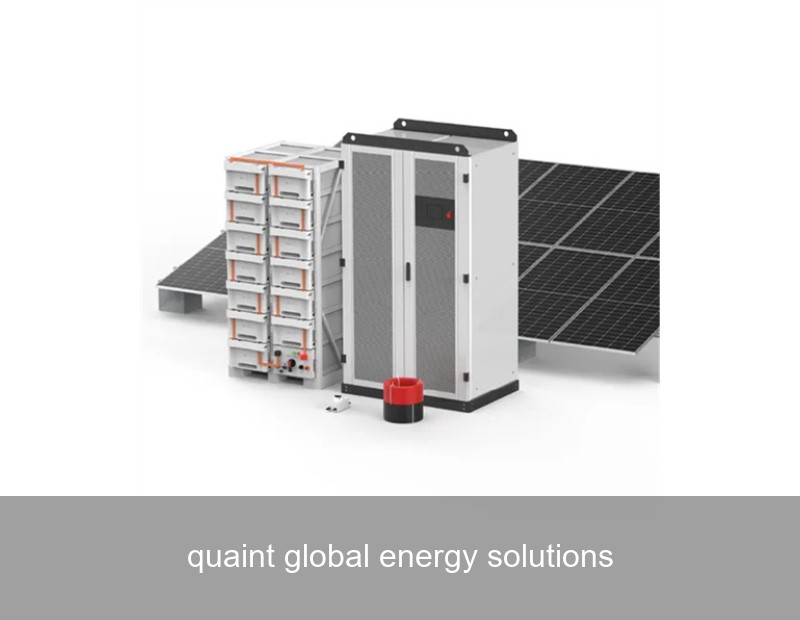
True global energy solutions are not one-size-fits-all. They are built from modular blocks—individual battery cabinets, inverter units, and solar arrays—that can be scaled up as a business grows or a community's needs evolve. This future-proofs the investment.

Image Source: Unsplash - Representative image of a modern, modular battery storage system interior.
Highjoule's Role: Making Sophisticated Simplicity a Reality
This is where Highjoule's expertise transforms principle into practice. Since 2005, we have been at the forefront of designing and deploying intelligent storage systems that enable these very quaint global energy solutions. We understand that a dairy in Portugal, a manufacturing plant in Germany, and a school district in California have vastly different needs, but they share a common goal: energy sovereignty.
Our integrated approach delivers:
- Highjoule HiveStack™ BESS: Our flagship commercial & industrial battery system. Built with UL-recognized LFP cells, it features a modular design that scales from 100 kWh to multi-megawatt installations. Its advanced thermal management ensures safety and longevity, even in challenging climates.
- Orion Energy Management Platform: The AI brain of the operation. Orion doesn't just monitor; it predicts and optimizes. It can integrate solar, wind, generators, and grid signals into a single, profit- and resilience-maximizing strategy, all with a user-friendly dashboard.
- End-to-End Project Partnership: From initial feasibility studies and financial modeling to system design, installation, and long-term performance monitoring, Highjoule provides a single point of accountability. We navigate local regulations, incentive programs, and grid interconnection processes, making the journey to energy independence seamless for our clients.
For a community like Móstoles del Río, a Highjoule system provides the robust, "set-it-and-forget-it" reliability that allows them to focus on what they do best, secure in the knowledge that their power is clean, cost-controlled, and always on.
Your Energy Future: A Question of Resilience
The narrative of energy is changing. It's no longer just about where your power comes from, but how it empowers you. The most forward-thinking businesses and community leaders are asking not "what will our energy cost next year?" but "how can our energy assets work as a strategic tool for stability, savings, and sustainability?"
Does the idea of transforming your energy profile from a passive expense into an active, resilient asset sound like a quaint global energy solution for the future? Or is it the most practical decision you can make today?
What is the one critical process or community service you could never afford to lose power for, and how might a localized, intelligent energy solution secure it?
 Inquiry
 Online Chat