


Smart Flower Solar System: The Blooming Future of Home Renewable Energy
Imagine a solar power system that greets the sun each morning, stretches its petals wide, and follows the light across the sky like a sunflower. This isn't science fiction; it's the reality of the smart flower solar system. For homeowners in Europe and the US, the quest for energy independence and sustainable living is growing stronger. While traditional rooftop panels are a common sight, they come with limitations—fixed angles, space requirements, and often, complex installation. The smart flower, an innovative all-in-one solar tracking system, presents a compelling and elegant alternative. As a product technology expert at Highjoule, a global leader in advanced energy storage founded in 2005, I've seen how pairing intelligent generation like this with our smart battery storage creates the ultimate home energy solution. Let's explore how this fascinating technology works and why it might be the perfect bloom for your energy garden.
Table of Contents
- What is a Smart Flower Solar System?
- The Rooftop Challenge: A Data-Driven Look at Limitations
- How the Smart Flower Solar System Works: A Technical Breakdown
- A Real-World Case Study: Efficiency in Action
- Beyond Generation: The Critical Role of Smart Storage
- Highjoule's Synergy: Integrating Smart Flowers with Advanced Storage
- Is a Smart Flower System Right for Your Home?
What is a Smart Flower Solar System?
Unlike static rooftop panels, a smart flower solar system is a ground-mounted, integrated unit designed to mimic nature's efficiency. It typically consists of a central stalk supporting several "petals" – each a high-efficiency solar panel. The magic lies in its dual-axis tracking system and fully automated operation. From dawn to dusk, the entire structure tracks the sun's path both horizontally (azimuth) and vertically (altitude), ensuring the petals are positioned at a near-perfect 90-degree angle to the sun's rays. At night or during high winds, it automatically folds into a closed, protective position. This isn't just about aesthetics; it's a profound engineering approach to maximizing energy capture from every available sunbeam.

Image Source: Unsplash - Representative image of a solar tracking system in a garden setting.
The Rooftop Challenge: A Data-Driven Look at Limitations
Let's address the elephant in the room: why not just stick with classic rooftop PV? The answer lies in physics and practicality. Fixed-tilt panels are inherently limited. According to data from the National Renewable Energy Laboratory (NREL), dual-axis trackers can increase energy production by 30-45% annually compared to fixed-tilt systems at an optimal angle. Why such a gap?
- Suboptimal Angles: A roof's angle and orientation are fixed. Unless your roof is perfectly south-facing (in the Northern Hemisphere) at an ideal tilt, you're losing potential energy.
- Shading and Obstructions: Chimneys, vents, or neighboring trees can cast shadows, significantly reducing the output of an entire panel string.
- Space and Roof Integrity: Not all roofs are suitable due to material, age, or structural limitations. The installation process can also be invasive.
- Heat Buildup: Rooftop panels have reduced air circulation underneath, which can raise their operating temperature and decrease efficiency—a factor smart flowers, with their open-air design, largely avoid.
The phenomenon is clear: to get the most from the sun, we need to follow it. That's the core promise of the smart flower design.
How the Smart Flower Solar System Works: A Technical Breakdown
Think of the smart flower as a sophisticated, weather-aware robot dedicated to harvesting photons. Its operation is a beautiful dance of software and hardware.
- Dual-Axis Sun Tracking: Using GPS and astronomical algorithms, the system knows the sun's precise position for its location every day of the year. Light sensors provide real-time fine-tuning.
- All-in-One Design: The unit contains the panels, inverter, monitoring system, and battery storage connection point in a single, compact footprint.
- Automated Safety: Anemometers monitor wind speed. At around 34 mph (54 km/h), the system will automatically fold its petals to prevent damage—a crucial feature for both European coasts and American plains.
- Plug-and-Play Philosophy: Many models are designed for relatively straightforward installation with minimal ground preparation, connecting directly to your home's electrical system.
This integrated, intelligent approach simplifies the user experience from acquisition to daily operation.
A Real-World Case Study: Efficiency in Action
Let's move from theory to practice with a concrete example. A 2022 installation in Freiburg, Germany—a city with a climate similar to many in Central Europe—provides compelling data. A household installed a single smart flower unit with a peak capacity of 2.5 kW. For comparison, a simulated 2.5 kW fixed-tilt south-facing rooftop system was used.
| Metric | Smart Flower System | Simulated Fixed-Tilt Rooftop System |
|---|---|---|
| Annual Energy Production | ~4,150 kWh | ~2,950 kWh |
| Capacity Utilization (Avg.) | >28% | ~20% |
| Peak Summer Day Output | 18.2 kWh | 14.1 kWh |
| Self-Consumption Rate (without storage) | ~35% | ~30% |
The data speaks volumes: the smart flower produced over 40% more energy annually. However, note the self-consumption rate. Even with this high yield, without a way to store the excess power generated in the middle of the day, a significant portion was exported to the grid. This highlights a critical insight: maximizing generation is only half the battle; capturing and using that energy on your schedule is the other.
Beyond Generation: The Critical Role of Smart Storage
Here's a key piece of the puzzle many homeowners miss. A solar system, no matter how efficient, operates intermittently. Your energy consumption, however, peaks in the morning and evening—often when the sun is low. This creates a mismatch. The true path to energy independence isn't just about producing more kilowatt-hours; it's about controlling when you use them. This is where a high-performance battery energy storage system (BESS) becomes non-negotiable. It transforms your solar array from a grid-dependent supplement into a personal, resilient power plant.
Highjoule's Synergy: Integrating Smart Flowers with Advanced Storage
This is precisely where Highjoule's expertise transforms a great solar solution into a complete home energy ecosystem. Since 2005, we've specialized in making renewable energy reliable and intelligent. A smart flower solar system generates the cleanest possible power, and Highjoule's storage solutions, like our H-Joule HomeStack, ensure none of it goes to waste.
Our battery systems are engineered for seamless integration. They store the excess midday production from your smart flower, safeguarding it for use during the evening peak, on cloudy days, or even during a grid outage. With Highjoule's intelligent energy management system, the entire setup works autonomously to:
- Maximize self-consumption of your solar energy, sometimes exceeding 80%.
- Provide backup power for critical loads during outages.
- Participate in utility demand-response programs (where available) to generate revenue.
- Offer real-time monitoring and control via a user-friendly app.
We view the smart flower not as a standalone product, but as the perfect generation partner for our storage technology. Together, they form a resilient, efficient, and sustainable microgrid for your home.

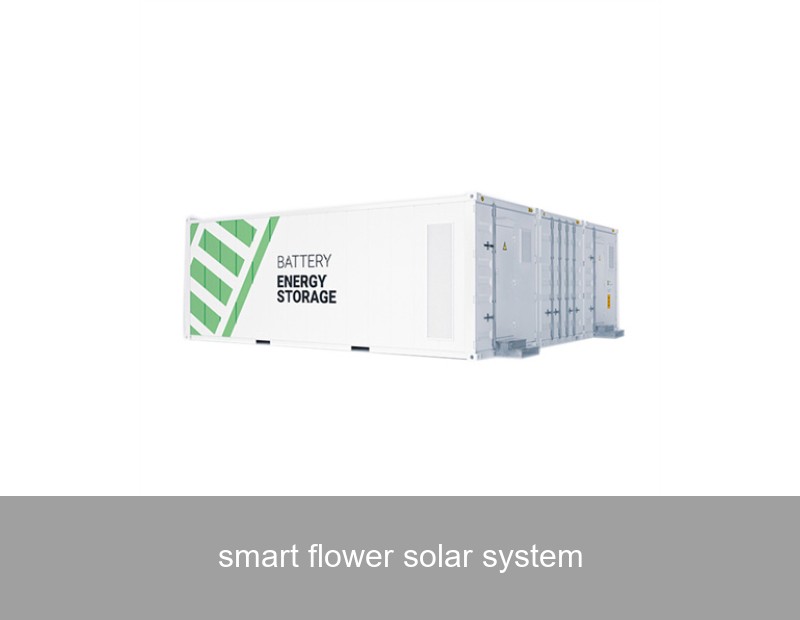
Image Source: Unsplash - Representative image of a modern home battery storage installation.
Is a Smart Flower System Right for Your Home?
So, should you consider this blooming technology? It's an excellent fit for certain scenarios. If you have a sunny garden, patio, or lawn space but an unsuitable roof, it's a prime candidate. If visual appeal and a compact, self-contained system are high priorities, it stands out. For those seeking the absolute maximum energy yield from a small footprint, its tracking advantage is powerful. However, it's vital to pair it with a robust storage solution to truly unlock its financial and practical benefits. Otherwise, you're simply exporting more expensive, high-efficiency solar energy to the grid at low rates.
The energy landscape is evolving from passive consumption to active, intelligent management. Technologies like the smart flower solar system and Highjoule's advanced storage are at the forefront of this shift, empowering homeowners like you to take control.
What's the first step you would take to understand your home's true potential for a smart, integrated renewable energy system?
 Inquiry
 Online Chat