


Choosing the Right Solar Panel for Your 220 Ah Battery: A Complete Guide
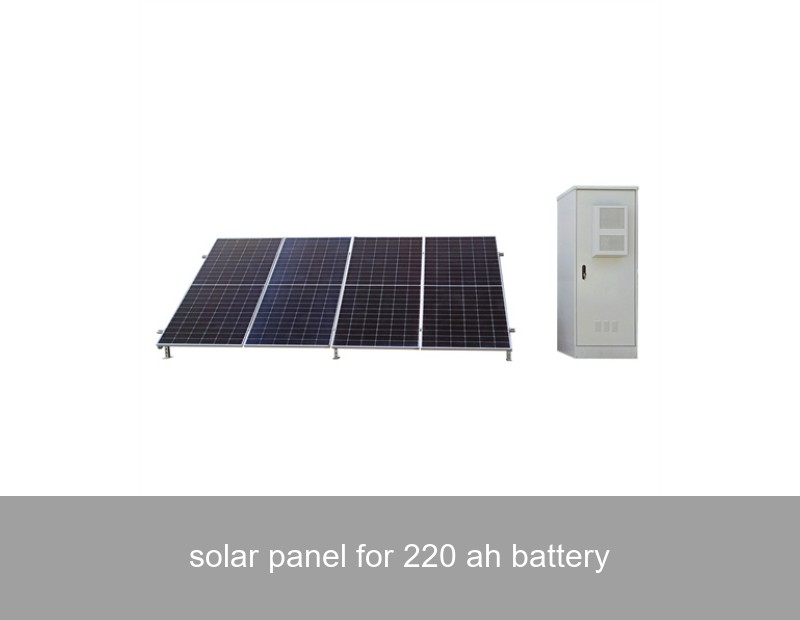
So, you've got a robust 220 amp-hour (Ah) battery—perhaps for your RV, boat, off-grid cabin, or home backup system. It's a powerhouse, capable of storing a significant amount of energy. But here's the question we hear all the time at Highjoule: "What size solar panel do I need to charge my 220 Ah battery effectively?" The answer, like most things in renewable energy, isn't a single number. It's a balance of science, real-world conditions, and smart system design. Let's demystify the process of selecting the perfect solar panel for a 220 Ah battery.
The Core Challenge: It's Not Just About Watts
Many assume pairing a solar panel with a battery is a simple plug-and-play operation. The reality is more nuanced. A 220 Ah battery, typically a deep-cycle lead-acid or lithium (LiFePO4) variant, isn't just a tank you fill with "solar power." It has specific voltage requirements (usually 12V or 24V) and, most importantly, a preferred charging profile. Throwing a random 100W panel at it might keep it trickle-charged, but for reliable, efficient recharging from a significant discharge, you need a calculated approach. Under-sizing your solar array leads to chronically undercharged batteries, reducing lifespan. Over-sizing can be wasteful and requires careful electronic management.
Understanding Your 220 Ah Battery's True Needs
First, identify your battery's key specs, as they dictate everything:
- Battery Voltage: Is it a 12V, 24V, or 48V system? This determines the solar panel array configuration (series vs. parallel).
- Battery Chemistry: Lead-Acid (Flooded, AGM, Gel) typically requires a 3-stage charging (Bulk, Absorption, Float) and should not be regularly discharged below 50% Depth of Discharge (DoD). Lithium (LiFePO4) can handle deeper discharges (80-90% DoD) and accept higher charge currents, allowing for faster solar recharge.
- Energy Capacity: A 12V 220Ah battery stores 12V * 220Ah = 2,640 Watt-hours (2.64 kWh) of energy. But you only want to replace the usable portion.
For example, if you have a lead-acid battery and avoid going below 50% DoD, your usable energy is 1.32 kWh. A lithium battery at 80% DoD gives you a usable 2.11 kWh. This "usable energy" is what your solar panels must replenish.
Calculating Your Solar Power Requirements: A Simple Framework
Let's build a practical example for a 12V 220Ah LiFePO4 battery in a sunny region like Southern Europe or California.
- Daily Energy Consumption: Determine how much energy you use daily. Let's say your loads (lights, fridge, pump) consume 1.5 kWh per day.
- Solar Hours & System Losses: You don't get 8 hours of full-power sun. We use "Peak Sun Hours" (PSH). In Madrid, the average is about 5 PSH in summer. Account for ~20% system losses (wiring, heat, controller efficiency).
- The Formula:
Solar Array Size (W) = (Daily Energy Use in Wh / Peak Sun Hours) / (1 - Loss Factor)
= (1500 Wh / 5) / 0.8
= 300 / 0.8 = 375 Watts
Therefore, a 375W to 400W solar array is a good starting point to reliably recharge a 220Ah lithium battery for this daily load. For lead-acid with less usable capacity, you might get away with slightly less, but oversizing solar is often a good hedge against cloudy days.

Image Source: Unsplash (Representative image of a solar-powered battery system)
Solar Panel Types: Which One is Best for Battery Charging?
Not all solar panels are created equal, especially in variable conditions.
| Panel Type | Pros for Battery Charging | Cons to Consider |
|---|---|---|
| Monocrystalline | Highest efficiency (18-22%), better performance in low-light and high heat, space-efficient. | Higher cost per panel. |
| Polycrystalline | Cost-effective, reliable technology. | Lower efficiency (15-17%), larger space needed for same power, worse heat performance. |
| Thin-Film | Excellent in high heat and diffuse light, lightweight. | Much lower efficiency (10-13%), requires significantly more roof/ground space. |
For most solar panel for 220 Ah battery applications, especially where space is limited (like an RV roof), high-efficiency monocrystalline panels are the preferred choice. Their ability to harvest more energy in the morning, evening, and on hazy days translates to more consistent charging current for your battery bank.
Beyond the Panel: The Critical Role of the Charge Controller
This is the unsung hero. A solar panel connects to a battery via a charge controller, not directly. For a 400W array on a 12V battery, the current can be high (400W/12V ≈ 33A). You need a robust controller.
- PWM (Pulse Width Modulation): Affordable but less efficient. It essentially "dumbs down" the panel voltage to match the battery, wasting potential power. Suitable for small systems (<200W).
- MPPT (Maximum Power Point Tracking): The gold standard. An MPPT controller intelligently finds the panel's optimal operating voltage and converts excess voltage into additional current, boosting harvest by up to 30% in cool weather. For a system designed around a 220 Ah battery, an MPPT controller is a non-negotiable investment.
Real-World Case Study: Off-Grid Cabin in Colorado, USA
Let's look at real data. A customer in the Rocky Mountains (average 4.5 PSH) needed to power a modest cabin with a 24V 220Ah LiFePO4 battery bank (from Highjoule's Residential ESS line). Daily consumption was ~2.8 kWh.
- Challenge: Recharge battery fully during short winter days with potential snow cover.
- Solution: A 600W array (3 x 200W monocrystalline panels) paired with a Highjoule 40A MPPT controller. The panels were mounted at a steep angle for winter sun and easy snow shedding.
- Result: Data logs from the Highjoule system monitoring portal showed the array consistently generated 2.9 - 3.4 kWh on clear winter days, fully replenishing the daily use. Even on partially cloudy days, the MPPT controller's efficiency ensured 1.5-2 kWh of harvest, preventing battery depletion. Over a year, the system achieved a 99.7% uptime for essential loads.
This case highlights that correctly sizing the solar panel for the 220 Ah battery, while using premium components, directly translates to reliability.
Highjoule's Integrated Solutions: Simplifying Solar & Storage
At Highjoule, we understand that this calculus of panels, batteries, and controllers can be daunting. That's why we design systems that take the guesswork out. Our Highjoule Home Energy Storage System and Industrial & Microgrid Solutions come with pre-engineered compatibility.
For instance, pairing our HJ-Stack 10kWh Lithium Battery (which can be configured to various voltages and capacities) with our HJ-Smart MPPT Hub creates a seamless DC-coupled architecture. The hub automatically communicates with the battery, optimizing the solar charge profile in real-time and extending battery life. For our commercial clients, this integrated approach ensures maximum ROI by squeezing every possible kilowatt-hour from the solar array into the battery storage. We don't just sell components; we deliver optimized, intelligent power ecosystems.

Image Source: Unsplash (Representative image of a modern home solar and storage installation)
Common Mistakes to Avoid
- Ignoring Voltage: Mismatching panel voltage (Vmp) with your battery bank voltage. Ensure your array's Vmp is high enough for the MPPT to operate, especially in hot weather when panel voltage drops.
- Forgetting the Sun: Basing calculations on "ideal" lab conditions. Always use conservative Peak Sun Hours for your location (resources like Global Solar Atlas are excellent).
- Neglecting Maintenance: Keeping panels clean and free of shade is critical. A single shaded cell can drastically reduce the output of a whole string.
- Oversizing Without a Capable Controller: Adding more panels without upgrading the charge controller can lead to overload and failure.
Choosing the right solar panel for your 220 Ah battery is a fundamental step toward energy independence. It requires a holistic view of your consumption, your environment, and the intelligent components that bridge the two. By focusing on the synergy between the solar array, the charge controller, and the battery's specific chemistry, you build a system that's not just functional, but resilient and efficient for years to come.
What's the biggest challenge you've faced when trying to size solar for your battery bank? Are you dealing with limited space, extreme weather, or highly variable daily loads? Share your scenario—we might just have an integrated Highjoule solution that fits perfectly.
 Inquiry
 Online Chat