


Finding the Right USA Solar Panels for Sale: A Guide to Smart, Sustainable Power
If you're searching for "USA solar panels for sale," you're already on a path toward energy independence and sustainability. But here's a crucial insight: the panel itself is just the beginning. The true power of a solar installation lies in the intelligent system that captures, stores, and manages that energy. In today's market, especially in the U.S. and Europe, a successful solar project is defined not by panels alone, but by the integrated technology that maximizes their value for your home or business.
Understanding the USA Solar Market
The U.S. solar landscape is booming, driven by federal incentives like the Investment Tax Credit (ITC), decreasing equipment costs, and a growing desire for clean energy. A simple search for "solar panels for sale" reveals a vast array of options, from tier-1 manufacturers to budget-friendly alternatives. The initial excitement, however, can quickly turn to confusion. How do you translate panel specifications into long-term savings and reliability?
The phenomenon is clear: homeowners and businesses are eager to adopt solar. The data backs this up. According to the Solar Energy Industries Association (SEIA), the U.S. solar market is expected to triple in capacity by 2033. But alongside this growth, a key challenge has emerged: solar overgeneration and waste. Many systems produce more power than can be used in the moment, sending it back to the grid for minimal compensation, while leaving the property vulnerable during grid outages.
This leads us to a vital insight: purchasing solar panels is a procurement decision. Designing a resilient, cost-effective energy system is an investment strategy. The latter requires thinking beyond the sale listing and focusing on the complete energy ecosystem.
Beyond the Panel: Solar as a System
Think of your future solar installation like a high-performance vehicle. The panels are the engine, generating raw power. But you also need a sophisticated transmission, braking system, and onboard computer to make it safe, efficient, and adaptable to different roads. In solar terms, this means:
- Inverters: The brain of the operation, converting direct current (DC) from panels into usable alternating current (AC) for your home.
- Energy Storage Systems (ESS): The heart of resilience. A battery stores excess solar energy for use at night, during peak rate times, or during power outages.
- Energy Management Software: The nervous system. Intelligent software learns your usage patterns, grid electricity rates, and weather forecasts to autonomously optimize when to store, use, or export energy.
A modern solar-powered home represents an integrated system, not just panels. (Image Source: Unsplash)
The Highjoule Advantage: Intelligent Storage
This is where Highjoule's expertise becomes critical. Since 2005, we have evolved from a component provider to a global leader in advanced, integrated storage solutions. We understand that the value of your USA solar panels for sale is unlocked and multiplied by the storage system they're paired with.
For residential clients, our Home Energy Hub is more than just a battery. It's a unified inverter and storage solution with built-in intelligence. It seamlessly integrates with your new solar panels, providing:
- Blackout Protection: Automatic switch to battery power during grid failures, keeping your lights on.
- Peak Shaving: Avoid using expensive grid power during high-rate periods by relying on stored solar energy.
- Solar Self-Consumption Optimization: Maximize the use of your own solar production, sometimes increasing self-consumption rates to over 80%.
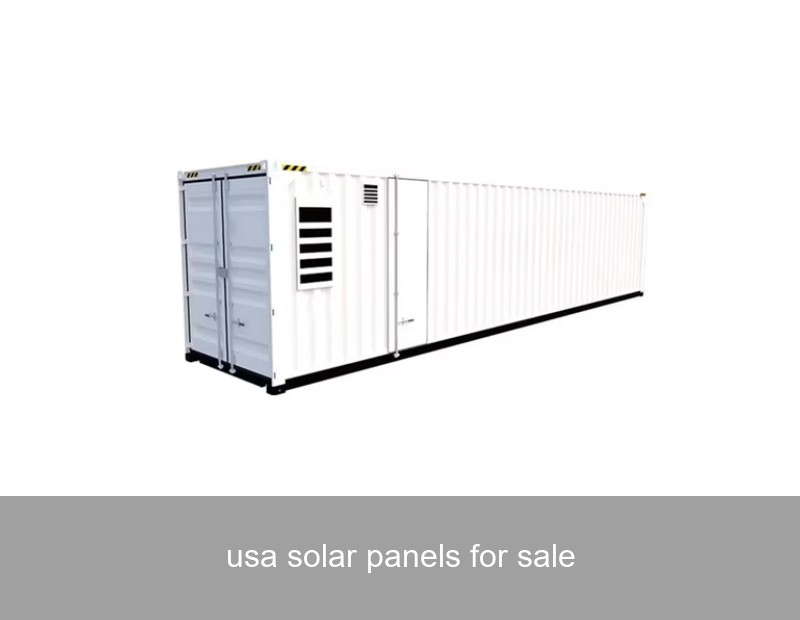
For commercial and industrial (C&I) applications, Highjoule's Containerized Battery Energy Storage Systems (BESS) offer scalable, turn-key solutions. These systems help businesses manage demand charges, participate in grid services, and build a robust microgrid for critical operations, ensuring that their large-scale solar investment delivers a rapid and reliable return.
Case Study: California Commercial Success
Let's look at a real-world application in California, a leader in both solar adoption and grid challenges. A mid-sized food processing plant in Fresno installed a 500 kW solar array. While it reduced daytime energy costs, they still faced crippling "demand charges"—fees based on their highest 15-minute power draw each month—often occurring in the early evening when solar production waned.
Simply adding more panels wouldn't solve this timing issue. Their solution was a Highjoule C&I BESS, sized at 250 kW / 550 kWh, integrated with their existing solar.
| Metric | Before Highjoule BESS | After Highjoule BESS Integration |
|---|---|---|
| Monthly Demand Charge Reduction | Baseline (0%) | ~65% |
| Solar Self-Consumption | ~45% | ~92% |
| Grid Import During Peak Hours | High | Minimal to None |
| Estimated Payback Period | Solar Only: 7 years | Solar + Storage: 5 years |
The system was programmed to discharge the battery during the utility's peak windows, shaving the facility's power draw from the grid. The result? A dramatic cut in demand charges and a faster payback on their total clean energy investment. The plant manager noted, "The solar panels capture the energy, but the Highjoule system is what gives us control over our costs and energy security." This case exemplifies why the most valuable solar panels for sale in the USA are those chosen as part of a synergistic system.
Making the Right Choice for Your Home
So, how should you approach your search? Follow this logical ladder:
- Define Your Goals: Is it pure bill savings, backup power, environmental impact, or all three?
- Audit Your Energy: Review your utility bills. Understand your usage patterns and peak demand costs. Resources from the U.S. Department of Energy can help.
- Select a System Designer, Not Just an Installer: Partner with a certified installer who understands system integration and can model the performance of different panel and storage combinations.
- Evaluate the Ecosystem: Inquire about compatible storage and management solutions from the outset. Ask: "How will this system perform for me at night, during a storm, or in ten years?"
Highjoule works with a network of certified, knowledgeable installers across the U.S. and Europe. These partners are trained to design systems where our storage solutions perfectly complement high-quality solar panels, ensuring you get a harmonious and high-performing energy asset.

Professional installation and system integration are key to long-term performance and safety. (Image Source: Unsplash)
FAQs on Solar Panels and Systems
Do I really need a battery if I have net metering?
Net metering policies are changing in many states, often reducing the credit you receive for excess solar. A battery future-proofs your investment, increases your energy independence, and is essential for backup power.
Can I add a Highjoule storage system to my existing solar array?
Absolutely. Our systems are designed for both new and retrofit installations. A Highjoule-certified installer can assess your current setup and integrate a storage solution to immediately enhance its value.
What's the lifespan of a solar-plus-storage system?
High-quality solar panels often have 25+ year performance warranties. Highjoule's battery systems are engineered for longevity with robust cycle life, typically warrantied for 10+ years. The long-term financial and resilience benefits compound over this lifespan.
The journey beyond the search for USA solar panels for sale is where true energy transformation happens. It's a shift from buying a commodity to engineering a personalized power solution. What specific energy challenge—whether it's an unreliable grid, rising rates, or a sustainability goal—is motivating you to explore solar today, and how can an intelligent system be designed to solve it?
 Inquiry
 Online Chat