


Which Hybrid BESS is Best? A Guide to Choosing Your Energy Future
You're not just looking for a battery. You're looking for a resilient, intelligent, and cost-effective energy backbone for your home, business, or community. The question "which hybrid BESS is best?" is the starting point of a crucial journey. A hybrid Battery Energy Storage System (BESS) combines multiple technologies—often advanced lithium-ion batteries with sophisticated power conversion and energy management software—to store energy from solar panels, the grid, or other sources, and dispatch it precisely when needed. But with a market flooded with options, how do you cut through the noise and find the system that truly delivers on its promises of savings, sustainability, and security? Let's break it down.
Table of Contents
- The Hybrid BESS Advantage: More Than Just a Battery
- Key Evaluation Criteria: What Makes a Hybrid BESS "The Best"?
- Technology Deep Dive: Chemistry, Inverters, and Intelligence
- Market Case Study: A Real-World Test in California
- Introducing Highjoule's Approach to Hybrid Excellence
The Hybrid BESS Advantage: More Than Just a Battery
Think of a basic battery as a simple water tank—it stores and releases. A hybrid BESS, however, is a complete water management plant with purification, pressure pumps, and smart irrigation schedules. It doesn't just store DC electricity from solar panels; it integrates a bi-directional inverter, advanced system controls, and often grid-forming capabilities into a single, optimized unit. This integration is key. A study by the National Renewable Energy Laboratory (NREL) highlights that integrated, hybrid systems can reduce balance-of-system costs by up to 25% compared to component-based setups, while also improving overall efficiency and reliability.
The core benefits are compelling:
- Maximized Self-Consumption: Store excess solar energy for use at night, drastically reducing grid reliance.
- Enhanced Resilience: Provide backup power during outages, often within milliseconds.
- Financial Optimization: Participate in grid services (where available) like peak shaving and frequency regulation to generate revenue or avoid demand charges.
- Future-Proofing: A well-designed hybrid system can adapt to new tariffs, technologies, and expanded energy needs.

Image: A modern, integrated hybrid BESS unit. Source: Unsplash (Representative image)
Key Evaluation Criteria: What Makes a Hybrid BESS "The Best"?
"Best" is not a universal term. The best hybrid BESS for a suburban home in Germany differs from the best system for a California microgrid or a Texas industrial facility. Your evaluation must be contextual. Here are the non-negotiable pillars to assess:
1. Performance & Specifications
| Metric | What It Means | Why It Matters |
|---|---|---|
| Usable Capacity (kWh) | The actual energy you can store and use. | Defines your energy independence duration. Look for systems that offer 100% depth of discharge on their cells. |
| Continuous Power (kW) | The rate at which energy can be delivered. | Determines how many appliances or machines you can run simultaneously during backup. |
| Round-Trip Efficiency (RTE) | Percentage of energy put in that you get back out. | A higher RTE (e.g., 95% vs. 88%) means less wasted energy and more savings. |
| Cycle Life & Warranty | Number of charge/discharge cycles before significant degradation. | A 10-year, 10,000-cycle warranty indicates robust, long-life battery chemistry and design confidence. |
2. Intelligence & Software
The hardware stores energy, but the software creates value. The system's brain—its Energy Management System (EMS)—should offer:
- Adaptive Learning: Can it learn your consumption patterns and weather forecasts to optimize charging/discharging?
- Multiple Operating Modes: Does it offer modes for self-consumption, backup priority, time-of-use cost savings, or grid support?
- Remote Monitoring & Control: A user-friendly app is essential for tracking performance and adjusting settings.
3. Safety & Reliability
This is paramount. Insist on certifications like UL 9540 (overall system safety) and UL 9540A (fire hazard assessment) in the US, and equivalent IEC standards in Europe. Ask about the thermal management system (liquid cooling often offers superior temperature uniformity for long life) and the supplier's track record for field reliability.
Technology Deep Dive: Chemistry, Inverters, and Intelligence
Let's look under the hood. The "hybrid" nature often refers to the seamless integration of three core tech layers:
- Battery Chemistry: While Lithium Iron Phosphate (LFP) is now the dominant standard for stationary storage due to its safety, long life, and cobalt-free design, the quality of cells (Tier 1 manufacturers) and the precision of the Battery Management System (BMS) are critical differentiators.
- Hybrid Inverter: This is the workhorse. A true hybrid inverter can manage input from both solar arrays and the grid, charge the battery, power your loads, and export to the grid—all simultaneously and efficiently. Look for high peak power capability for starting motors and transformers.
- Grid-Forming Capability: This advanced feature allows the BESS to create a stable voltage and frequency "grid" from scratch. This is essential for maintaining power to critical loads during a blackout without interruption, a feature known as seamless backup.

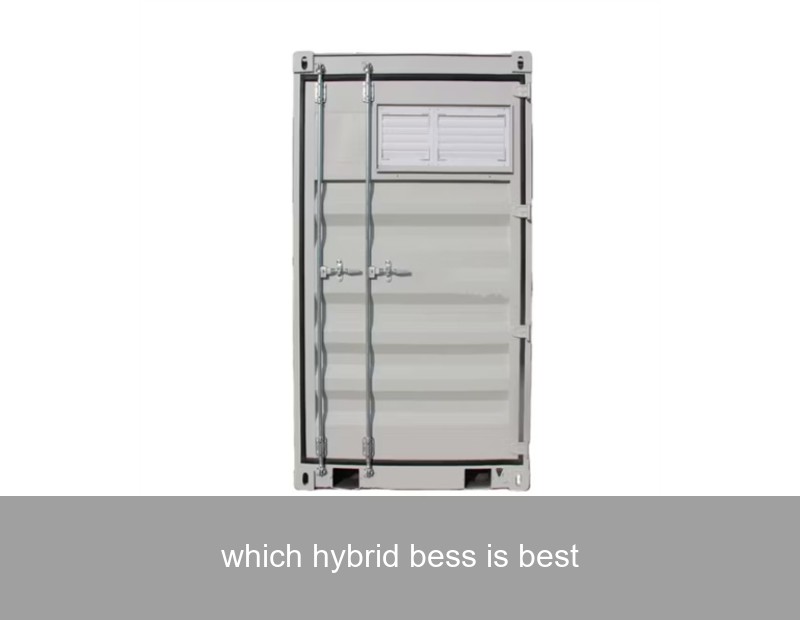
Image: A large-scale containerized BESS, showcasing the complexity of industrial systems. Source: Unsplash (Representative image)
Market Case Study: A Real-World Test in California
Theory meets reality in places like California, where wildfires, grid outages (PSPS events), and complex time-of-use (TOU) rates create a perfect testing ground. Consider this anonymized case from a commercial client in 2023:
Phenomenon: A mid-sized winery faced crippling demand charges, unreliable grid power during harvest season, and wanted to reduce its carbon footprint.
Data & Solution: After analysis, a 250 kW / 500 kWh hybrid BESS was paired with an existing 150 kW solar array. The system was programmed for peak shaving (capping grid draw during high-cost periods) and providing up to 8 hours of backup for critical refrigeration and processing.
- Demand Charge Reduction: 40% decrease, saving over $18,000 annually.
- Self-Consumption Increase: Solar self-consumption rose from 65% to over 90%.
- Reliability: Successfully rode through 3 grid outages, preventing spoilage of inventory valued at $120,000+.
- ROI: Projected payback period of 6.5 years, not accounting for available state incentive programs (like SGIP).
This case underscores that the "best" system delivered tangible, multi-faceted value: financial, operational, and risk-mitigating.
Introducing Highjoule's Approach to Hybrid Excellence
At Highjoule, we've been engineering advanced energy storage solutions since 2005. We believe the best hybrid BESS is one that disappears into the background—working so intelligently and reliably that you simply enjoy uninterrupted, low-cost, clean power. Our product philosophy is built on the three pillars we've discussed.
For residential and commercial applications, our Helios Series Hybrid Systems exemplify this. They feature:
- Ultra-Safe LFP Batteries: With a cycle life exceeding 6,000 cycles and a 15-year warranty, they're built to last.
- High-Efficiency Hybrid Inverter: With 97.5% peak efficiency and native grid-forming technology for zero-interruption backup.
- Adaptive OS Software: Our AI-driven platform, Highjoule Nexus™, continuously analyzes weather, utility rates, and usage patterns. It can automatically switch between optimization modes, and for our commercial clients, it enables participation in virtual power plant (VPP) programs for additional revenue.
For larger-scale industrial and microgrid needs, our Atlas Series Containerized BESS provides a modular, utility-grade solution that can be scaled from 500 kWh to multi-MWh, all managed under the same intelligent Nexus™ platform. Every Highjoule system is backed by a comprehensive warranty and our global network of certified installers and energy partners.
Making Your Choice: The Path Forward
So, which hybrid BESS is best? It's the one that is meticulously matched to your specific energy profile, physical site, local regulations, and financial goals. It's the system where superior hardware is multiplied in value by brilliant, adaptable software. It's a solution provided by a partner with proven expertise, not just a product from a vendor.
Your next step is to move from general comparison to specific analysis. What does your last year of utility bills reveal about your consumption patterns and cost drivers? How critical is seamless backup power for your operations or family's comfort? Have you explored the local incentives available, such as the EU's support for energy storage or the federal Investment Tax Credit (ITC) in the US?
We invite you to start this conversation. What's the single biggest energy challenge you hope a hybrid BESS will solve for you?
 Inquiry
 Online Chat