


How Big Renewable Energy Companies Are Powering a Sustainable Future
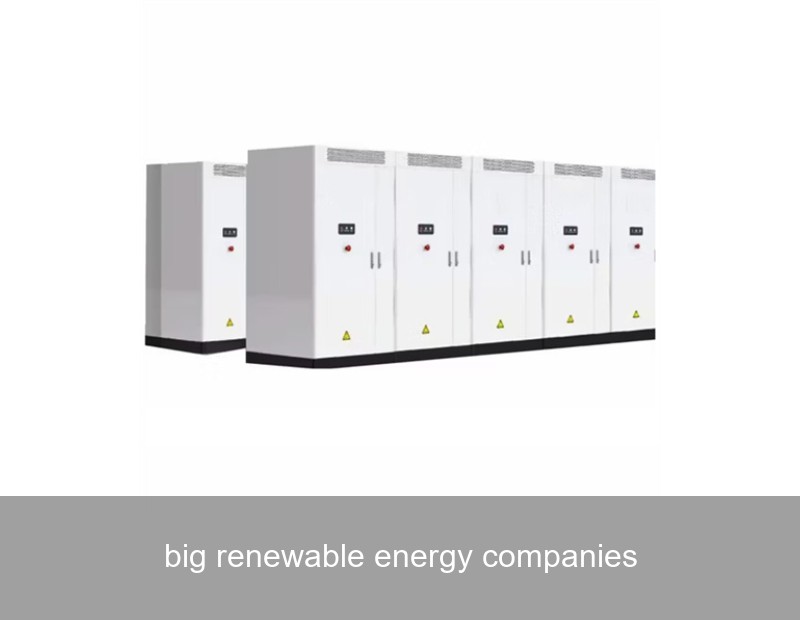
The global energy landscape is undergoing a seismic shift. While headlines often focus on the ambitious goals of big renewable energy companies, a more profound story is unfolding on the ground. The real challenge isn't just generating clean power from the sun and wind; it's about making that power reliable, dispatchable, and truly integrated into our grids. This is where the next frontier of the energy transition lies, and it's being shaped by the intelligent systems that store and manage this new power.
Table of Contents
- The Grid Challenge: When the Sun Sets and the Wind Stops
- The Data Reality: Intermittency in Numbers
- Case Study: A German Industrial Park's Solution
- Beyond Storage: The Rise of Intelligent Energy Management
- Highjoule's Role: Enabling Commercial & Industrial Energy Independence
- The Future Landscape: What's Next for Renewable Integration?
The Grid Challenge: When the Sun Sets and the Wind Stops
Think about it for a moment. A major utility, powered by vast solar farms, sees production plummet as evening clouds roll in. A wind-powered region experiences a calm week. This intermittency is the fundamental puzzle that big renewable energy companies and grid operators must solve. It's no longer just about capacity (how much you can generate), but about reliability (how much you can deliver on demand). This creates a pressing need for technologies that can act as a buffer, absorbing excess energy when production is high and releasing it when it's needed most.

This challenge is particularly acute for commercial and industrial (C&I) consumers who have committed to sustainability goals and long-term renewable energy contracts. They need to ensure their operations aren't disrupted by the inherent variability of green power.
The Data Reality: Intermittency in Numbers
The scale of this integration task is monumental. According to the International Energy Agency (IEA), renewables are set to contribute 80% of new power capacity globally through 2030. However, grid stability requires a constant balance between supply and demand. In markets like California (CAISO) and parts of Europe, there are already days where solar generation exceeds demand in the middle of the day, leading to negative electricity prices, followed by a rapid "ramp" requirement as the sun sets—a phenomenon often called the "duck curve."
This volatility isn't just a grid operator's problem; it translates directly to price volatility for businesses. Without a buffer, companies are exposed to peak pricing and grid dependency, undermining both their economic and environmental objectives.
The Key Pillars of Modern Renewable Integration
- Grid-Scale Storage: Massive battery systems that provide frequency regulation and store bulk energy.
- Behind-the-Meter Solutions: On-site storage for businesses to maximize self-consumption of solar power.
- Advanced Energy Management Systems (EMS): The "brain" that predicts, optimizes, and automates energy flow.
- Hybrid Power Plants: Combining solar, wind, and storage into a single, dispatchable asset.
Case Study: A German Industrial Park's Solution
Let's look at a real-world example. A medium-sized manufacturing park in North Rhine-Westphalia, Germany, partnered with a local renewable developer. They installed a 5 MW rooftop solar array, a significant step towards decarbonization. However, they found themselves exporting 60% of their solar generation to the grid at low feed-in tariffs during midday, only to purchase expensive grid power in the early morning and evening for their round-the-clock operations.
Their solution was to integrate a 2.5 MWh / 1.25 MW battery energy storage system (BESS) with a sophisticated EMS. The results, monitored over 12 months, were compelling:
| Metric | Before BESS | After BESS + EMS |
|---|---|---|
| Solar Self-Consumption | ~40% | ~85% |
| Grid Power Draw During Peak Hours | ~95% of need | ~15% of need |
| Annual Energy Cost Savings | Baseline | €142,000 |
| Grid Independence (during daylight operations) | Low | ~90% |
The system wasn't just a battery; it was an intelligent asset. The EMS forecasted solar production and energy consumption patterns, automatically deciding when to store, when to discharge, and when to participate in grid-balancing programs for additional revenue. This is the model that is becoming essential for C&I entities working with big renewable energy companies.
Beyond Storage: The Rise of Intelligent Energy Management
As this case shows, the hardware is only part of the equation. The true value is unlocked by software. Modern energy management systems use AI and machine learning to perform tasks like:
- Predictive Analytics: Forecasting weather, energy prices, and load patterns.
- Automated Optimization: Making real-time decisions to minimize cost or carbon footprint.
- Virtual Power Plant (VPP) Integration: Aggregating distributed assets to act as a single, grid-supportive power plant.

Highjoule's Role: Enabling Commercial & Industrial Energy Independence
This is precisely where Highjoule, as a global leader in advanced energy storage systems since 2005, focuses its expertise. We don't just see ourselves as a hardware provider; we are a partner in building resilient, sustainable energy ecosystems. Our solutions are designed to bridge the gap between the promise of big renewable energy companies and the practical, operational needs of businesses.
Highjoule's H-Series Commercial Battery Storage Systems are engineered for high-cyclability, safety, and longevity. Paired with our proprietary JouleMind AI Energy Management Platform, we offer a turnkey solution that allows businesses to:
- Maximize self-consumption of on-site solar PV, dramatically improving ROI.
- Provide backup power for critical loads, enhancing operational resilience.
- Reduce demand charges by smoothing out peak power draws from the grid.
- Participate in grid service markets (where available) to generate new revenue streams.
For larger-scale applications, such as microgrids for campuses, municipalities, or industrial complexes, Highjoule provides integrated system design and engineering. We work alongside project developers and big renewable energy companies to ensure storage is not an afterthought but a core, value-optimizing component of any renewable project.
Why Highjoule's Technology Stands Out
Our systems feature a modular, containerized design for scalable deployment. We use lithium iron phosphate (LFP) battery chemistry, known for its superior thermal stability and cycle life. The JouleMind platform's algorithms are continuously refined using real-world data from our global fleet, ensuring our clients always benefit from the latest in optimization intelligence.
The Future Landscape: What's Next for Renewable Integration?
The partnership between generation and storage will only deepen. We are moving towards a future where every major solar or wind farm will have storage co-located by design. The U.S. Department of Energy's Solar Futures Study highlights storage as a critical enabler for high-penetration solar scenarios. Similarly, in Europe, the push for energy security is accelerating the deployment of storage alongside renewables.
The next evolution will involve more sophisticated market mechanisms and AI-driven "autonomous energy" networks, where millions of distributed assets—from home batteries to industrial storage systems—coordinate seamlessly to support the grid. This democratizes energy and creates a more robust, decentralized system.

So, as we applaud the gigawatt-scale projects of big renewable energy companies, let's also ask: How is your business or community preparing to not just generate clean energy, but to harness its full potential with intelligence and resilience? What would true energy independence look like for your operations?
 Inquiry
 Online Chat