


Price of PV Panels: How Much Do Solar Panels Really Cost in 2024?
So, you're thinking about going solar. It's a smart move. But the first question that pops up is almost always: "Price PV panels – how much will this actually cost me?" It's a great starting point, but the answer is more nuanced than a simple price tag per panel. The true cost of solar is an equation involving the panels themselves, the supporting technology, installation, and the long-term value it brings. Let's demystify the investment and look at what you're really paying for when you harness the sun's power.
Table of Contents
- The Price Puzzle: It's More Than Just a Panel
- Breaking Down the Costs: Hardware, Software, and Labor
- The Game Changer: Pairing PV with Energy Storage
- A Real-World Case: The German Bakery Maximizing Solar ROI
- Highjoule's Integrated Solutions: Beyond the Panel Price
- Making the Decision: Key Questions to Ask
The Price Puzzle: It's More Than Just a Panel
Asking "price PV panels how much?" is like asking "how much does a car cost?" A compact city car and a luxury SUV have vastly different price points and values. Similarly, solar panels come in different efficiencies (monocrystalline, polycrystalline), wattages, and brand tiers. According to market data, the average cost for solar panels alone can range from $0.30 to $0.60 per watt before installation. For a typical 6kW home system, that's $1,800 to $3,600 just in panel hardware. However, this is only 20-25% of the total system cost. The rest? Inverters, racking, wiring, permits, and the expertise to bring it all together safely and efficiently.

Image source: Unsplash - Professional solar installation involves more than just panels.
Breaking Down the Costs: Hardware, Software, and Labor
To understand the total investment, let's look at the complete package. The U.S. Department of Energy's Homeowner's Guide to Going Solar breaks down the typical installed cost structure. Here's a simplified view for a residential system:
| Cost Component | Description | Approx. % of Total |
|---|---|---|
| Solar Panels | PV modules that convert sunlight to DC electricity. | 20-25% |
| Inverter(s) | Converts DC electricity from panels to usable AC for your home. | 10-15% |
| Balance of System (BOS) | Racking, wiring, connectors, and monitoring hardware. | 15-20% |
| Installation & Labor | Professional design, permitting, and installation work. | 25-30% |
| Sales & Permits | Customer acquisition, administrative costs, and local permits. | 15-20% |
This holistic view shows why focusing solely on the "price PV panels" can be misleading. A cheaper panel might lead to higher long-term costs if it's less efficient or degrades faster. Conversely, investing in a high-quality inverter and robust mounting system protects your entire investment.
The Hidden Factor: System Efficiency and Lifetime Value
Think of it this way: a premium panel with 22% efficiency will generate more electricity in the same space over 25 years than a standard 18% efficiency panel. That higher energy yield directly offsets your electricity bills for decades. The levelized cost of energy (LCOE), which spreads the total cost over the system's lifetime generation, is a far more useful metric than upfront panel price alone.
The Game Changer: Pairing PV with Energy Storage
Here's where the solar story gets even more interesting. What happens when the sun isn't shining? Traditionally, you'd pull power from the grid. But with volatile energy prices—especially evident in European markets in recent years—this can undermine your savings. This is where adding a battery energy storage system (BESS) transforms your solar array from a cost-saving tool into an energy resilience asset.
By storing excess solar energy produced during the day, you can use it at night, during peak tariff periods, or even during a grid outage. This maximizes self-consumption, sometimes from 30-40% to over 80%, dramatically increasing your independence and ROI. So, when evaluating "price PV panels how much," the forward-thinking question is: "What is the cost of a solar-plus-storage system that will truly cover my needs?"
A Real-World Case: The German Bakery Maximizing Solar ROI
Let's look at a concrete example from Bavaria, Germany. A family-run bakery with high energy consumption for ovens and refrigeration installed a 50 kWp rooftop PV system in 2020. While it reduced daytime grid consumption, they still faced high costs in the early morning and evening.
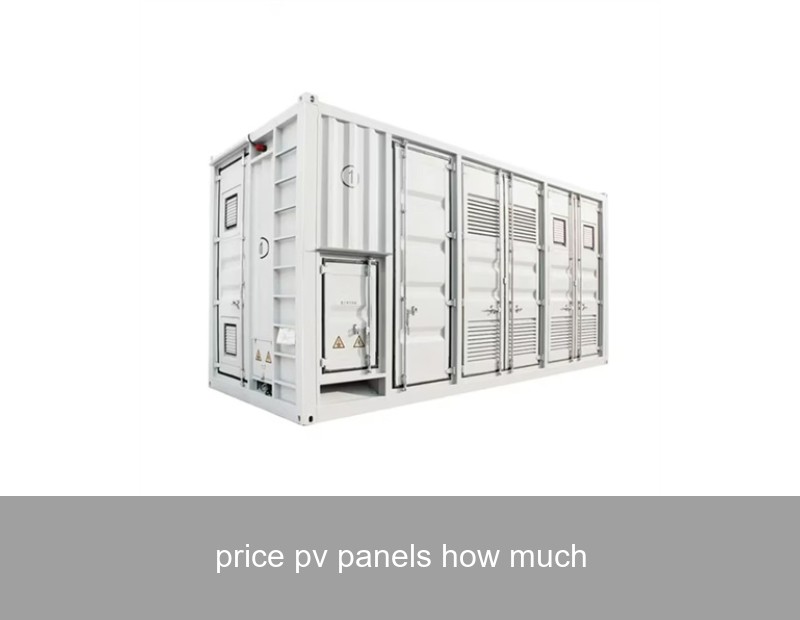
In 2022, they integrated a Highjoule H2-Cube 30 commercial battery storage system (30 kWh capacity). The results were compelling:
- Self-Consumption Rate: Increased from 35% to 82%.
- Grid Energy Cost Reduction: Achieved an additional 45% reduction on top of solar savings alone.
- Payback Period: The combined system's payback time was calculated at under 7 years, thanks to Germany's high electricity prices and intelligent energy management.
- Resilience: The bakery now maintains critical cooling during brief grid disturbances, protecting inventory.
This case, supported by data from the Fraunhofer Institute for Solar Energy Systems ISE, illustrates that the ultimate value lies in an integrated system, not isolated component costs.

Image source: Unsplash - A battery storage system like Highjoule's H2-Cube enables energy independence.
Highjoule's Integrated Solutions: Beyond the Panel Price
At Highjoule, we understand that your journey isn't about buying panels; it's about acquiring reliable, clean, and cost-effective energy. Since 2005, we've evolved from a component provider to a full-system solution architect. Our answer to "price PV panels how much" is to provide a transparent, value-driven proposal for a complete energy ecosystem.
For our residential clients, the Highjoule Home Energy Hub seamlessly combines high-efficiency PV recommendations with our adaptive lithium-ion battery storage and AI-driven energy management software. The system learns your consumption patterns, automatically deciding when to store, use, or even sell back energy based on real-time grid conditions, maximizing your financial return.
For commercial and industrial applications, our H2-Series modular storage systems scale from 100 kWh to multi-MWh installations. They provide demand charge management, backup power, and even grid services. We handle the complex integration, ensuring your solar investment works in concert with storage to meet your specific financial and operational goals. Our services include feasibility studies, system design, commissioning, and remote monitoring for the lifecycle of your installation.
Why the "Balance of System" Matters Most
The magic often lies in the components you don't see. Highjoule's proprietary Energy Management System (EMS) is the brain of the operation. It's this intelligence that squeezes every possible kilowatt-hour of value from your solar panels and battery, ensuring that the question of "price PV panels" becomes a historical footnote to your overall energy success story.
Making the Decision: Key Questions to Ask
As you move forward, shift the conversation from component cost to system value. Here are key questions to discuss with any provider:
- What is the total installed cost and projected lifetime energy yield (kWh) of the system?
- How does adding storage impact my self-consumption and ROI, given my local utility rates and net metering policy?
- What is the warranty and degradation rate on the panels, and what is the cycle life and warranty on the battery?
- How does the system's software optimize my energy flows in real-time?
- Can you provide a detailed case study or simulation for a property with a profile similar to mine?
By focusing on these questions, you position yourself not as a shopper for commodities, but as an investor in a long-term energy infrastructure.

Image source: Unsplash - Modern systems provide clear insight into production and savings.
Ready to see what a truly optimized solar-plus-storage system could look like for your home or business? What's the one energy challenge you'd most like to solve—reducing a specific monthly bill, achieving energy security, or meeting sustainability targets? Let's start that conversation.
 Inquiry
 Online Chat