


Choosing the Right Solar Panel for a 200Ah Battery: Your Guide to Efficient Off-Grid Power
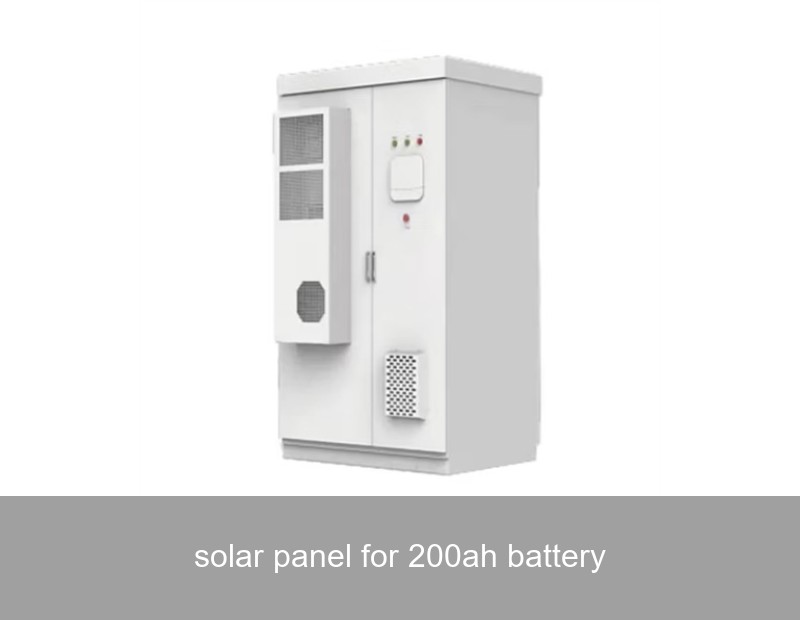
So, you've got a 200Ah battery. It's a popular choice for cabins, RVs, boats, and backup power systems. But here's the question we hear all the time at Highjoule: "What size solar panel do I need to charge my 200Ah battery effectively?" The answer isn't a simple one-size-fits-all wattage. It's about understanding the relationship between your battery's capacity, your energy consumption, and the sun's generosity. Getting the right solar panel for your 200Ah battery is the difference between reliable, sustainable power and frustrating downtime. Let's demystify the process.
Table of Contents
- The Challenge: Why a 200Ah Battery Isn't a "Set and Forget" System
- The Science Behind the Pairing: Watts, Amps, and Sun Hours
- Practical Sizing Guide: From Minimal to Optimal
- Beyond the Panel: The Crucial Role of the Charge Controller
- The Highjoule Advantage: Intelligent Systems, Not Just Components
- Future-Proofing Your Solar Investment
The Challenge: Why a 200Ah Battery Isn't a "Set and Forget" System
Think of your 200Ah battery as a water tank. Amp-hours (Ah) tell you the tank's size. But to refill it, you need a solar panel—your water pump. A pump that's too small will never fill the tank if you're using water daily. A common pitfall is underestimating daily energy use and overestimating solar harvest, leading to a chronically undercharged battery, which severely shortens its lifespan, especially for lead-acid types.
The Science Behind the Pairing: Watts, Amps, and Sun Hours
Let's break down the key variables. A 200Ah, 12V battery has a theoretical energy capacity of 2,400 Watt-hours (200Ah x 12V = 2,400Wh). You should only regularly use about 30-50% of this for lead-acid (800-1200Wh) and up to 80% for Lithium (like Highjoule's LiFePO4 systems) to preserve battery health.
Your solar panel must replenish this daily usage. The formula hinges on Peak Sun Hours—the equivalent number of hours per day when sunlight intensity averages 1,000 watts per square meter. This varies massively by location:
| Region | Average Daily Peak Sun Hours (Summer) | Average Daily Peak Sun Hours (Winter) |
|---|---|---|
| Southern California, USA | 7.5 - 8.5 | 4 - 5 |
| Florida, USA | 5.5 - 6.5 | 4 - 4.5 |
| Southern Germany | 5 - 5.5 | 1.5 - 2 |
| UK | 4.5 - 5 | 1 - 1.5 |
Data sourced from Global Solar Atlas estimates.
As you can see, a system in Bavaria needs much larger panels than one in Arizona to achieve the same daily charge in winter.
Practical Sizing Guide: From Minimal to Optimal
Let's assume a 12V, 200Ah Lithium (LiFePO4) battery with a safe 80% Depth of Discharge (DoD), needing to replenish 1,920Wh daily (200Ah x 12V x 0.8).
- Scenario A (Sunny Climate, Summer): 6 peak sun hours.
Minimum Panel Size: 1,920Wh / 6h = 320 Watts. - Scenario B (Northern Europe, Winter): 1.5 peak sun hours.
Minimum Panel Size: 1,920Wh / 1.5h = 1,280 Watts.
These are minimums. We strongly recommend adding a 20-30% buffer for system losses (temperature, dust, wiring). For Scenario B, a robust system would need 1,500W+ of solar. This is why pairing a solar panel for a 200Ah battery is highly location-dependent.

Image: A typical off-grid application where correctly sizing solar for the battery bank is critical. Source: Unsplash
Beyond the Panel: The Crucial Role of the Charge Controller
The solar panel and battery don't connect directly. The charge controller is the essential "brain" in the middle. For a system of this size, a Maximum Power Point Tracking (MPPT) controller is non-negotiable. It can be up to 30% more efficient than older PWM types, especially in cool or cloudy weather. It converts the panel's higher voltage output to the precise voltage the battery needs to charge efficiently.
The Highjoule Advantage: Intelligent Systems, Not Just Components
This complexity is exactly why Highjoule moves beyond selling individual components. We provide integrated, intelligent energy storage solutions. For a 200Ah battery system, our Highjoule H-ESS Home platform seamlessly integrates optimized solar input, advanced MPPT charging, and our high-cycle LiFePO4 batteries with a built-in Battery Management System (BMS).
Our smart energy management software does the heavy lifting: it automatically adjusts charging parameters based on weather forecasts, prioritizes loads, and ensures your battery is always charged in the most efficient way possible. You're not just buying a solar panel and a battery; you're buying guaranteed performance and peace of mind, with a system that can be monitored and managed from your smartphone anywhere in the world.
Case Study: Powering a Belgian Farmstead's Water Pumping System
A dairy farm in Wallonia, Belgium, needed a reliable, off-grid power source for a remote water pumping system critical for livestock. Their existing 24V, 200Ah lead-acid battery bank was constantly failing due to chronic undercharging from an undersized 400W solar array.
The Highjoule Solution: We replaced the bank with a 24V, 200Ah Highjoule LiFePO4 battery (with a wider temperature tolerance and deeper safe DoD) and paired it with a 1.2kW solar array and our 60A MPPT controller. The system was sized for Belgium's low winter insolation.
The Data-Driven Result: Post-installation monitoring showed the system now consistently replenished the daily 4.8kWh usage, even in December. Battery State of Charge (SoC) rarely fell below 45%, compared to the previous system which regularly plunged below 20%. The farmer reported zero pumping interruptions in 18 months, and the projected battery lifespan increased from 3 years to over 10.

Image: Reliable off-grid solar power is transformative for agricultural operations. Source: Unsplash
Future-Proofing Your Solar Investment
When planning your system, consider future needs. Will you add more appliances? An electric vehicle charging point? Modular systems like Highjoule's allow you to start with a 200Ah core and later add more battery capacity or solar panels seamlessly. Always design with your worst-case solar season (winter) in mind, not the average.
Your Energy Independence Journey
Selecting the correct solar panel for your 200Ah battery is a calculated step towards energy independence. It requires honest assessment of your location, consumption, and a commitment to quality components that work intelligently together.
What's the biggest challenge you've faced in sizing or maintaining your own off-grid solar power system?
 Inquiry
 Online Chat