


Solar Panels Prices in Mombasa: Your Guide to Smart Energy Investment
If you're a homeowner or business owner in Mombasa, you've likely felt the pinch of rising electricity costs and the occasional unreliability of the grid. It's no wonder that "solar panels prices in Mombasa" has become such a hot topic. But here's a crucial insight: focusing solely on the per-panel sticker price is like buying a car based only on the cost of the tires. The real value—and the real savings—lie in the complete, intelligently engineered solar energy storage system. Let's demystify the costs and explore how to make a truly empowering investment for Mombasa's sunny climate.
Understanding Solar Panel Prices in Mombasa
The initial question on everyone's mind is, "How much will the solar panels themselves cost?" In the Mombasa market, you might find quotes ranging widely. A basic, low-efficiency panel might seem attractively cheap, while high-efficiency monocrystalline panels command a higher price. However, the panel cost is typically only 30-40% of a full system's expense. The rest comes from the balance of system (BOS): the inverter, the battery storage, mounting structures, wiring, and most importantly, the quality of design and installation.

Image: A rooftop solar installation in a coastal climate. Source: Unsplash
A professional installer in Kenya will provide a quote based on your specific energy needs (measured in kilowatt-hours, kWh). They consider your roof's orientation, shading from Mombasa's beautiful but sometimes obstructive palm trees, and your consumption patterns. Do you run appliances during the day, or is most of your usage in the evening when the sun is down? This last point is critical—it directly determines the size and type of battery storage you'll need, which is a significant part of the investment.
Key Factors Influencing Your Solar Investment
To move beyond a simple price tag, let's break down what you're really paying for:
- Panel Quality & Type: Tier-1 monocrystalline panels are more efficient, meaning you need fewer of them on your limited roof space. They also perform better in Mombasa's heat and humidity over their 25+ year lifespan.
- Inverter Technology: This is the brain of your system. A basic inverter might just convert DC to AC. A smart hybrid inverter, like those integrated into Highjoule's systems, manages energy flow between panels, batteries, and the grid intelligently, maximizing self-consumption and protecting your appliances.
- Battery Storage - The Game Changer: This is where the real magic happens for energy independence. Lithium-ion phosphate (LFP) batteries, such as those used in Highjoule's H-ESS (Home Energy Storage System), are the safe, long-lasting standard. Their capacity (kWh) and power rating (kW) determine how much of your solar energy you can use at night. Yes, it adds to the upfront cost, but it transforms your system from a daytime supplement to a 24/7 power solution.
- Installation & After-Sales Service: A poorly installed system will underperform and fail prematurely. Professional design, secure mounting to withstand seasonal rains, proper wiring, and a reliable service warranty are non-negotiable for a long-term asset.
The Real Story: It's About More Than Just Panels
Think of it this way: solar panels are excellent harvesters, capturing Mombasa's abundant sunshine. But without a smart way to store and manage that harvest, much of it goes to waste—exported to the grid for minimal feed-in tariffs, or simply curtailed. The true modern solution is an integrated solar-plus-storage system.
This is where companies with deep system integration expertise, like Highjoule, create distinct value. Since 2005, Highjoule has specialized not just in components, but in intelligent, software-driven energy storage systems for homes, businesses, and microgrids. For a Mombasa homeowner, their H-ESS product seamlessly combines high-efficiency solar conversion with resilient LFP battery storage and an intelligent energy management system (EMS). The EMS learns your usage patterns and automatically optimizes when to use solar power directly, when to charge the batteries, and when to draw from the grid, ensuring you get the maximum financial return on your investment.
A Mombasa Case Study: From High Bills to Energy Independence
Let's look at real data. A medium-sized guesthouse in Nyali, Mombasa, was facing an average monthly electricity bill of KSh 45,000, with frequent outages disrupting business. In 2023, they installed a 15kW solar array coupled with a 40kWh Highjoule H-ESS battery system.
| Metric | Before Installation | After Installation (First Year Avg.) |
|---|---|---|
| Monthly Grid Electricity Cost | KSh 45,000 | KSh 6,500 (baseline connection fee & minimal night use) |
| Grid Dependency | 100% | <15% |
| Outage Impact | Business disruption for hours | Zero disruption; seamless backup | Annual Savings | - | Approx. KSh 462,000 |
The system's intelligent design allowed the guesthouse to run almost entirely on solar, charging the batteries during the day to power the evening and night load of air conditioners, lights, and water heating. The payback period was calculated at under 5 years, and for the system's remaining 20+ year life, the energy costs will be minimal. This case highlights that while the upfront price of a full system was significant, the long-term value and operational resilience far outweighed the initial investment.

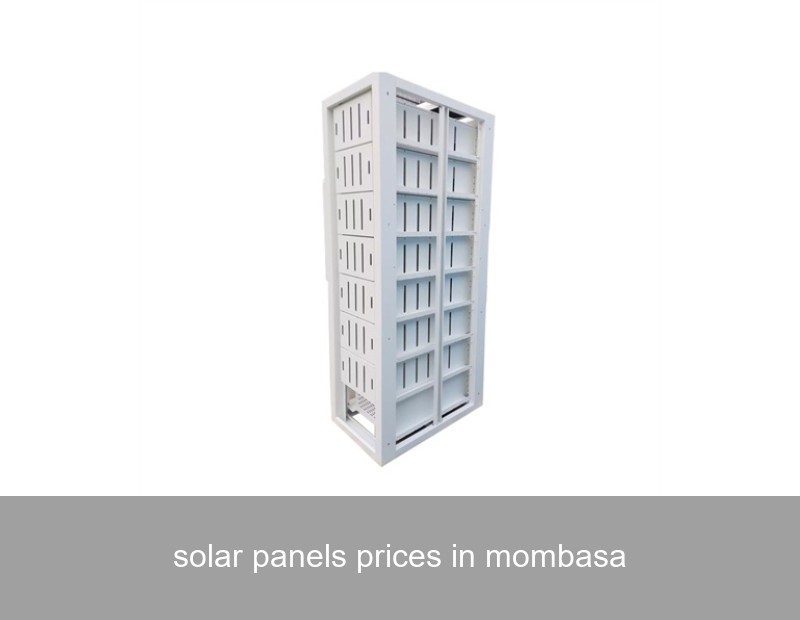
Image: A modern, compact battery storage system. Source: Unsplash
The Future of Solar in Mombasa & Coastal Kenya
The trend is clear. As the global cost of lithium-ion batteries continues to fall (BloombergNEF reports a 14% drop in 2023), the economics of solar-plus-storage become even more compelling. Furthermore, Kenya's regulatory environment is evolving to support distributed energy resources. The future isn't just about offsetting your own bill; it's about your home or business becoming a node in a more stable, resilient local grid.
For commercial and industrial applications in the port area or manufacturing zones, Highjoule's commercial and microgrid solutions offer scale and sophistication. These systems can include advanced features like peak shaving (intentionally using stored solar to avoid high-demand grid tariff periods) and even potential revenue streams from grid services in the future.
Making the Right Decision for Your Home or Business
So, when you research "solar panels prices in Mombasa," reframe your quest. You are shopping for a 25-year energy partner. Ask potential providers these questions:
- Do you provide a detailed energy audit and consumption analysis?
- Is your proposal for a complete system with integrated, high-cycle life battery storage?
- What is the software intelligence behind the system? Can I monitor and control it remotely?
- What is the warranty on the entire system, and what does your local service and support network look like?
By now, you understand that the most relevant figure isn't the price per panel, but the cost per reliable kilowatt-hour over the system's lifetime. A robust, smart system from a global leader like Highjoule, with nearly two decades of engineering heritage, may have a higher initial outlay but delivers far greater lifetime value, savings, and peace of mind.
Ready to calculate what your true energy independence could look like? What would you do with an extra KSh 400,000 or more in annual operational savings for your business?
 Inquiry
 Online Chat